A Bat Mitzvah Has Two Audiences. Most Photo Booths Only Serve One.
VNV Events
A Bat Mitzvah Has Two Audiences. Most Photo Booths Only Serve One.
Most vendors sell a bat mitzvah photo booth as a kids' activity. That framing is wrong twice over. The guest of honor is twelve or thirteen — old enough to have opinions about how she looks online and young enough that a bin of foam sunglasses insults her. Meanwhile, half the room is family who flew in for a milestone, and what they want from a booth has nothing to do with props. Pick a setup that serves one of those audiences and you have paid for a station that half the room walks past.
Who is actually in the room
A bat mitzvah marks the point at which a young woman is called to the Torah and formally takes on the obligations of Jewish law. As Pike & West notes in its 2026 planning guide, the ceremony and the celebration are two distinct events, and families frequently host the party at a separate venue with flexible space for dining, dancing, and personalization.
That party holds at least four groups, and they want different things:
- The honoree and her friends. Twelve and thirteen year olds who are fluent in vertical video and merciless about a bad photo of themselves.
- The parents' generation. There for the family, want a good picture with the honoree, will not stand in a line for twenty minutes.
- Grandparents and out-of-town relatives. Often the people for whom a physical print matters most, and often the least likely to operate a QR code unaided.
- Younger siblings and cousins. Small children with an entirely different energy, running between tables.
Levyticus Entertainment describes exactly this spread in its analysis of mitzvah entertainment — a single event pulls in young cousins circling the tables and grandparents who flew in for the occasion, and the events that work are the ones where the entertainment creates shared moments rather than separate ones.
Why the standard setup fails
Two failure modes, and they are opposites.
The props-and-backdrop booth is built for a children's party. Foam hats, oversized glasses, a printed strip. Thirteen-year-olds treat it as a joke setup for about four minutes, then leave, because it produces nothing they would post. Their entire social currency is content, and a 4x6 strip is not content.
The digital-only AI or 360 station solves that problem and creates the reverse one. Teens love it — MUNRO's mitzvah rental guide notes 360 video booths are particularly popular with teen guests specifically because of the shareable output. But grandmother came for a photograph she can hold, and she is not going to fish a QR code out of her purse to find it.
MUNRO makes the point that photo booths are enormously popular at mitzvah events precisely because they give kids and adults a shared activity and produce instant souvenirs. Notice that the value depends on both halves being true. Drop either one and the station stops being the thing that unites the room.
Zone the party. Share the booth.
There is a real tension in the planning advice, and it is worth naming because resolving it correctly is the whole job.
On one side, Pike & West recommends creating distinct zones — a gaming lounge and interactive stations for the teens, a comfortable conversation area for adults — so neither generation feels sidelined. Infinity Park Event Center reinforces it: teens will not dance for four straight hours, and adults will want somewhere quieter to talk, so layered entertainment is the answer.
On the other side, Levyticus argues that the memorable celebrations are the ones where entertainment connects the groups instead of dividing them.
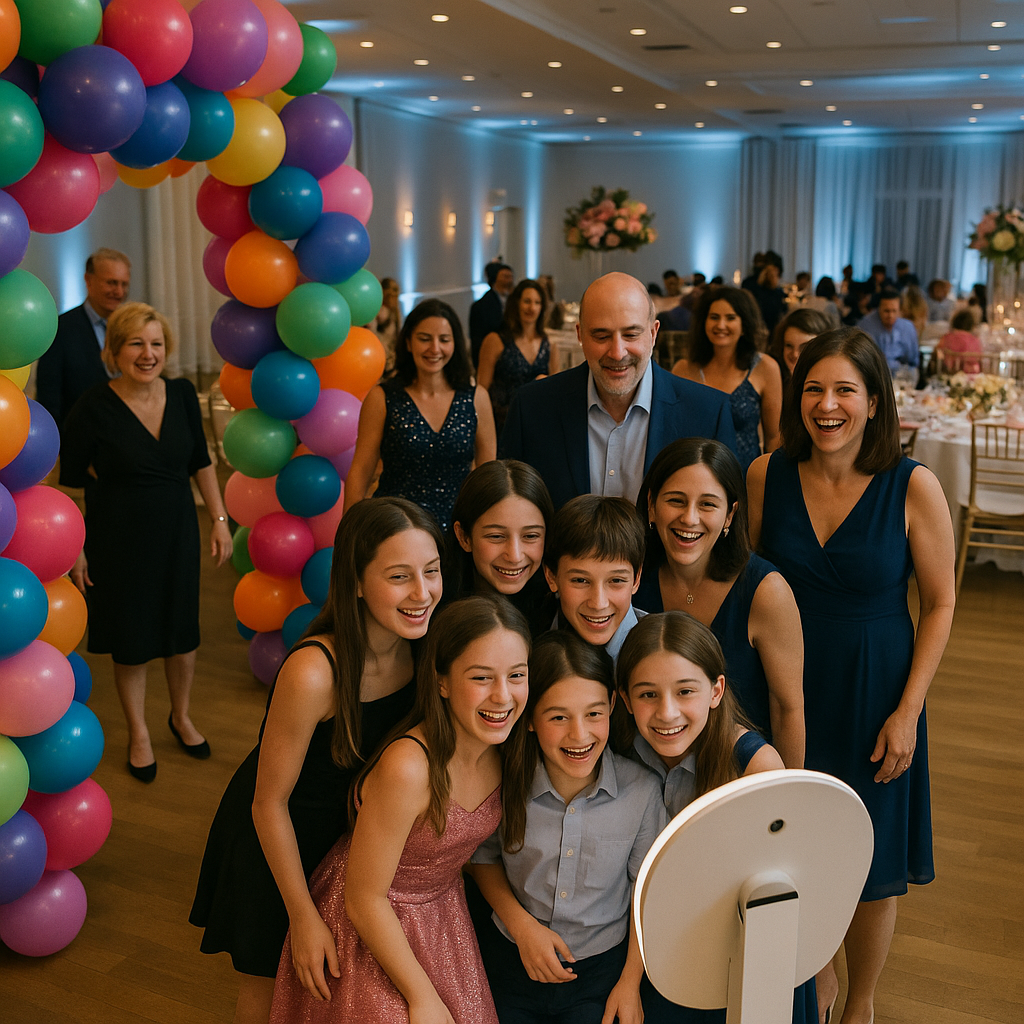
Both are right, and the resolution is straightforward once you say it plainly: zone the activities, share the photo station. The gaming lounge is for the teens. The lounge seating is for the adults. The booth is the one place both are expected to end up, which means it cannot sit inside either zone — it belongs on the boundary between them, where a grandmother and a thirteen-year-old will plausibly cross paths.
What a dual-audience setup actually includes
- Two output paths from one station. Instant vertical digital delivery for the teens, on-demand print for everyone else. The print side is slower, so treat it as a second flow rather than a second queue behind the same machine.
- A backdrop that isn't juvenile. MUNRO recommends pairing the booth with a themed backdrop in the event's colors. That reads as design to an adult and as a set to a teenager. Foam props read as a kids' table to both.
- A video or audio message option. The Temple House lists interactive visuals and creative stations among the experiences that hold both teens and adults through the evening. A recorded message station is the one output the family will still care about in ten years, and it is the strongest reason for the adult half to approach.
- Personalization tied to the honoree. Pike & West notes that themes tied to the guest of honor's actual interests are outperforming generic party themes in 2026. A gobo or overlay with her name does more work than any prop bin.
- Something for the younger cousins. AR overlays with animated costumes engage small children without requiring them to stand still or read a screen — and it keeps them from clogging the main station.
The timing problem nobody plans for
Levyticus describes the arc of a modern mitzvah: club-style production — remixes, moving lights, layered effects — takes over the moment dinner ends and the floor opens. That is when the room's energy peaks, and it is also when a photo station either becomes the second destination or dies quietly.
Infinity Park's observation is the planning key here: teens will not dance nonstop, so they cycle off the floor in waves. Those waves are your booth traffic. If the station is visible from the dance floor and staffed at that moment, it absorbs them. If it's around a corner, they go look at their phones instead.
The adults follow a different clock entirely — they are most available during cocktail hour and immediately after dinner, before the volume rises. In practice that means the booth needs two openings, not one, and someone has to own the second. We cover this in more depth in our guide to why placement matters more than the booth you rent.
What this looks like in practice
The two-room venue
Venues built for milestone events increasingly offer this structure by design. The Temple House describes spaces designed specifically to support immersive celebrations with flexible layouts, and Pike & West points to venues with indoor-outdoor flexibility — a terrace or courtyard — as the practical way to hold multiple generations without either feeling pushed aside. When the venue gives you two rooms, the booth's correct position is almost always the threshold between them rather than the center of either.
The teen-content reality
MUNRO's guide is blunt about why 360 booths dominate the teen half of these events: the output is shareable, and that is the point for that audience. Pair that with the same guide's observation that the booth's real function at a mitzvah is being a shared activity, and the brief writes itself — you need the format teens want, with an output path the adults can use.
[TITULO DEL CASO REAL]
[Contexto del evento y el reto de los dos públicos.] [Qué montamos y por qué.] [Resultado o detalle que lo hizo funcionar.]
The planning checklist
- Count the room in two columns: teens and adults. If the split is anywhere near even, a single-output booth is the wrong purchase.
- Confirm both a digital and a print path, and plan them as separate flows.
- Position the station on the boundary between the teen zone and the adult zone, visible from the dance floor.
- Replace prop bins with a themed backdrop in the event colors and an overlay carrying the honoree's name.
- Add a recorded message option — it's the adult half's reason to walk over.
- Give the younger children their own activity so they don't occupy the main station.
- Plan two openings: cocktail hour for the adults, post-dinner for the teens, with someone assigned to restart it.
Our event planning team works this through alongside the floor plan, catering stations, and entertainment timeline. If throughput is your concern with a large guest list, see our breakdown of how AI booths handle volume.
Frequently Asked Questions
What kind of photo booth is best for a bat mitzvah?
One with two output paths. Teens want vertical, instantly shareable content, which points toward a 360 or AI station. Adult family members frequently want a physical print. A hybrid setup that delivers both is the only configuration that serves the full room, and the print side should be planned as a separate flow because it runs slower.
Are props a good idea at a bat mitzvah?
Generally no, at least not the standard foam-and-feather bin. A twelve or thirteen year old reads that as a children's activity. A themed backdrop in the event's colors and a custom overlay with the honoree's name accomplishes far more, and it doesn't alienate the adult guests either.
Where should the photo booth go if the venue has two rooms?
On the boundary between them. If the teens have a gaming lounge and the adults have a conversation area, the booth belongs where those two zones meet and remains visible from the dance floor. Placed inside either zone, it becomes that zone's activity and the other half of the room never uses it.
How do you keep both teens and adults engaged all night?
Layer the entertainment and stagger the timing. Teens cycle off the dance floor in waves rather than dancing continuously, and those waves are your booth traffic. Adults are most available during cocktail hour and right after dinner. Plan two openings rather than one, with someone responsible for restarting the station later in the evening.
What do older relatives actually want from a photo station?
A print they can hold, and a picture with the guest of honor. A recorded video or audio message option is also disproportionately valuable to this group — it gives them a reason to approach the station and produces the keepsake the family is most likely to revisit years later.
Do 360 booths work at mitzvahs?
Very well with the teen guests, which is why they are among the most requested formats for these events. The caveat is spatial: a 360 platform needs clearance and draws a ring of spectators, so it has to be planned into the floor plan rather than added at the end. Pair it with a print option to cover the adult half of the room.
Sources
- MUNRO Enterprises — Bar and Bat Mitzvah Rental Planning Guide
- Pike & West — Bar Mitzvah Celebration Guide 2026
- Levyticus Entertainment — Making a Mitzvah Work for Kids and Adults
- Infinity Park Event Center — Bat Mitzvah Party Ideas
- The Temple House — Planning a Bar or Bat Mitzvah Party
- Pleasantdale — Unique Bar and Bat Mitzvah Ideas for 2026
Tell us the guest split and we'll build the station around it
Send us your guest count broken into teens and adults, plus the venue layout. We'll tell you which format fits, where it goes, and how to run both output paths without a bottleneck. Around 200 events a year across Broward, Miami-Dade, and Palm Beach.
Request a Quote