
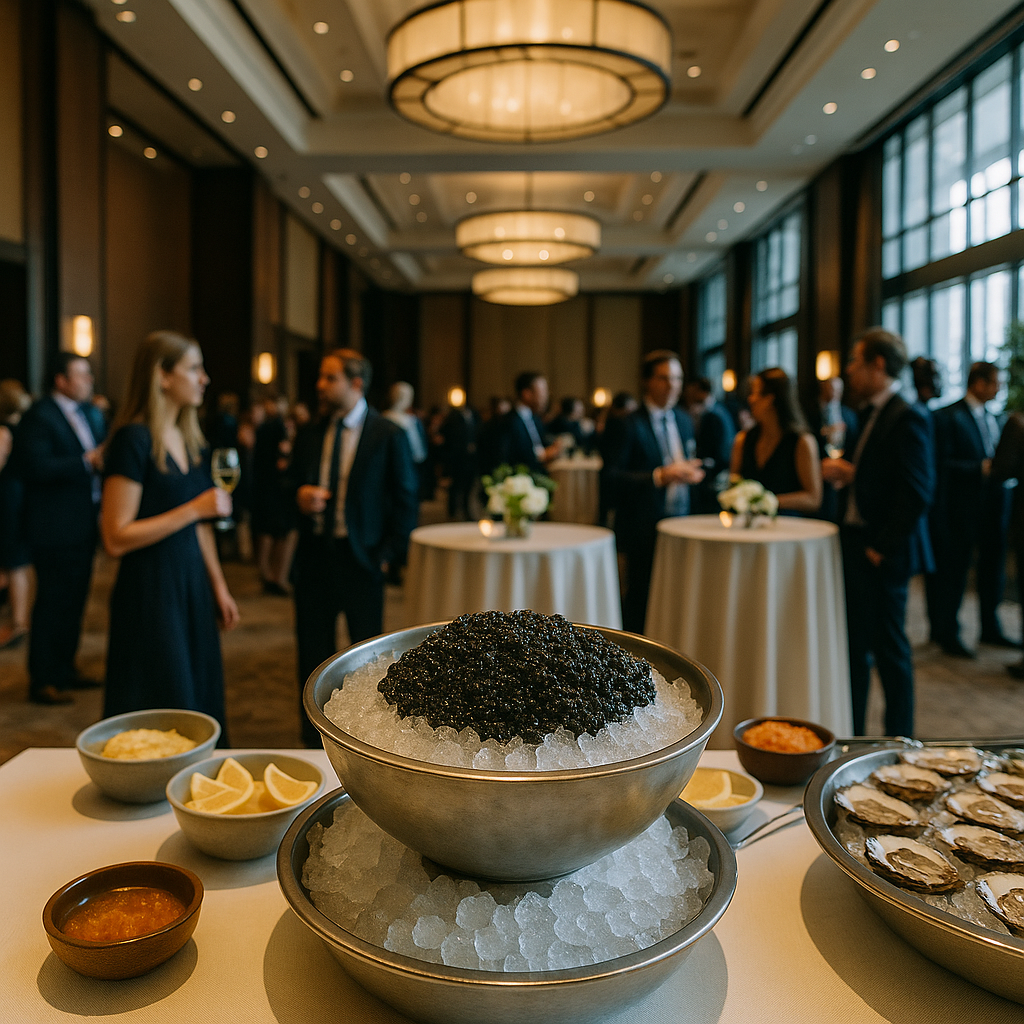
Caviar Is a More Responsible Choice Than Most of What's on Your Raw Bar
VNV Events
Caviar Is a More Responsible Choice Than Most of What's on Your Raw Bar
This sounds like a luxury brand defending itself. It isn't. Every ounce of legal, high-quality caviar served in the United States today comes from a farm, and those farms exist specifically because the wild fishery collapsed. Meanwhile the shrimp sitting beside it on the ice — the item nobody questions, the thing on every raw bar in Florida — carries an environmental record that would make most hosts uncomfortable if they knew it. There is one exception to our argument, and we'll name it, because leaving it out would make the rest dishonest.
Start with the shrimp, because that's where the problem is
Shrimp is the most-consumed seafood in America and the least-examined item on a catering menu. The numbers are not close.
Bycatch. Sustainable Fisheries UW reports that the Gulf of Mexico shrimp trawl fishery — considered one of the better-managed wild shrimp fisheries in the world — still ranks fifth-highest globally in bycatch, discarding roughly 4.6 pounds of other marine life for every pound landed. Their broader finding is the damning one: even with turtle excluder devices and careful management, the best rating any wild shrimp fishery has earned from Monterey Bay Aquarium's Seafood Watch program is yellow, "Good Alternative." Environmental sustainability for most shrimp fisheries is capped by the nature of the gear.
Green Reset's analysis puts the scale in perspective: shrimp trawl fisheries account for about 2 percent of the global fish catch but are responsible for more than a third of the world's bycatch.
Mangroves. Farming was supposed to solve that, and it introduced a different problem. FoodUnfolded documents that between 1980 and 2005, the largest aquaculture-producing countries lost roughly 52 percent of their combined mangrove area, with 28 percent of total mangrove loss attributed to conversion for aquaculture — primarily shrimp and fish farming. FoodPrint cites a United Nations figure of a fifth of the world's mangroves cleared for shrimp farms between 1980 and 2012.
Carbon. The Shrimp Welfare Project cites research finding that shrimp farming on deforested mangrove land carries roughly ten times the carbon intensity of beef raised on deforested Amazonian rainforest.
Feed and chemicals. Green Reset notes an estimated average of 1.4 pounds of wild fish used to produce each pound of farmed shrimp, often species like anchovies and sardines that other marine life depends on. FoodPrint reports that Seafood Watch scoring for farmed shrimp consistently returns low marks for chemical use, habitat impact, and disease.
Now the caviar
The counterintuitive fact is that caviar's reputation is stuck about twenty years behind its reality.
Petrusco Caviar's guide to sustainable sourcing states the current situation directly: wild sturgeon populations were decimated by overfishing, legal wild-caught caviar is virtually impossible to find today, and nearly all high-quality caviar now comes from responsible aquaculture. The World Sturgeon Conservation Society notes that aquaculture is currently the only legal source of sturgeon products, subject to detailed state and international control.
That shift is not neutral — it's restorative. Caviar Star's analysis explains that stable farmed supply relieves fishing pressure on wild populations and gives ecosystems room to recover. The direction of travel is deliberate: a University of Georgia aquaculture program described the industry goal as flipping a market that was historically 98 percent wild-caught to 98 percent farmed, which benefits wild sturgeon and farmers simultaneously.
Some farms go further than reducing harm. SeafoodSource reports that Sturgeon Aquafarms secured its exemption to sell beluga caviar after supplying roughly 160,000 fertilized eggs in 2017 and 2018 toward reviving the Caspian Sea's beluga population. Marky's notes the same facility is the only one in the United States legally producing purebred beluga caviar, made possible by importing broodstock before the 2005 ban.
There is no equivalent story on the shrimp side of the ice.
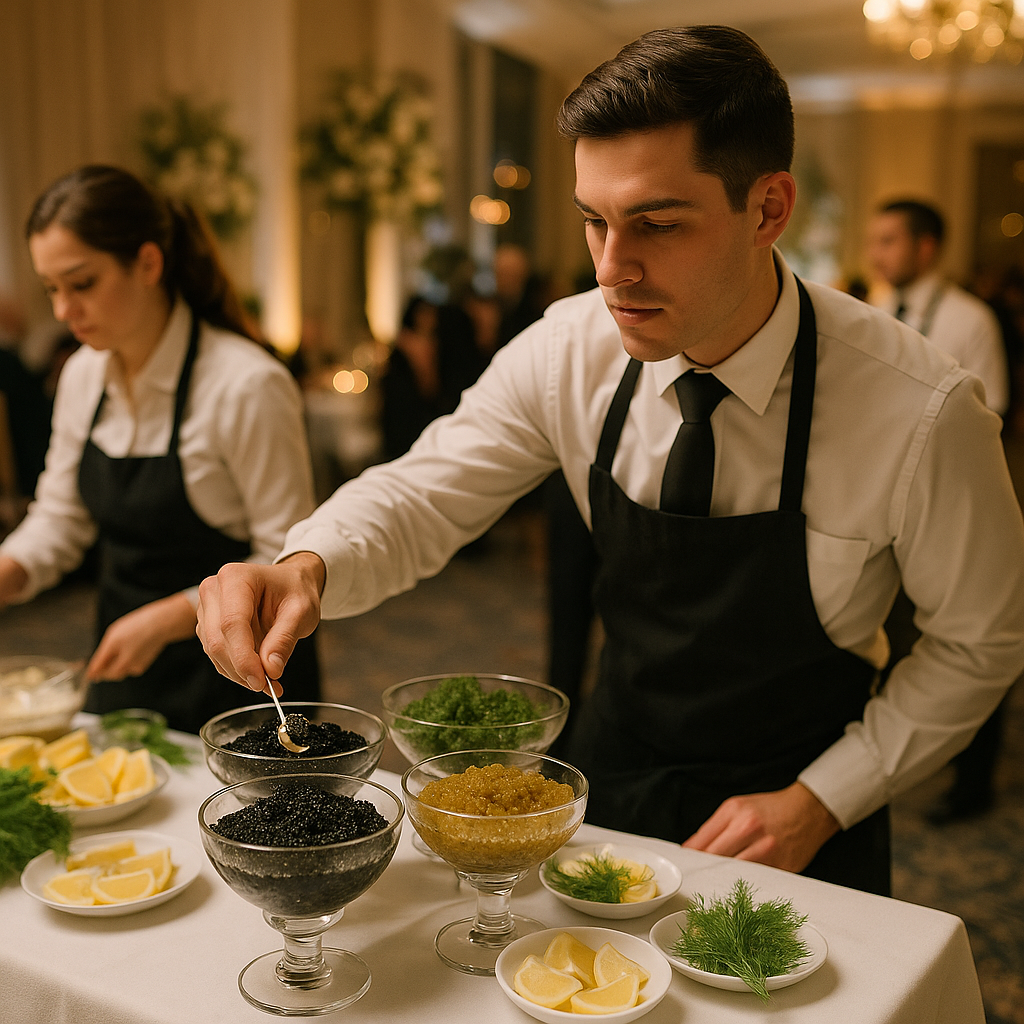
The exception: oysters beat caviar, and it isn't close
If we stopped here you'd be reading marketing. So here is the honest limit of the argument.
Oysters are almost certainly the most environmentally beneficial animal protein on your raw bar, and probably on any menu. NOAA Fisheries explains why: oysters are filter feeders that remove algae, organic matter, and excess nutrients as they grow, improving water quality for other species. A single adult oyster can filter up to 50 gallons of water a day, and when harvested, nitrogen and phosphorus are physically removed from the ecosystem. NOAA adds that oyster beds stabilize coastal sediment and help buffer storm surge.
The decisive difference is feed. In A Half Shell's sustainability guide makes the point plainly: oysters require no feed inputs at all, filtering their food directly from the water, which makes the practice unusually low-impact. Business First frames the contrast with fed aquaculture — a finfish farm imports food into the system, often from wild-caught fish, while an oyster farm extracts food already present in the water.
Sturgeon cannot match that. They are fed, and they take years to reach roe maturity, which means real inputs over a long grow-out. Farmed caviar is dramatically better than the wild fishery it replaced, and better than shrimp by a wide margin. It is not better than a filter feeder that cleans the water while it grows.
So the practical conclusion is not "replace your raw bar with caviar." It's this: keep the oysters, question the shrimp, and stop treating caviar as the indulgent outlier on the table. On the evidence, it's the shrimp that deserves that label.
Sourcing still matters, and here's the uncomfortable proof
Farmed does not automatically mean clean. SeafoodSource reports on a WWF market survey conducted under an EU-funded project across Bulgaria, Romania, Serbia, and Ukraine that found a substantial share of caviar and sturgeon meat sampled in those markets to be illegal. Provenance is a real variable, not a formality.
The questions worth asking your caterer or supplier:
- Which species, and from which farm and country?
- What's the harvest date? Caviar Market emphasizes confirming harvest dates and shipping timing with the supplier, since freshness is non-negotiable.
- Is there CITES documentation and labeling? The World Sturgeon Conservation Society has argued that adopting CITES regulation and labeling would do more for sturgeon protection than trade restrictions that don't distinguish farmed from wild.
- How was it shipped and held? It should arrive cold, sealed, and properly packed.
A caterer who can answer all four without checking is a caterer who has done this before.
[TITULO DEL CASO REAL]
[Contexto del evento.] [Qué se sirvió y de dónde venía.] [Reacción o resultado.]
Why this matters for corporate events specifically
If your company publishes sustainability commitments, your catering menu is part of that story whether anyone audits it or not. The default assumption — shrimp is normal, caviar is excessive — runs exactly backwards on the evidence. A caviar station is served in portions measured in grams, sourced from traceable aquaculture, from an industry whose growth is directly tied to the recovery of a species. A shrimp tower is served by the pound from a supply chain most hosts have never examined.
We're not suggesting you brief guests on bycatch ratios at a cocktail hour. We're suggesting that the item you'd have felt sheepish about is the one with the defensible story — and if someone asks, you now have the answer.
Frequently Asked Questions
Is caviar sustainable?
Modern farmed caviar largely is. Wild sturgeon populations were decimated by overfishing and legal wild-caught caviar is effectively unavailable today, so aquaculture is now the only legal source and accounts for essentially all high-quality caviar. Farmed production relieves pressure on wild populations, and some farms have contributed directly to restocking programs. Sourcing still matters, since illegal product does circulate in some markets.
Is caviar more sustainable than shrimp?
By most measures, yes. Even well-managed wild shrimp fisheries discard several pounds of bycatch per pound landed, and shrimp trawling accounts for a disproportionate share of global bycatch. Farmed shrimp has driven extensive mangrove loss and relies on wild fish for feed. Farmed caviar carries none of those specific impacts.
Is caviar more sustainable than oysters?
No. Farmed oysters are the strongest performer on any raw bar. They require no feed, filter and clean the water as they grow, remove excess nutrients when harvested, and provide habitat and sediment stability. Sturgeon are fed and slow-growing, so they cannot match a filter feeder. Caviar's case is against shrimp, not against oysters.
How do I know the caviar I'm serving is legitimate?
Ask for the species, the farm and country of origin, the harvest date, and CITES documentation. Confirm how it was shipped and held. Market surveys in some regions have found significant volumes of illegally sourced caviar, so provenance questions are appropriate rather than paranoid.
Is any caviar still wild-caught?
Essentially none in legal trade. Wild sturgeon are critically depleted and international commerce is tightly restricted, with only narrow exceptions. If a supplier is offering wild caviar, that is a reason for scrutiny rather than a selling point.
Sources
- Sustainable Fisheries UW — Shrimp and Its Sustainability
- FoodUnfolded — The Hidden Cost of Eating Shrimp
- FoodPrint — What You Need to Know About Farmed Shrimp
- Shrimp Welfare Project — Shrimp Welfare and Sustainability
- Green Reset — Shrimp's Environmental Record
- Petrusco Caviar — Guide to Sustainable Caviar: Wild vs. Farmed
- Caviar Star — How Sustainable Aquaculture Is Changing Caviar
- Marky's — Inside Sustainable Caviar Farming
- SeafoodSource — Sturgeon Farmers and ESA Restrictions
- SeafoodSource — WWF Market Survey on Illegal Caviar
- University of Georgia — Cultivating Caviar
- NOAA Fisheries — Sustainable Pacific Oyster Farming
- NOAA Fisheries — Eastern Oyster Aquaculture and Ecosystem Services
- In A Half Shell — Oyster Sustainability
- Business First — How Oysters Are Farmed
- Caviar Market — Sourcing and Freshness for Caviar Service
We'll tell you where every item on the ice came from
Species, farm, country, harvest date. If your event has a sustainability story to tell, the raw bar is a better place to tell it than most people realize. Around 200 events a year across Broward, Miami-Dade, and Palm Beach.
Request a Quote