
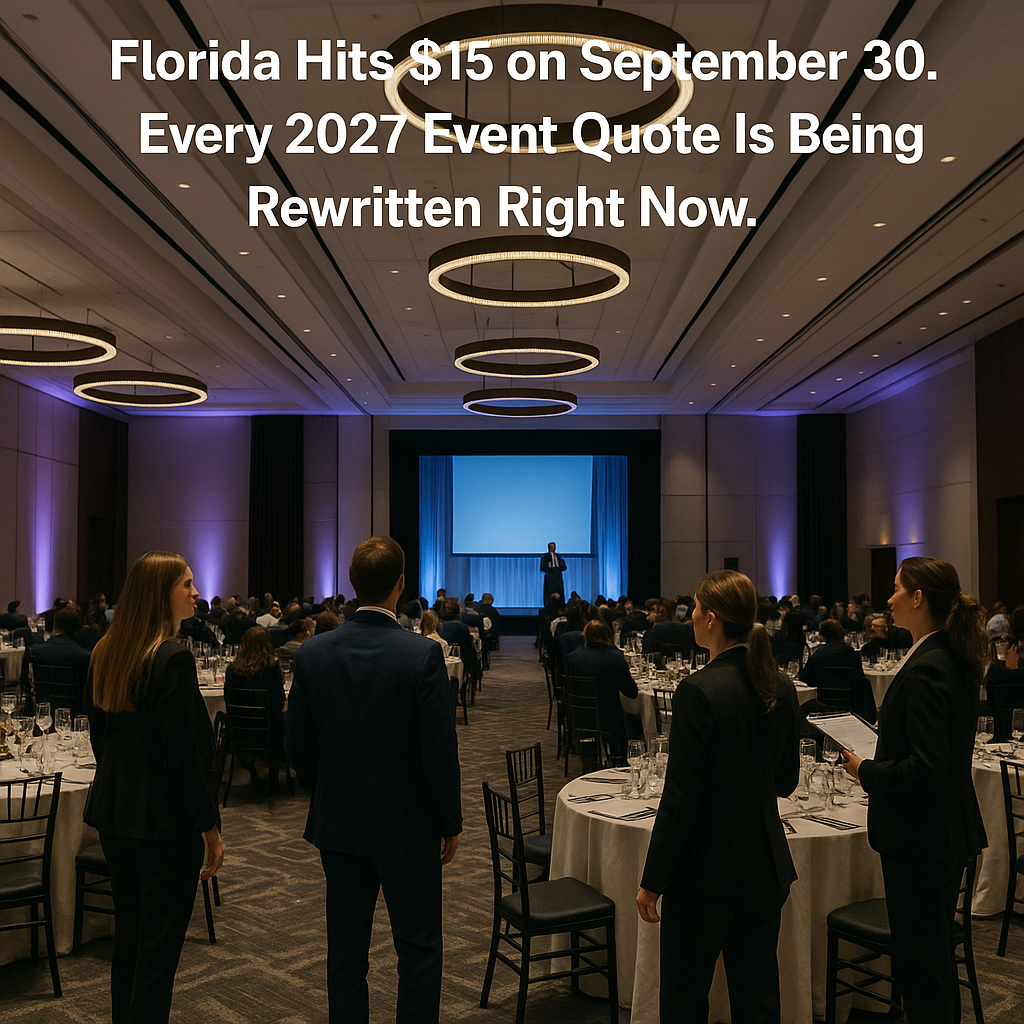
Florida Hits $15 on September 30. Every 2027 Event Quote Is Being Rewritten Right Now.
Somewhere in Broward this week, a corporate planner is holding a signed proposal for a March 2027 gala. The staffing line on that proposal was built on a $14 labor floor. The event happens five months after that floor moves. Someone is going to absorb the difference — the client, the vendor, or the crew — and the contract almost never says which.
The date is fixed, and it is the last one of its kind
On September 30, 2026, Florida's minimum wage reaches $15.00 per hour, and the required direct cash wage for tipped employees goes to $11.98. That completes the schedule of $1.00 annual steps written into the state constitution by voters in 2020, and confirmed on the Florida Department of Commerce minimum wage page.
What most 2027 budgets have not absorbed is what happens after that. The fixed steps stop. Under the Florida Minimum Wage Act (Fla. Stat. § 448.110), the state calculates an inflation-adjusted rate each September 30 beginning in 2027, publishes it by October 15, and the new rate takes effect the following January 1. Florida's labor floor stops being a headline and becomes a recurring line item that changes every year, on a schedule, forever.
That is the real planning problem. A one-time dollar increase can be eaten. A permanently indexed input has to be written into contracts.
Why $1.00 is the smallest part of the increase
If your entire crew sat at the minimum, the math would be a 7.1% bump on the base rate and the conversation would end there. Almost no event operation is built that way. Three effects stack on top of the dollar.
1. Compression pushes the whole ladder, not the bottom rung
Nationally, the Bureau of Labor Statistics' May 2025 Occupational Employment and Wage Statistics put the median hourly wage for food and beverage serving workers at $16.06 and for bartenders at $16.51 — both already above the new Florida floor. A floor that lands underneath the market median does not raise those wages directly. It raises the wage of the newest, least-trained hire until it sits a few cents from the captain who has worked 200 events.
Captains, leads, banquet chefs and setup foremen do not stay for a differential that evaporates. Holding the same spread across a five-tier crew is what actually moves the labor line, and it moves it by more than a dollar an hour.
2. Event days are not eight-hour days
Federal law requires overtime at one and a half times the regular rate for hours over 40 in a workweek. Florida adds no daily overtime rule, so a 14-hour Saturday by itself triggers nothing. A load-in Thursday, a Friday rehearsal dinner, a Saturday gala and a Sunday strike in the same workweek absolutely does. At a $15.00 base, every hour past 40 costs $22.50 — before you account for the next point.
3. The "regular rate" is usually higher than the hourly rate
This is where most quotes quietly break. Under DOL Fact Sheet #56A, essentially all compensation for hours worked goes into the regular rate used to compute overtime. Distributed service charges are compensation. If a $15.00/hour server also receives a service-charge distribution worth roughly $4.00/hour that week, the overtime premium is calculated on $19.00, not $15.00 — $9.50 per overtime hour instead of $7.50.
Multiply that across a full banquet crew on a peak weekend and the gap between a correctly priced staffing line and a lazily priced one is not rounding error.
What actually changes on September 30, 2026
| Line item | Through Sept 29, 2026 | From Sept 30, 2026 | Effect on a 2027 quote |
|---|---|---|---|
| Standard minimum wage | $14.00/hr | $15.00/hr | Resets the floor every crew rate is measured against |
| Tipped employee direct cash wage | $10.98/hr | $11.98/hr | Full $1.00 increase; the tip credit absorbs none of it |
| FLSA tip credit | $3.02/hr | $3.02/hr | Fixed by the constitution at the 2003 federal amount; it does not scale |
| Overtime at the floor | $21.00/hr | $22.50/hr | Applies to hours over 40 in a workweek, before service-charge uplift |
| Future increases | Fixed $1.00 steps | CPI-W indexing from Sept 30, 2027 | Published by Oct 15, effective the following Jan 1 — an annual variable |
Note the third row carefully. Because Florida's tip credit is frozen at $3.02 while the minimum rises, every increase transfers directly onto the employer's cash wage obligation for tipped roles. The federal tip credit rules still require that cash wages plus actual tips reach the full minimum in every workweek, with the employer covering any shortfall.
The service charge trap nobody is pricing
Nearly every catering and banquet contract in South Florida carries a service charge line — 20%, 22%, sometimes higher. Two federal rules make that line more consequential in 2027 than it was in 2024, and they cut in opposite directions.
For wage-and-hour purposes, a mandatory service charge is not a tip. The Department of Labor treats a compulsory charge as part of the employer's gross receipts; when distributed to staff, it is treated as a commission payment rather than a tip. It can be used toward minimum wage and overtime obligations — but as shown above, it also raises the regular rate on which overtime is calculated.
For tax purposes, that same charge is worth less to your crew. Under the tips and overtime deductions created by the 2025 federal tax law, only voluntary tips qualify; Treasury and IRS final regulations exclude mandatory service charges and automatic gratuities from the deduction. The IRS explains the framework for both deductions in its guidance on the tips and overtime deductions, and the overtime side is capped at $12,500 ($25,000 for joint filers) with phase-outs above $150,000 of modified AGI, per the IRS overtime deduction summary.
The practical consequence: a venue or caterer that converts voluntary gratuity into a mandatory service charge to "simplify" a 2027 invoice may reduce what its own staff can deduct — while increasing the employer's overtime exposure. That is a compensation decision disguised as a billing decision, and it belongs in the conversation before the contract is drafted, not after.
One more overlooked point for banquet operations: under DOL Fact Sheet #15B, managers and supervisors may not keep any portion of other employees' tips, including through a tip pool. If your event captain meets the executive duties test, whether that person sits in the pool is a live compliance question, not a house preference.
How to read a 2027 staffing line
There are only three honest ways to price labor across the September 30 boundary, and every quote you receive is using one of them — whether or not it says so.
| Pricing structure | What it looks like | Who carries the risk |
|---|---|---|
| Fixed rate, locked at signing | A flat hourly or per-position rate held through the event date | The vendor — which usually means the increase was already priced in, or the crew quality quietly drops |
| Indexed to the published state rate | Rates adjust by reference to the Department of Commerce figure in effect on the event date | The client — transparent, predictable, and the only structure that survives annual CPI indexing |
| Re-quote window | Staffing re-priced at a defined date, typically 60–120 days out | Shared — workable, but only if the window and the adjustment method are both written down |
Ask any vendor which of the three they are using. A quote that cannot answer that question is a fixed rate with an unfunded liability behind it, and you will meet that liability as a change order.
Beyond the structure, five specifics are worth confirming in writing before you sign anything dated after September 30, 2026:
- Hours definition. Does the rate cover load-in, briefing, meal breaks and strike, or only floor hours? Compensable time is where quotes diverge most.
- Overtime treatment. Whether overtime is billed at cost, at a stated multiplier, or absorbed — and whether service-charge distributions are included in the regular rate calculation.
- Minimum call. A four-hour minimum on a two-hour ribbon cutting is not padding; it is what makes a shift worth accepting. Know it up front.
- Service charge disclosure. What portion goes to staff, whether it is mandatory or voluntary, and how it appears to the guest.
- Escalation language. What happens if the January 2028 indexed rate lands above the assumption in the contract.
For events already in production, our event staffing scope and labor planning page sets out how crew counts, call times and supervision tiers are structured — the variables that determine whether an increase in the floor shows up as a small adjustment or a large one. Menu format drives the same math on the food side, which is why catering operations and staffing should be planned together rather than quoted separately.
What to do before September 30
- Pull every signed 2027 contract and sort by event date. Anything after September 30, 2026 with a fixed labor rate is exposed. Anything after January 1, 2028 is exposed twice, because the first CPI-indexed rate lands then.
- Recalculate your peak weekends, not your average event. The cost increase concentrates where hours cross 40 in a single workweek. A December with four events in nine days behaves nothing like a quiet March.
- Audit the wage ladder, top to bottom. Decide now what spread you will hold between entry crew and captains. Deciding in November, after two leads resign, is more expensive.
- Separate voluntary tips from mandatory service charges in your point-of-sale and payroll records. The distinction now drives overtime calculation and employee tax reporting, and beginning with tax year 2026 employers must report qualified overtime compensation separately on Form W-2 — see the IRS FAQs on the overtime deduction.
- Update payroll effective-dating. The change takes effect mid-pay-period for most schedules. Hours worked on and after September 30 must be paid at the new rate, even if the period began earlier.
- Replace the poster. Fla. Stat. § 448.109 requires a conspicuous minimum wage notice in each establishment, and the Department of Commerce publishes the updated version in English, Spanish and Creole. It is the cheapest item on this list and the one most often missed.
- Write the escalation clause once and reuse it. Given annual indexing, a labor adjustment clause is now standard infrastructure — not a negotiation tactic.
Multi-year corporate programs deserve particular attention here. A three-year sponsorship activation or annual conference signed on 2026 rates will cross at least two indexed adjustments before it ends, which is worth modeling explicitly in corporate event budgeting rather than discovering at renewal.
Frequently asked questions
Does the increase apply to an event booked before September 30 but held in 2027?
The wage obligation attaches to the hours worked, not the date the contract was signed. Staff working your March 2027 event must be paid at the rate in effect when they work. Whether your contract passes that cost through is a separate, purely commercial question — and it is the one to settle before signing.
Our staffing is billed through a third-party agency. Does that insulate us?
It changes who writes the paychecks, not what they must contain. Agency rates are built on the same floor, the same overtime rules and the same regular-rate calculation, and they will reprice accordingly. If an agency quote for 2027 shows no movement at all, ask what assumption it is carrying.
Can we avoid the increase by classifying event staff as independent contractors?
Classification is determined by the actual working relationship under the FLSA, not by the label on an agreement. Staff who are scheduled, supervised, uniformed and directed on-site by the event operator are difficult to characterize as contractors. Florida's minimum wage law is also privately enforceable: an employee who gives written notice and 15 days to cure may sue for back wages, damages and attorney's fees, and intentional violations carry a $1,000 per-violation fine payable to the state under § 448.110.
Will a mandatory service charge cover the increase?
Partially, and with side effects. Distributed service charges count toward minimum wage and overtime obligations, but they also raise the regular rate used to compute overtime premiums — and they are excluded from the federal tips deduction, which reduces their after-tax value to your crew. Raising a service charge is a real lever; it is not a free one.
Does the tipped rate really go up by the full dollar?
Yes. Florida's tip credit is constitutionally fixed at $3.02 — the allowable FLSA credit as of 2003 — so it does not expand as the minimum rises. The direct cash wage moves from $10.98 to $11.98, and every future indexed increase lands entirely on the employer's cash obligation.
What happens after 2026?
Beginning September 30, 2027, the state recalculates the minimum annually using CPI-W for the twelve months prior to September 1, publishes the figure by October 15, and applies it the following January 1. Plan for a rate you will not know until mid-October each year, and build contracts that can absorb it without renegotiation.
This article is general information about published wage and tax rules, not legal, tax or accounting advice. Rates, regulations and reporting requirements change. Verify current figures with the Florida Department of Commerce and the U.S. Department of Labor, and consult qualified counsel or a tax professional before making payroll, classification or contract decisions.
The quotes are being rewritten either way
Every event company in South Florida is doing this arithmetic right now. The difference between them is whether the client sees the arithmetic before signing or after invoicing.
September 30 is not the deadline that matters. The deadline that matters is the day you sign a 2027 contract without knowing which of the three pricing structures it uses. After that date, the increase is no longer a market condition — it is a term you agreed to, whether or not anyone said it out loud.
Go find the fixed-rate contracts on your 2027 calendar. Today, while there is still time to change them.
Let's price your 2027 events honestly
Bring us the events already on your 2027 calendar and we'll walk the staffing line with you — hours definitions, overtime exposure on peak weekends, service charge structure and escalation language — so you know exactly what you're signing before the floor moves.
Visuals