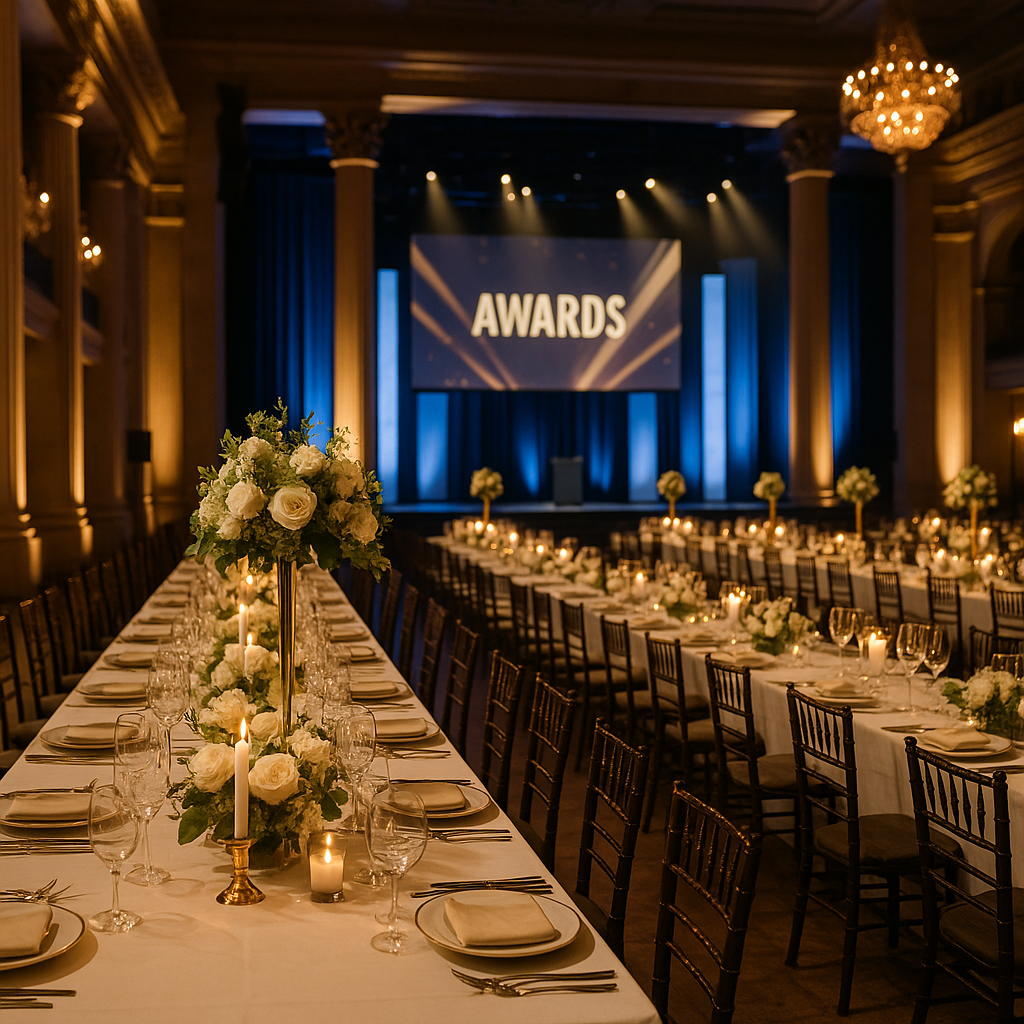

Stop Throwing a Holiday Party. Throw an Awards Night.
Corporate Events
A holiday party has no failure mode and no upside. An awards night has both — which is exactly why it changes how people feel about working for you. Here is how the decision actually gets made, from award selection to stage access to who holds the liquor license.
Picture the moment: a director walks a top performer onstage in December, hands her an envelope with a $500 gift card, the room applauds, and everyone goes back to the bar. In January, payroll adds $500 to her W-2. She pays income tax and payroll tax on her own recognition. Nobody told her, and nobody meant to do it — but the IRS is unambiguous that gift cards and gift certificates are cash equivalents and are never excludable as a de minimis benefit, regardless of the amount.
That is the difference between a party and a program. A holiday party is a line item that asks nothing of leadership and produces nothing but photos of people holding drinks. An awards night is a decision — about who gets named, what gets rewarded, and whether the company can stand behind the criteria in front of a room. It is harder. It is also the only version of the December event that people still talk about in March.
The holiday party can't fail, which is why it can't matter
Every year-end event budget buys the same four things: a room, food, drinks and music. The question is what you put in the middle of them. A holiday party puts nothing there, so the evening drifts — teams sit with their own teams, executives circulate for forty minutes, and the event ends with no one having heard anything worth repeating.
An awards night puts a program in the middle. Suddenly the room has a focal point, an arc and a reason for the CFO to sit through dessert. It also creates real exposure: bad categories, a fumbled name, dead microphones or an award nobody believes in will be remembered longer than any centerpiece. Our corporate events work exists in that gap — the production decisions that make the difference between a program that lands and one that limps.
The tradeoff is worth naming plainly: you are exchanging a guaranteed mediocre night for a night that can be genuinely good if you make five or six decisions correctly. What follows are those decisions.
Decide what the award is before you decide who wins it
Most companies discover the tax question after the trophies are ordered. Run it first, because it reshapes the categories.
Under Internal Revenue Code §274(j), an "employee achievement award" is an item of tangible personal property, given for length of service or safety achievement, awarded as part of a meaningful presentation, under circumstances that don't look like disguised compensation. The statute explicitly excludes cash, cash equivalents, gift cards, gift coupons and gift certificates, along with vacations, meals, lodging, event tickets and securities. Deduction limits run to $400 per employee per year outside a qualified written plan, and $1,600 inside one.
Two consequences most planners miss:
- "Employee of the Year" is not an achievement award under §274(j). The category covers length of service and safety achievement only — productivity awards were dropped from the definition. Your best-salesperson award is a fine thing to give; it is simply compensation, not a §274(j) award.
- The presentation itself is part of the legal test. "Awarded as part of a meaningful presentation" is statutory language. A trophy handed out at a desk on a Tuesday is doing less work than the same trophy handed out from a stage — one of the few places where the ceremony has a defensible business rationale, not just a sentimental one.
| What you hand over | How it generally behaves | Practical implication |
|---|---|---|
| Engraved trophy, watch, tool set, branded jacket (tangible property, length of service or safety) | May qualify as a §274(j) employee achievement award within the deduction limits | Best candidate for the "big" stage moment |
| Gift card, gift certificate, prepaid card, cash bonus | Cash equivalent — never de minimis, generally reportable wages | Give it, but route it through payroll and say so in advance |
| Trip, dinner, concert or sports tickets | Excluded from the tangible personal property definition | Treat as a taxable perk, not an "award" |
| Low-value non-cash items given infrequently (flowers, a small gift) | May fall under the de minimis rules depending on facts and circumstances | Fine for door prizes; not a headline award |
This is general information, not tax or legal advice. Award structures, plan documents and withholding decisions belong with your CPA, payroll provider and counsel before invitations go out.
Write the categories so the criteria survive the room
The fastest way to lose a room is an award nobody can trace back to a reason. Three rules keep the categories credible:
- Publish the criteria and the nomination window before nominations open. If people learn the rules from the stage, they assume the winner was chosen first and the category second.
- Name the specific act, not the adjective. "Held the Doral install together when the freight elevator failed" beats "Excellence in Teamwork." Specifics are what the winner's family hears about later.
- Be careful with safety awards tied to injury counts. OSHA's 2018 memorandum is direct on this: rate-based safety incentive programs are permissible, but not where they're implemented in a way that discourages reporting — such as withholding a prize or bonus because an employee reported an injury. Programs that reward reporting near-misses and hazards are, in OSHA's words, always permissible under the rule. Recognize the behavior, not the silence.
One more structural choice: cap the number of awards. Fourteen categories in a 40-person company means everyone gets one, which means none of them mean anything. Six that are hard to win beat fourteen that aren't.
Build the program like a show, not an agenda
The most common failure is not a bad award. It's ninety minutes of speeches with no shape. Award nights work in a tight, produced block that ends while the energy is still high — then releases the room into the part everyone actually wanted anyway.
| Block | Duration | What it does |
|---|---|---|
| Arrival, bar, capture | 60 min | People find their table, get one drink in hand, get photographed while they still look fresh |
| Seated, first course, opening remarks | 20 min | Leadership sets the year in context — once, briefly, and not again |
| Award block one | 25 min | Three to four categories, each with a 45-second citation and a walked-up winner |
| Main course, live music or DJ set down | 30 min | Reset the room's energy; no talking over dinner |
| Award block two, closer | 25 min | Top honors last, ending on the highest-value moment of the night |
| Open floor, dancing, photo capture | 60–90 min | The party you would have thrown anyway — now with a reason behind it |
Two production notes that decide whether this works. First, every winner walks — a name called from a table with no stage is a category that felt like an afterthought. Second, the citation is pre-written and pre-read. Presenters who improvise run long and mispronounce names. Our event production team builds the stage, riser, lectern position and cue sheet around that run of show, because staging that works for a band rarely works for a 12-person award procession.
The room decisions that decide whether the moment lands
Stage access is a design decision, not a courtesy
A two-foot riser with steps quietly excludes someone. The 2010 ADA Standards require that where a circulation path directly connects a performance area to assembly seating, an accessible route connect the seating area to the performance area, and to the ancillary spaces performers use. Those scoping rules govern how facilities are built and altered rather than every temporary riser you rent — but they are the right benchmark. A ramped riser, or a floor-level presentation position with the same lighting and camera treatment, costs almost nothing when specified in advance and is nearly impossible to fix at 6:15 p.m.
People have to be able to hear the citation
The 2010 Standards also address assembly areas where audible communication is integral to the space: an assistive listening system is required where audio amplification is provided, with receiver counts scaled to seating capacity and at least 25 percent of receivers (never fewer than two) hearing-aid compatible. Ask your venue three questions during the site visit: do you have a system, how many working receivers, and where are they issued? "We have some in a drawer somewhere" is a no.
Wireless microphones have a legal spectrum problem
This one surprises people. After the broadcast incentive auction, the FCC repurposed most of the 600 MHz band, and wireless microphones may no longer operate on the 617–652 MHz and 663–698 MHz service band frequencies; operation in the 700 MHz band has been prohibited since 2010. Legal operation continues on TV channels 2–36, on narrow slices of the 600 MHz guard band and duplex gap, and on bands including 902–928 MHz and 1920–1930 MHz. Plenty of older handhelds still in venue closets fall in the dead zone. If a presenter mic drops mid-citation, that is the moment the room remembers. Our presenter and entertainment audio setups are spec'd on compliant frequencies with coordinated channels and a backup handheld at the lectern — because the second mic is the cheapest insurance at the entire event.
Capture the person, not the plaque
The photo people keep is the handshake and the face, not the trophy on a table. Brief the photographer on the exact sequence — presenter left, winner right, hold for three seconds, then the two-shot — and build a lit backdrop where winners can be photographed with their team afterward. Winner and program capture is what turns one evening into twelve months of internal comms, recruiting content and LinkedIn posts your employees write themselves.
The bar, the license and the part nobody plans
Recognition and open bar are a specific combination: people drink faster before a program than after one, because they're nervous. Sequence accordingly — a controlled bar during arrival, service paused during award blocks, full bar after the closer.
Two operational facts worth confirming in writing. First, in Florida, alcohol service at an off-premises catered event runs through a licensed party — the state's Division of Alcoholic Beverages and Tobacco license types include a caterer's license for licensed food caterers serving at catered events. Know whether the venue, the caterer or a third party holds it, and get it named in the contract.
Second, Florida's approach to service liability is narrower than most states'. Under Florida Statutes §768.125, furnishing alcohol to someone of lawful drinking age generally does not create liability for injuries resulting from that person's intoxication, with exceptions for willfully and unlawfully serving someone underage or knowingly serving a person habitually addicted to alcohol. Narrow statutory exposure is not the same as no exposure, and it says nothing about your obligations as an employer to people who drove to your event. Trained bartenders, a hard stop on service and pre-arranged rides are the operational answer regardless of what the statute says. Again — general information, not legal advice; run your event contracts past counsel.
Somebody has to hold the music license
Live or recorded music at a company event is a public performance, and performance rights are administered through PROs. ASCAP is explicit that a license with one PRO covers only that organization's repertory, so coverage generally requires more than one. A venue's own blanket licenses may or may not extend to private contracted events, and a DJ or band cannot supply the license on your behalf. Ask the venue in writing what its licenses cover; if they don't reach your event, the responsibility sits with the event's owner.
FAQs
Can we just hand out gift cards from the stage?
You can — just don't call it a tax-free award. Gift cards are cash equivalents and are generally reportable wages regardless of amount. If you're giving them, tell recipients in advance that the value runs through payroll, and pair the card with a tangible item for the stage moment. Confirm treatment with your payroll provider.
We're a five-year-old company with no long-tenured staff. What do we recognize?
Recognize decisions, not tenure. Categories built around a specific judgment call someone made — the save, the recovered account, the process someone quietly fixed — travel better than milestone awards in a young company. Just remember that these are compensation-style awards rather than §274(j) achievement awards.
How long should the whole night run?
Three to four hours total, with the produced program held to roughly 50 minutes split across two blocks. Programs that run past an hour without a break lose the back half of the room, and the back half of the room is usually the people you most wanted to reach.
Does an awards night mean no party?
The opposite. The party is better because the room has already shared something. Keep the dancing, keep the bar, keep the late block — you're adding 50 minutes of substance to an evening that previously had none.
What ruins these nights most often?
Audio, and it isn't close. A dead lapel, a lectern mic aimed at a chin, or a presenter who steps off-axis mid-citation. Rehearse the walk-ups with live audio in the actual room, and keep a wired handheld on the lectern as a backup.
Make the harder choice
You are going to spend the money either way. The room, the food, the bar and the music are already in the budget. The only question is whether the evening contains a moment somebody's spouse hears about on the drive home.
Pick six categories. Publish the criteria. Ramp the stage. Confirm the microphones are legal, the receivers exist, and the liquor license has a name on it. Then hand someone a trophy in front of everyone they work with, and say exactly what they did.
That's not a holiday party. That's a reason to stay another year.
Ready to Plan Your Awards Night?
Bring us your category list and your headcount and we'll build the run of show, staging, audio and capture around it. Contact us to start with a site visit and a program outline.
Visuals