
If You're Using a Metal Spoon, You Ruined the Caviar Before Anyone Tasted It
VNV Events
If You're Using a Metal Spoon, You Ruined the Caviar Before Anyone Tasted It
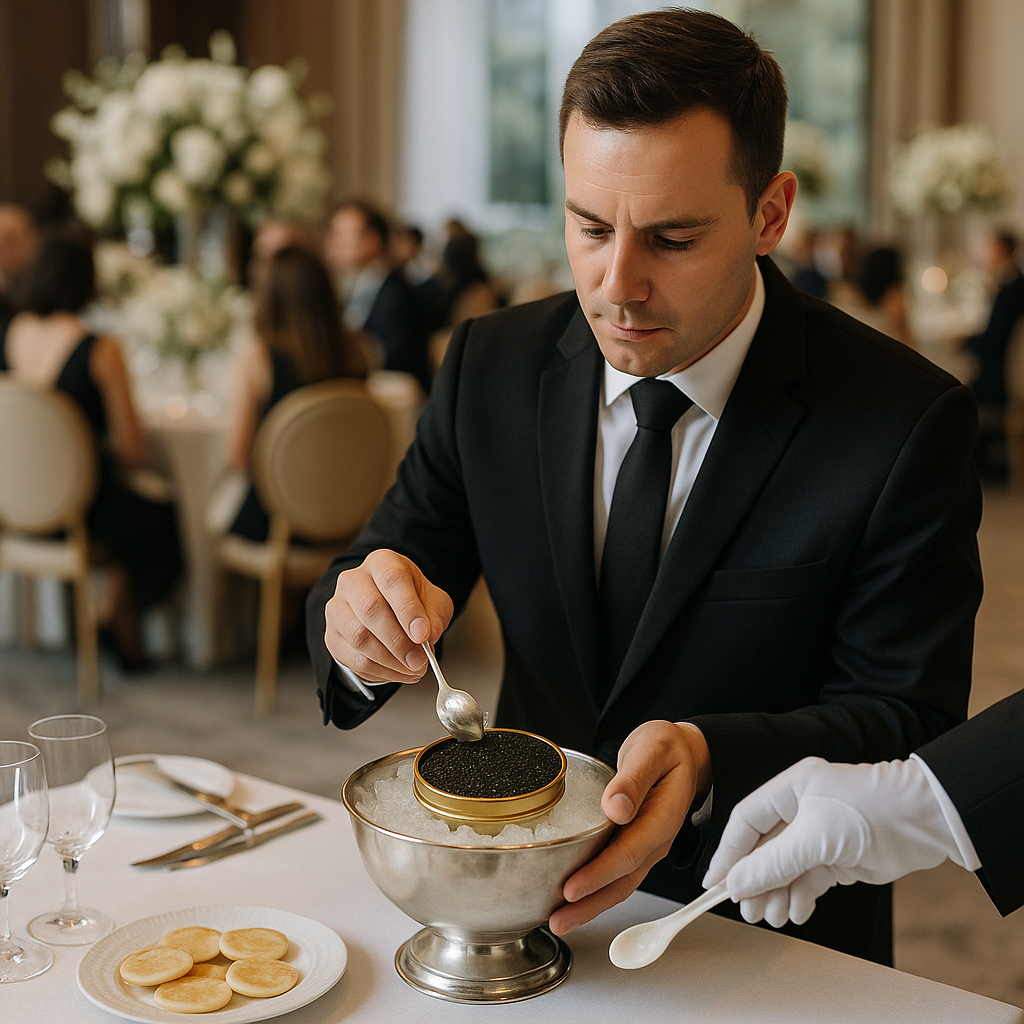
It's the most expensive thing on the table and the mistake costs four dollars to avoid. A metal spoon doesn't just look wrong — it chemically alters the caviar between the tin and the guest's mouth. The guest tastes a bitter metallic finish, concludes they don't care for caviar, and never learns the spoon did it. Here's the mechanism, the materials that work, and the three other ways a service gets ruined before anyone has tasted anything.
What actually happens
The roe is fragile in a specific way. Meredith Marks Caviar explains that metal spoons react with the salt and oils in caviar, frequently leaving a bitter or metallic aftertaste — and that mother-of-pearl works because its smooth, non-reactive surface keeps the flavor pure.
OM Caviar puts the practical consequence bluntly: metal reacts with the natural oils and salt, leaving a metallic aftertaste, and the difference is immediately noticeable. Le Chef's Wife describes the same effect — metal reacts with the flavor and gives it a metallic taste.
This isn't ceremony. It's the reason a guest's first impression can be permanently wrong.
It isn't only the spoon
Most articles stop at utensils and miss the larger surface area sitting underneath.
Kitchen Confidante's guidance covers both: caviar should be served in bowls and with utensils that are non-reactive. Le Chef's Wife is direct about it — never use metal spoons or metal bowls, and either keep the caviar in its own tin, which is lined with a non-reactive surface, or transfer it to a small glass bowl.
That last detail is the one caterers get wrong most often. The tin is engineered for this. Decanting into a pretty silver vessel for presentation undoes the entire point.
What to use instead
The acceptable materials are broader than most people assume, and none of them are expensive.
- Mother-of-pearl — the traditional answer, and Meredith Marks notes it adds visual sophistication alongside the functional benefit.
- Bone, horn, shell, porcelain, glass, or wood — the International House of Caviar lists ceramic, bone, tortoise shell, and wood as fully sufficient substitutes.
- Solid gold — the one metal that appears on the acceptable list, since it doesn't react.
- Plastic — Cooking With Janica notes it works in a pinch. Not elegant, but better than silver.
On cost: Le Chef's Wife points out that mother-of-pearl spoons sound far fancier than they are and can be bought online for a few dollars. There is no scenario where the spoon is the expensive part of a caviar service.
A note on where the rule came from
Worth knowing, because a guest will eventually ask. Several sources name silver specifically rather than metal generally — Caviar Star warns that metals like silver can react with the roe, and Eating With Erica's guidance is simply to avoid silver.
That's a clue to the origin: the convention was formed in an era when the metal on a fine table was silver, which is notoriously reactive. Whether every modern alloy behaves identically is a fair question, and you'll find people who argue the rule is now more tradition than chemistry.
Our position as caterers is unbothered by the debate. The downside of being wrong is ruining the most expensive item on the menu. The cost of compliance is a few dollars per spoon. That math doesn't require a chemistry degree.
One spoon per guest
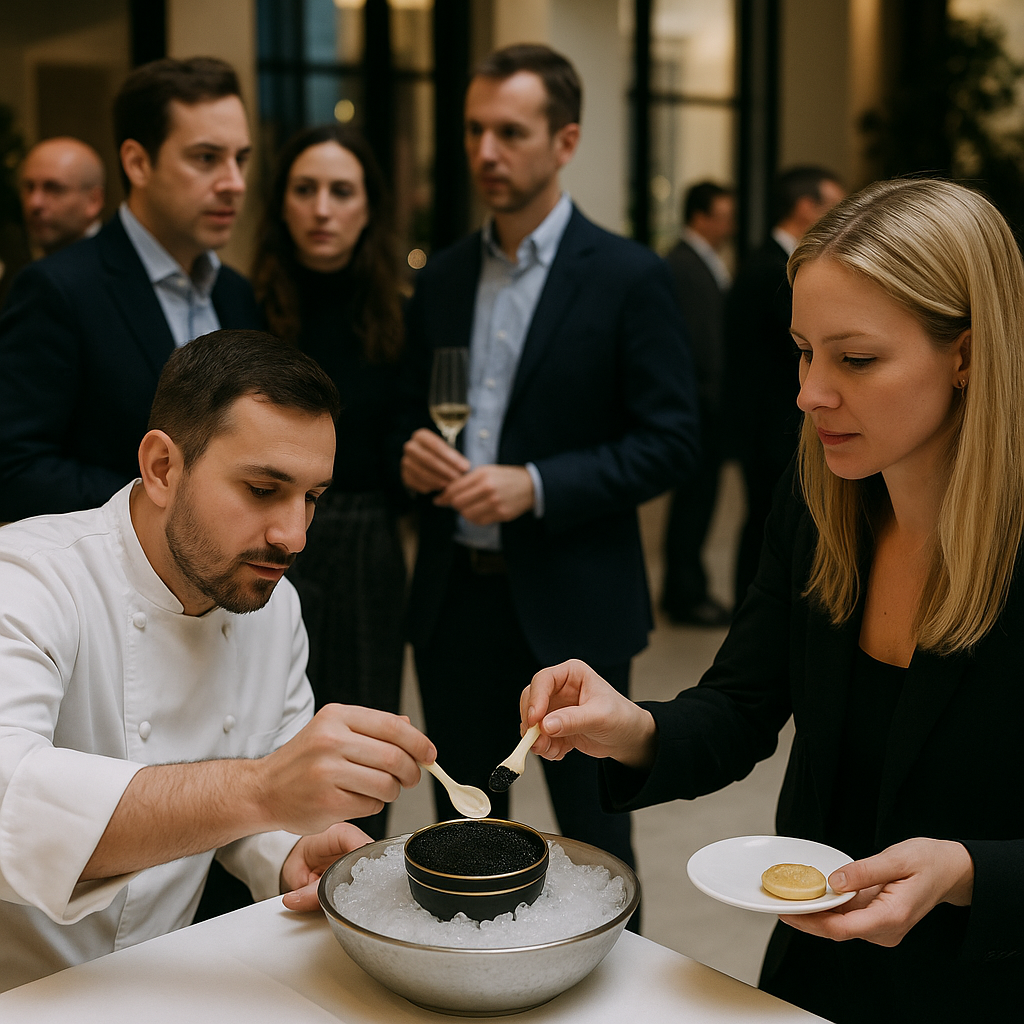
Meredith Marks recommends giving everyone their own spoon, describing it as both thoughtful and a way of keeping the act of serving elegant.
There's a practical layer too. At a self-serve station, a single shared spoon becomes a hygiene issue and a bottleneck within twenty minutes. Individual spoons remove both problems and, with a first-time crowd, quietly remove the hesitation about how much to take.
Three other ways it's ruined before anyone tastes it
The spoon gets the headline. These do the same damage.
- Temperature. OM Caviar specifies 28 to 32°F, always with the tin nested in crushed ice, because warm caviar loses its texture. The beads stop popping and the whole point of the ingredient disappears.
- Opening the tin early. Eat Healthy 365 is explicit: never open the tin until the moment you're ready to serve. A tin opened during setup and left sitting through cocktail hour is a different product by the time guests arrive.
- Burying it. OM Caviar's guidance is that the roe should sit on top as the star rather than be buried under crème fraîche in three layers — a thin layer reads as elegant, a heap as wasteful. Meredith Marks adds that intense additions like lemon or raw onion overpower delicate roe.
[TITULO DEL CASO REAL]
[Qué encontramos o cómo lo montamos.] [Qué cambió.]
What to ask before the event
- What material are the serving spoons, and is there one per guest?
- Is the caviar staying in its tin, or being transferred — and into what?
- How is it being held cold, and for how long before service?
- When does the tin get opened?
- Does each garnish have its own separate vessel and spoon?
Any caterer who has actually run caviar service answers all five without pausing. If you're planning a station and want the rest of the setup, see our guide to serving caviar to first-timers.
Frequently Asked Questions
Why can't you use a metal spoon with caviar?
Metal reacts with the salt and natural oils in the roe and leaves a bitter, metallic aftertaste. The effect is immediately noticeable, and a guest tasting caviar for the first time will attribute that off flavor to the caviar rather than to the spoon.
What spoon should you use for caviar?
Mother-of-pearl is traditional and effective because its surface is non-reactive. Bone, horn, shell, porcelain, glass, and wood all work equally well. Solid gold is the one metal generally considered acceptable. Plastic works in a pinch and is still better than silver.
Does the bowl matter too, or just the spoon?
Both. The serving vessel should be non-reactive as well. The simplest solution is to leave the caviar in its own tin, which is lined for this purpose, or transfer it to a small glass bowl. Never decant into a silver or other metal vessel for presentation.
Is a stainless steel spoon acceptable?
Guidance across caviar sources is to avoid metal generally, with silver named most often. Whether every modern alloy behaves the same way is debatable, but the risk of being wrong is ruining the most expensive item on the menu, and non-reactive spoons cost a few dollars. There is no practical reason to test it.
What temperature should caviar be served at?
Between 28 and 32°F, with the tin nested in crushed ice throughout service. Warm caviar loses its texture, and the tin should not be opened until the moment you are ready to serve.
Sources
- Meredith Marks Caviar — Mother of Pearl Spoons and Caviar Service
- OM Caviar — Caviar Pairing, Serving Ware and Temperature
- Le Chef's Wife — How to Serve Caviar
- International House of Caviar — How to Serve and Store Caviar
- Kitchen Confidante — Caviar and Blini Board
- Caviar Star — How to Eat and Serve Caviar
- Cooking With Janica — How to Serve Caviar
- Eating With Erica — How to Make the Perfect Caviar Board
- Eat Healthy 365 — Guide to Caviar Pairings and Accompaniments
We bring the spoons
Non-reactive service ware, one per guest, tin on ice, opened at service. If you're putting caviar on your menu, the setup is the part worth getting right. Around 200 events a year across Broward, Miami-Dade, and Palm Beach.
Request a Quote