LED Wall or Projection: The Answer Is in the Room, Not the Budget
Sound and Media · Event Production
The complaint never arrives during the keynote. It arrives on Monday, in an email from the executive who sat at table 22 and could not read a single number on the revenue slide.
By then the screen has been struck and the argument is unwinnable. So the useful question is not "LED wall or projection?" It is: what does this specific room allow, and what does the content actually require? Answer those two, and the technology chooses itself. Answer them backwards — starting from a budget line — and you buy a display that the room quietly defeats.
Two numbers decide this before you price anything
Every visual decision in a ballroom traces back to a pair of measurements taken on site: the distance to the farthest viewer, and how much stray light lands on the screen surface. One sets image size. The other sets whether an image survives at all.
The AV industry has consensus standards for both. ANSI/AVIXA V202.01, Display Image Size for 2D Content in Audiovisual Systems (known as DISCAS) defines the calculations for minimum image size relative to viewing positions, and it explicitly applies to temporary systems, not just permanent installs. ANSI/AVIXA V201.01, Image System Contrast Ratio covers the other half: it treats the display, the source, the signal path and the room environment as one system, because a projector in a lit ballroom is a different product than the same projector in a dark one.
Size the image first. Then argue about technology.
DISCAS separates content into Basic Decision Making — slides, agendas, sponsor logos, presentations where the audience absorbs information but does not inspect detail — and Analytical Decision Making, where every element of detail has to resolve. The math is short enough to run in a venue walkthrough:
- Basic Decision Making: minimum image height = farthest viewer distance ÷ (200 × %element height), where 200 is the standard's acuity factor for 20/20 vision.
- Analytical Decision Making: farthest viewer distance = (image height ÷ vertical resolution) × 3438.
Run it on a real gala. A 10-foot-tall image with a back row 70 feet away means the smallest readable element must be about 3.5% of image height — roughly 38 pixels tall on a 1080-line image. That is not a body-copy bullet. That is a headline. Push the same image into analytical territory — a floor plan, a P&L, an engineering drawing — and the standard's farthest viewer collapses to about 32 feet. Everyone behind that line is looking at decoration.
The same standard rules out the front of the room. Closest viewer distance for Basic Decision Making is the vertical viewing factor (image height plus the offset from eye level to the bottom of the image) multiplied by 1.732 — a 30-degree limit above the seated sightline. A 10-foot image whose bottom edge sits 4 feet above seated eye height creates a non-conforming zone roughly 24 feet deep. Those are your VIP tables. AVIXA publishes free calculators for these conformance checks, so there is no excuse for guessing.
Note what DISCAS deliberately does not do: it excludes contrast, luminance and color rendition from its scope. It tells you how big the picture must be. It never tells you which technology can deliver that picture in your room.
Ambient light is the real referee
This is where budget-first decisions die. AVIXA's contrast standard defines four viewing categories — passive viewing, basic decision making, analytical decision making and full motion video — each with its own required system contrast ratio. Under the viewing categories carried into DISCAS, Basic Decision Making calls for a minimum 15:1 contrast ratio and Analytical Decision Making for 50:1, and the analytical category assumes a controlled environment with blackout treatment and no ambient light striking the screen.
A South Florida hotel ballroom is the opposite of that. Chandeliers on a dimmer the banquet captain controls. Uplighting washing the drape behind the screen. A gobo pattern spilling onto the surround. Foyer doors that open every ninety seconds during a plated dinner service. Windows with sheer treatments that were never meant to black out an 11 a.m. general session.
Projection loses contrast to every one of those. LED does not — it emits its own light instead of relying on reflected light, which is why it holds up in a room nobody is willing to darken. If the client refuses to dim the room during dinner because the photographer needs light and the sponsors want ambiance, the argument is over. Spec LED.
Do not shop on the brightness number alone
Projector output claims are only comparable when measured the same way. ISO/IEC 21118:2020 specifies what belongs in a data projector's specification sheet, which is why "ISO lumens" and the legacy "ANSI lumens" can be compared while marketing terms like "LED lumens" or a lux figure cannot. Ask for the standards-based figure, then ask what surface it will hit and what the room will do to it.
Where each one actually wins
| Room condition or requirement | Points to projection | Points to LED |
|---|---|---|
| Ambient light you cannot control | No | Yes — self-emissive, holds contrast |
| Low ceiling or shallow throw distance | Only with short-throw or rear projection depth you may not have | Yes — depth is the panel plus its structure |
| Very wide canvas, blends, or projection onto an architectural surface | Yes — cost per square foot scales gently | Costly at scale |
| Full blackout general session, cinematic content | Yes — often the better image for the money | Yes, but you are paying for headroom you won't use |
| Non-rectangular or curved design element | Limited | Yes — panels configure to the design |
| Beam-crossing risk: talent, cameras, moving heads, guest traffic | No — anything in the beam is on screen | Yes — nothing to interrupt |
| Venue with strict floor loading or no rigging points | Yes — lighter tripod or truss-hung screen | Requires weight, ballast or verified rigging capacity |
Pixel pitch is a content decision, not a bragging right
Pixel pitch is the distance between the centers of adjacent LEDs. Smaller pitch means more pixels in the same physical area — and it also sets your real canvas resolution, which is the number your designers need before they build a single frame. A 16-by-9-foot wall built from 2.6 mm panels is roughly 1,875 by 1,055 pixels: just under 1080p, no matter what the source is feeding it. The same wall in 3.9 mm lands near 1,250 by 703. Send 4K content to either and it gets scaled down; send a slide deck with 14-point footnotes and it disappears.
The other half of the pitch decision is distance. Coarser pitch is invisible from 40 feet and obvious from six. If guests will pose against the wall for photos, or if it doubles as a backdrop behind a step-and-repeat, the closest viewer governs the spec — not the back of the house.
The operational constraints that actually kill a design
These are the items that turn a beautiful renders-well plan into a load-in argument at 6 a.m.
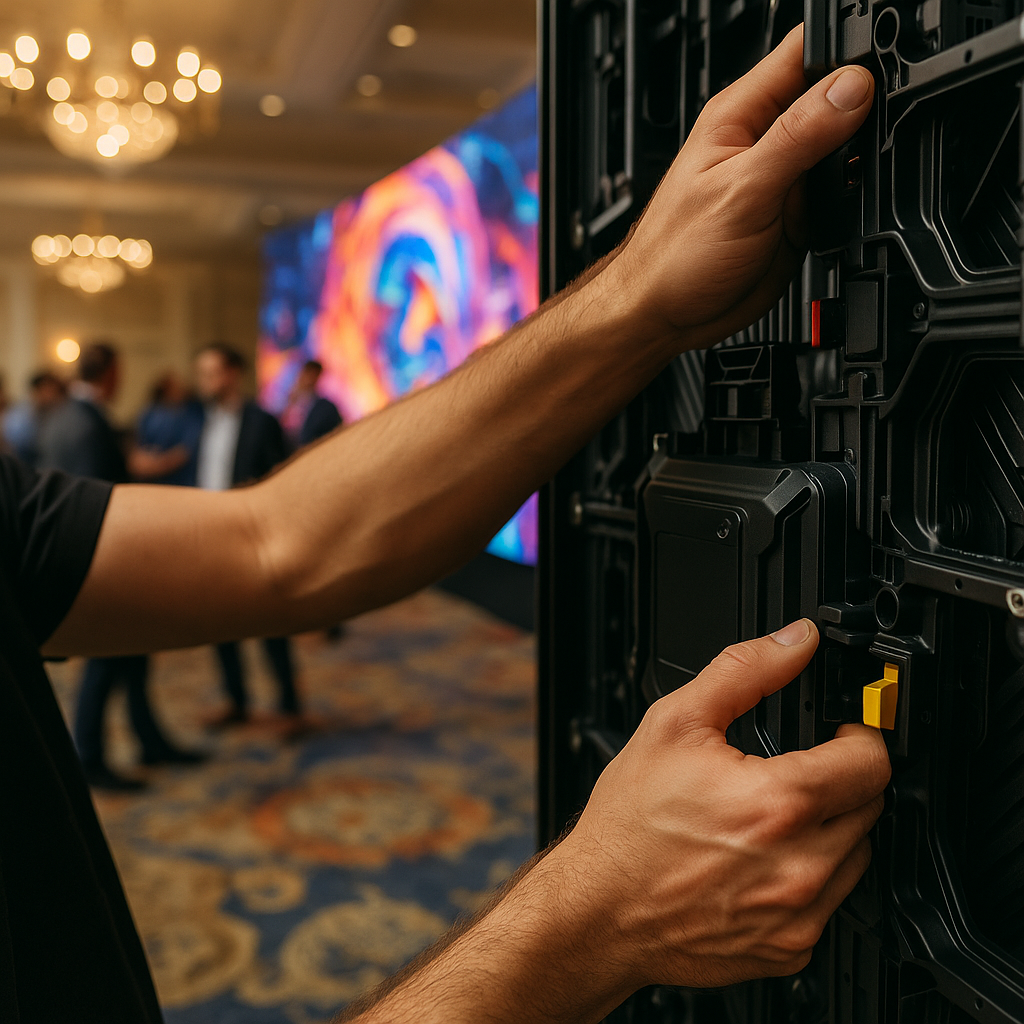
- Rigging and floor loading. LED walls are heavy and their weight is concentrated. Confirm the venue's rigging capacity and point locations in writing, or design ground-supported with proper ballast. Never assume a ballroom ceiling grid will take it.
- Outdoors, wind governs. A ground-supported wall is a sail. ANSI E1.21-2024, Temporary Structures Used for Technical Production of Outdoor Entertainment Events, sets minimum design and performance parameters for exactly these structures and is now referenced by and correlated with the 2024 International Building Code and International Fire Code. It also contemplates mitigating actions and configuration changes when specified environmental conditions are reached — meaning your plan needs a documented wind threshold and a person empowered to call it.
- Permits. In Florida, Florida Building Code Chapter 31 requires temporary structures to conform to structural strength, fire safety, means of egress, accessibility, light, ventilation and sanitary requirements, with permit applications and construction documents submitted for each installation. Timelines vary by jurisdiction across Broward, Miami-Dade and Palm Beach — build them into the production schedule, not the week of.
- Sightlines are an accessibility obligation. Under the 2010 ADA Standards for Accessible Design, wheelchair spaces in assembly areas must be provided lines of sight to the screen or performance area under sections 221 and 802. A screen or wall placed to solve a camera problem can create a compliance problem.
- Flashing content. A bright self-emissive wall filling a guest's field of view is not a laptop screen. The W3C's three flashes or below threshold criterion — derived from broadcast guidance — exists because content flashing more than three times per second can trigger photosensitive seizures. Review sponsor reels and opener animations against it before showtime.
- Power and cameras. Both technologies need clean, adequately sized power. If the program is being recorded or streamed, confirm the wall's refresh rate and the camera's shutter settings during rehearsal, not during the CEO's opening remarks.
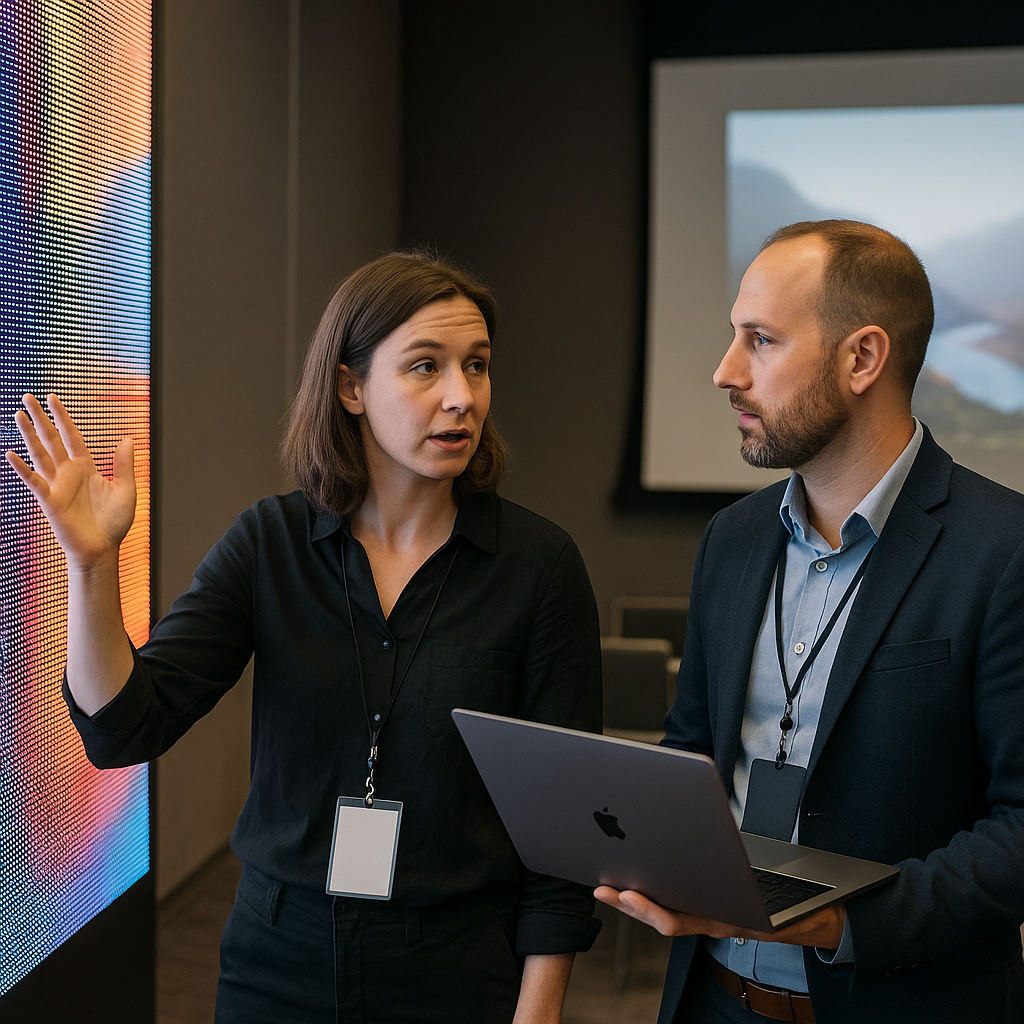
These are calls that get made on the site visit — reading the room, metering the light, checking the grid — which is why event production and sound and media coordination belong in the conversation before the floor plan is locked, not after.
The IMAG question is separate — and usually the expensive one
Image magnification exists so the person in the last row can see a face, not a slide. That is a different requirement, and it often changes the whole design: two side screens instead of one center screen, or a center wall with content plus flanking IMAG.
DISCAS gives you the horizontal boundary for this. The conforming viewing area is bounded by lines drawn 60 degrees inward from each edge of the image, which is why seats jammed against the far wall next to a screen are functionally outside the design. If your seating chart is wider than it is deep — typical of a gala or awards dinner with rounds — a single screen at the front will not serve the room, regardless of which technology you buy.
FAQ
Is projection always the cheaper option?
Per square foot of image, usually. Per usable square foot in a lit room, frequently not. A projector that cannot hold 15:1 system contrast in your actual conditions is not a cheaper display; it is a display that fails at the moment it matters. Price the outcome, not the gear.
What pixel pitch do I need?
Work from the closest viewer and the content. If guests will stand within a few feet of the wall, or if it appears in close-up photography, you need finer pitch. If the nearest seat is 30 feet back and the content is motion and typography, a coarser pitch saves money without a visible penalty. Then confirm the resulting pixel dimensions and hand them to whoever is designing the content.
Can we use both in the same room?
Yes, and it is often the right answer: an LED wall as the scenic centerpiece behind the stage, projection for wide ambient washes, band backdrops, or a foyer surface. The trap is content design — two canvases with different resolutions, aspect ratios and color behavior need two sets of files and one show operator who has rehearsed both.
How do I size the screen for my ballroom?
Measure to the last seat, decide whether the content is basic or analytical, and run the DISCAS formulas above. Then check the closest-viewer boundary and the 60-degree horizontal limits before you commit to a seating chart. If the required image height does not fit under the ceiling, the honest answers are a smaller room, a second screen, or content redesigned with larger elements — not a bigger projector.
Does a brighter projector solve a bright room?
Partially, and with diminishing returns. Contrast is a system property that includes the screen surface, the ambient light landing on it, and the room finishes. Doubling lumens against a washed-out surround buys less than moving one uplight and closing one door.
The decision, in one line
Walk the room with a light meter and a tape measure before you walk into a pricing conversation. If the room can go dark and the canvas is wide, projection will very likely give you the better image for the money. If the room will stay lit, if there is nowhere to hang a projector, if anything will cross the beam, or if the screen is part of the scenic design, buy the LED wall and stop negotiating with physics.
The budget tells you what you can spend. The room tells you what will actually be seen. Only one of those changes on show day — and it is never the room.
This article is general production guidance, not legal, engineering or code-compliance advice. Structural, rigging, electrical, permitting and accessibility requirements vary by venue and jurisdiction and must be confirmed with a licensed engineer and the authority having jurisdiction for your specific event.
Visuals