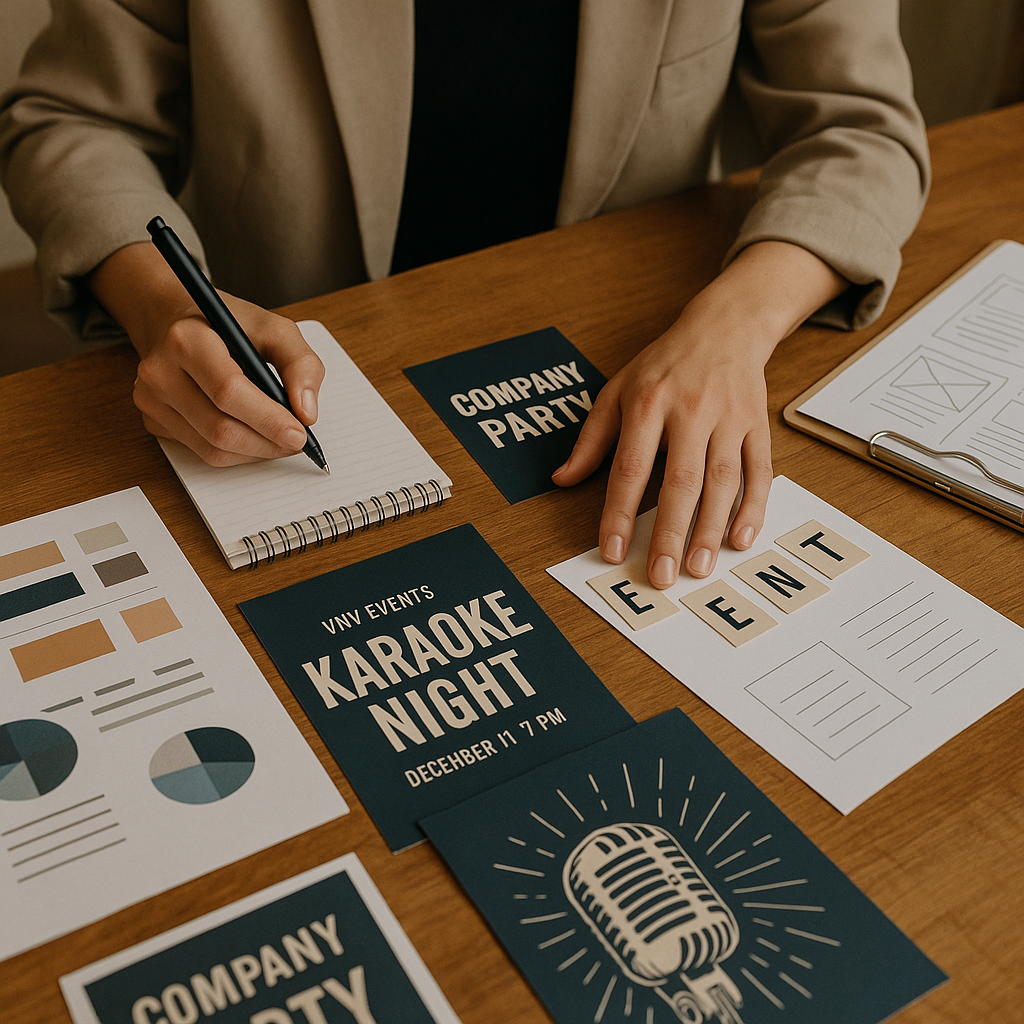
Nobody Danced at the Company Party. Karaoke Would Have Fixed It.
Corporate Events
The room didn't fail at 9 p.m. It failed six weeks earlier, when someone booked "entertainment" instead of deciding what 140 employees were supposed to do for three hours.
Here is the moment most planners recognize: dinner service ends, the band starts its second set, and the dance floor holds four people — three from marketing and the CFO's spouse. Everyone else is seated, phone-lit, waiting for a socially acceptable exit. The food was good. The venue was nice. The band is genuinely talented. And the party is over by 9:15.
Nothing malfunctioned. The format simply never gave anyone a reason to stand up. A DJ and a band both ask your guests to be an audience. Karaoke asks them to be participants — and that single structural difference is usually what separates a company party people talk about in March from one they forget by Monday.
The real problem isn't the music. It's the participation gap.
Corporate crowds behave differently than wedding crowds. Wedding guests arrive with permission to be silly. Employees arrive with a reporting structure in the room. Nobody wants to be the first person dancing in front of their director, so the floor stays empty until someone breaks the seal — and if nothing is designed to break it, nothing does.
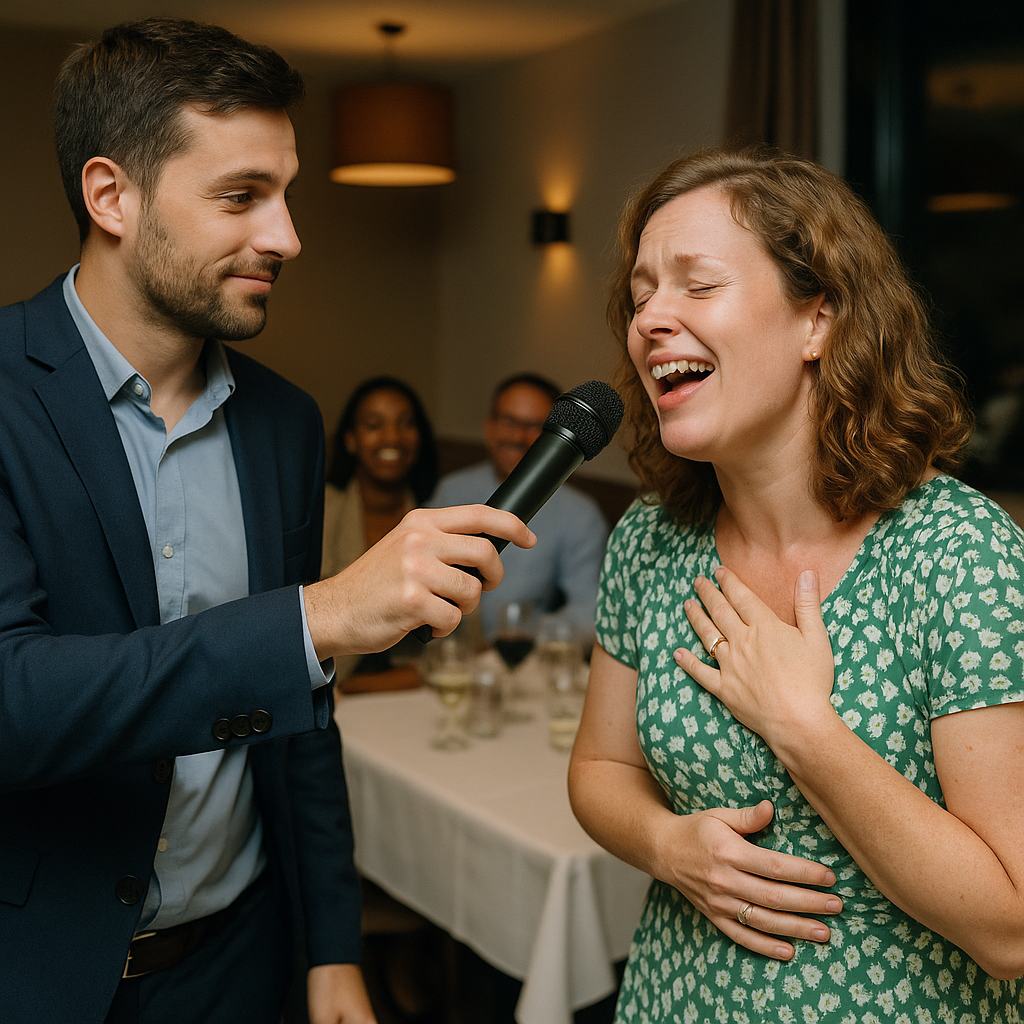
Karaoke breaks it structurally rather than socially. A queue creates a sequence of low-stakes, sanctioned reasons to be in front of the room. The first singer isn't showing off; they're taking their turn. By the fourth song, the floor is already occupied and standing up costs nothing.
There's a workforce argument underneath the party argument, too. The U.S. Surgeon General's Framework for Workplace Mental Health & Well-Being names Connection and Community as one of five essentials, grounded in social support and belonging, and points to "prosocial" behavior — welcoming, helping, reassuring others — as the practical starting point. A room where colleagues cheer each other through a chorus is prosocial behavior with a sound system attached. A room where colleagues watch a band is not.
- Cross-department mixing: the queue is the only thing at a company party that reliably puts accounting next to warehouse ops.
- A visible on-ramp: people who won't dance will hold a microphone, and people who won't do either will absolutely film a colleague doing both.
- Content you didn't have to produce: the photos and clips that circulate afterward come from participation, not from a stage.
- Graceful failure: a bad karaoke performance is the best part of the night. A band losing the room is just awkward.
DJ vs. live band vs. karaoke: an honest comparison
None of these formats is objectively better. They fail in different directions, and the right pick depends on your headcount, your room, and how much control you need over the timeline. This is the trade-off table we work from when scoping corporate events.
| Factor | DJ | Live band | Karaoke (hosted) |
|---|---|---|---|
| Guest role | Audience, optional dancers | Audience | Participants in rotation |
| Timeline control | High — songs cut on cue | Low — sets run in blocks with breaks | Medium — the queue is the schedule |
| Volume management | Precise, adjustable per zone | Constrained by stage volume and drums | Precise, but singers push the mic hot |
| Footprint | Smallest | Largest — stage, backline, load-in time | Small, plus screens and sightlines |
| Handles a mixed-age, bilingual crowd | Yes, with a prepared crate | Only within the band's repertoire | Yes — the songbook is the repertoire |
| Main failure mode | Empty floor, nobody starts | Wrong genre, crowd sits out the set | Long queue, three people monopolize it |
| Works during dinner | Yes | Sometimes, too loud for tables | No — schedule it after service |
In practice, the strongest corporate format is rarely a pure choice. It's a DJ running the room with a karaoke block inserted after dinner, then handing back to open-format dance music once the floor is full. The karaoke segment does the hard work of getting people standing; the DJ keeps them there. That's the combination behind our DJ and karaoke services — one host, one system, one timeline, no dead-air handoff between vendors.
One correction to a common assumption: karaoke is not automatically the cheap option. Doing it properly means a host running the rotation, a dedicated screen the whole room can read, wireless microphones with spares, and a mix engineer's attention on feedback. A consumer machine on a folding table in a 200-person ballroom fails within twenty minutes — the lyrics aren't legible past row four and the mic feeds back the moment someone walks toward the speakers.
The compliance layer nobody budgets for
Karaoke at a company party touches four regulatory areas at once. None of them is difficult, but all of them are easier to handle six weeks out than the night of.
Music licensing is two separate rights, not one
Playing recorded music publicly implicates the copyright owner's exclusive public performance right under Section 106 of the Copyright Act. That right is typically cleared through blanket licenses from performing rights organizations — and each PRO covers only its own catalog. ASCAP is explicit that its license does not authorize the repertories of other U.S. societies such as BMI, SESAC or GMR, and separately notes that a performance license does not authorize reproduction or distribution of musical works.
That second point is the karaoke-specific one. Karaoke tracks are re-recorded instrumentals with synchronized on-screen lyrics — a different use than spinning the original master. So the backing-track source matters independently of your PRO coverage, which is why a commercially licensed karaoke platform is not interchangeable with a consumer app or a lyric video pulled off the internet. Ask your entertainment vendor, in writing, which platform they use and how it's licensed for commercial events.
Who holds the PRO license also varies. Many venues carry their own; many of those licenses do not extend to private functions. Confirm coverage with the venue before you assume it exists, and get the answer in the contract rather than from a coordinator on the phone.
The songbook is a workplace document
An employer-hosted party is still a work environment for harassment purposes. The EEOC's guidance on workplace harassment lists offensive jokes, slurs, ridicule and mockery among the conduct that can create a hostile environment, and notes that employers can be liable for harassment by non-supervisory employees or non-employees they control when they knew or should have known and failed to act promptly.
The practical move is not to police the fun. It's to curate the songbook in advance — remove tracks whose entire premise is a slur or a demeaning bit — and to brief the host on how to handle an improvised "dedication" that turns into a roast of a specific colleague. A good karaoke host cuts a track and moves the queue along without the room noticing there was a decision. That takes a host who has done it before, not a volunteer with a tablet.
Alcohol changes the risk profile of a microphone
Florida takes an unusually narrow approach to alcohol-service liability. Under Fla. Stat. § 768.125, a person who sells or furnishes alcoholic beverages to someone of lawful drinking age is generally not thereby liable for injury resulting from that person's intoxication — with exceptions for willfully and unlawfully furnishing to someone underage, or knowingly serving someone habitually addicted to alcohol.
Narrow statutory liability is not the same as no exposure, and it says nothing about employment claims, property damage or your own insurer's position. Operationally: close the bar before the karaoke block ends, not after; make the last song a planned group number rather than whatever the queue produces at midnight; and keep the microphone rotation moving so no one holds the room for twenty minutes.
Sound levels and accessibility
Guests who sing push microphones far hotter than a DJ set ever runs. NIOSH sets a recommended exposure limit of 85 A-weighted decibels averaged over an eight-hour workday, with allowable exposure time halving for every 3 dBA increase; OSHA's own occupational noise standard permits eight hours at 90 dBA but only two hours at 100 dBA. Your party isn't a shift, but your bartenders, servers and AV crew are working it — and the same physics apply to the guest seated ten feet from a main.
On accessibility: the 2010 ADA Standards require assistive listening systems in assembly areas where audible communication is integral to the space and audio amplification is provided, along with signage informing patrons that the system is available. Beyond the standards, there's a design point worth stating plainly: if the microphone position sits on a riser reachable only by two steps, you have quietly excluded colleagues from the one part of the night built around participation. Put the singing position on the floor, or specify a ramped platform. This is exactly the kind of detail that belongs in event production planning rather than in a last-minute conversation with a venue tech.
This article is general information about operational planning, not legal, tax or insurance advice. Licensing obligations, liability exposure and accessibility requirements depend on your venue, your contracts and your specific facts — confirm them with qualified counsel and with your venue in writing.
A run of show that actually produces a full floor
The single most common karaoke failure at corporate events is placement. Scheduled too early, it competes with food service and dies. Scheduled too late, half the room has already left. The window is narrower than people expect.
- Arrival through dinner — DJ only, background level. Conversation has to be possible at every table. No microphone in sight yet.
- Awards or remarks, if any. Get the formal block done while people are still seated and attentive. Never after karaoke starts.
- The seed songs. Three to five people recruited in advance — ideally one visible leader and a couple of genuinely good singers — go first, back to back. This is the entire trick. Do not open with a general invitation to a room of 140 strangers.
- Open queue, hard rotation. One song per person until everyone who wants a turn has had one. The host enforces this; the client does not have to.
- The pivot. A planned group song — something everyone in your specific workforce actually knows — then straight into the DJ set with no gap. The floor is already occupied at this point, which is the whole reason the sequence exists.
- Final thirty minutes — DJ only. Microphones go away before the bar closes, not after.
South Florida specifics worth naming
- Build a bilingual songbook. Across Broward, Miami-Dade and Palm Beach, a monolingual English catalog will exclude part of your workforce from the one participatory moment of the night. Salsa, merengue, bachata, Spanish-language pop and rock en español belong in the book alongside the English standards — and the host should be able to run the room in both languages.
- Confirm the venue's amplified-sound curfew in writing. Hotels, waterfront properties and residential-adjacent venues frequently cut amplified sound earlier than the contracted end time. Build your run of show backward from that number.
- Outdoor and tented events need a different sound plan. There are no walls to reinforce the low end and no ceiling to hold it in. Lyric screens also lose legibility fast in ambient light — budget for brightness, not just size.
Frequently asked questions
What if our employees genuinely refuse to sing?
Then you've learned something before the invoice, not after. Seed the queue with volunteers recruited in advance and cap the block at thirty to forty minutes with a DJ set behind it. If participation doesn't materialize, the host pivots early and the night continues as a dance party. A karaoke block should always have a planned exit.
Is karaoke appropriate for a formal or client-facing event?
For an employee party, yes. For an event with clients, board members or press in the room, be deliberate: karaoke works when the entire room shares a context, and it gets uncomfortable when half the guests are relationships you're managing. If outside guests are attending, consider a shorter, curated block early in the evening rather than an open queue.
Do we need a license if it's a private company party?
"Private" in the everyday sense and "not a public performance" in the copyright sense are not the same question. Coverage depends on the venue's existing licenses, whether they extend to private functions, and which catalogs are involved. Confirm with the venue and the PROs, and confirm your karaoke track source separately. Your entertainment vendor should be able to tell you exactly what they carry.
Can we deduct the cost of the party?
Section 274 of the Internal Revenue Code generally disallows entertainment deductions, but § 274(e)(4) carves out expenses for recreational, social or similar activities primarily for the benefit of employees — Treasury's final regulations under section 274 address how those exceptions apply to food and beverage costs as well. How that maps to your event depends on your guest list, your documentation and your entity. Talk to your CPA before you assume anything; this is not tax advice.
Karaoke or a live band, if we can only pick one?
If the goal is a memorable evening for a workforce that mostly knows each other, karaoke wins — it converts guests into participants. If the goal is a polished, spectator-friendly evening with outside guests present, a band wins. If the goal is a full dance floor for four hours, neither one alone is the answer: you want a DJ with a karaoke block inside it.
How much equipment does this actually take?
At minimum: a licensed karaoke platform with a searchable catalog, at least two wireless handheld microphones plus a charged spare, a lyric display sized and positioned so the singer and the room can both read it, mains that cover the floor evenly, and someone at the console who can ride gain and kill feedback. The screen and the spare microphone are the two things most often skipped and most often regretted.
The decision, stated plainly
You are not choosing between music formats. You are choosing whether your employees spend three hours as an audience or three hours as participants — and that choice is made in the contract, not on the dance floor. A band is a performance you buy. A DJ is a room you steer. Karaoke is the only one of the three that hands the room to the people in it.
So before you sign anything, answer one question: what is the moment you want people describing on Monday morning? If the honest answer is "the food was good," book whatever you like. If the answer involves a name — someone from finance who nobody expected — then the format has already picked itself. Lock the songbook, seed the queue, close the bar before the last song, and confirm your licensing in writing.
Plan the moment, not just the playlist.
VNV Events runs DJ and karaoke as one integrated program with a single host, a bilingual songbook, and a production plan built around your venue's sound limits and room layout. Explore our DJ and Karaoke Services or Event Production options today.
Visuals