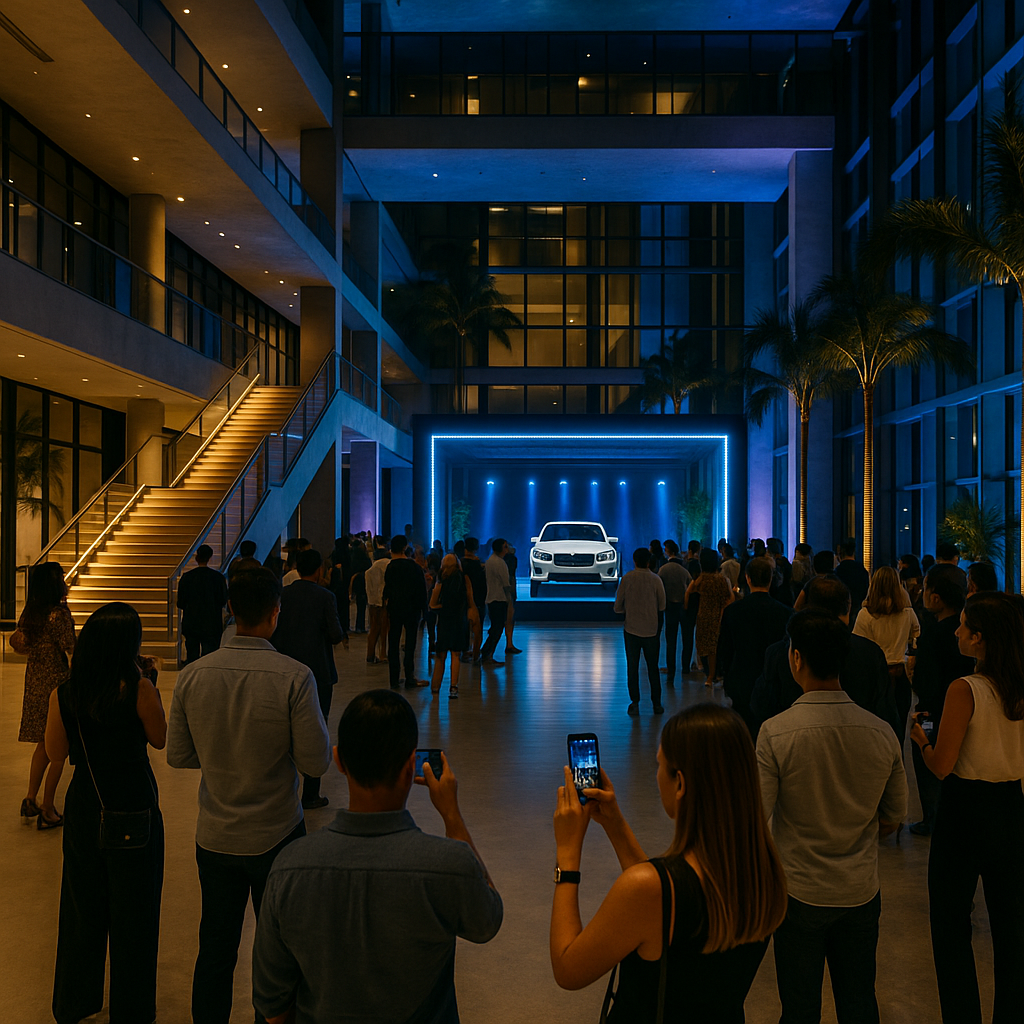
A brand activation in Miami has two audiences: the few hundred people standing in the room, and the much larger group who will only ever see the event through someone else's phone. The second audience is the one most launches under-plan for. You can spend the entire budget on a beautiful build and still end up with a night that photographs like a hotel conference — flat, backlit, crowded with clutter no one meant to include in the shot.
Guests photograph what is easy to photograph. That's the whole principle. Below is how we approach product launches and brand activations so the room looks good in person and holds up in a vertical video shot at eye level by someone holding a drink.
Decide what the event is supposed to produce
Before the moodboard, get the client to answer one question: what does success look like the morning after?
- Earned content. You want volume — guest posts, stories, tagged clips. That pushes budget toward lighting, backgrounds and a repeatable moment anyone can shoot.
- Owned assets. You want a controlled set of images and video for paid media and the brand's own channels. That pushes budget toward a dedicated capture area, art direction and time carved out of the run of show.
- Product comprehension. You want people to actually understand and remember the thing. That pushes budget toward demonstration, staffing and pacing.
- Relationships. Press, buyers, partners. That pushes budget toward guest management, seating, sound levels and hosted service.
Most launches want all four. The events that go sideways are the ones that never ranked them. Ranking is what tells you whether the DJ goes up at 8:00 or 9:30, whether the room is loud or conversational, and whether the centerpiece is a stage or a table.
Design for the camera before you design the floor plan
Build one hero moment, not five
Spreading small photo opportunities around the space usually produces small results. One well-lit, well-composed installation that people naturally walk into — a sculptural product display, an oversized set piece, a bar back that reads as a backdrop — tends to generate more content than four half-committed corners. It also concentrates your lighting and staffing budget where it does the most work.
Give the moment a queue path and a natural exit. If people don't know where to stand, they won't stand anywhere.
Light is most of the outcome
Phone cameras are unforgiving in dim rooms and in harsh overhead light. Two adjustments fix a majority of bad event photos:
- Put soft, front-ish light on faces at the hero moment and near the bar. Faces lit from above only will read as shadowed eye sockets on every phone in the room.
- Keep color temperature consistent within a shot. A warm practical fighting a cool wash produces skin tones nobody wants to post.
Uplights and color washes are for the room, not for faces. Plan both.
Watch what's behind people
Backgrounds decide whether an image looks produced or improvised. Walk the space and shoot test frames on a phone from standing height at the three or four spots guests will naturally gather. You'll find the exit signs, the stacked cases, the AV cart and the neighboring building's scaffolding before the event does.
Choosing a Miami venue for the brand, not the photo alone
Every venue type here has a look and a corresponding production cost. Know both before you fall in love.
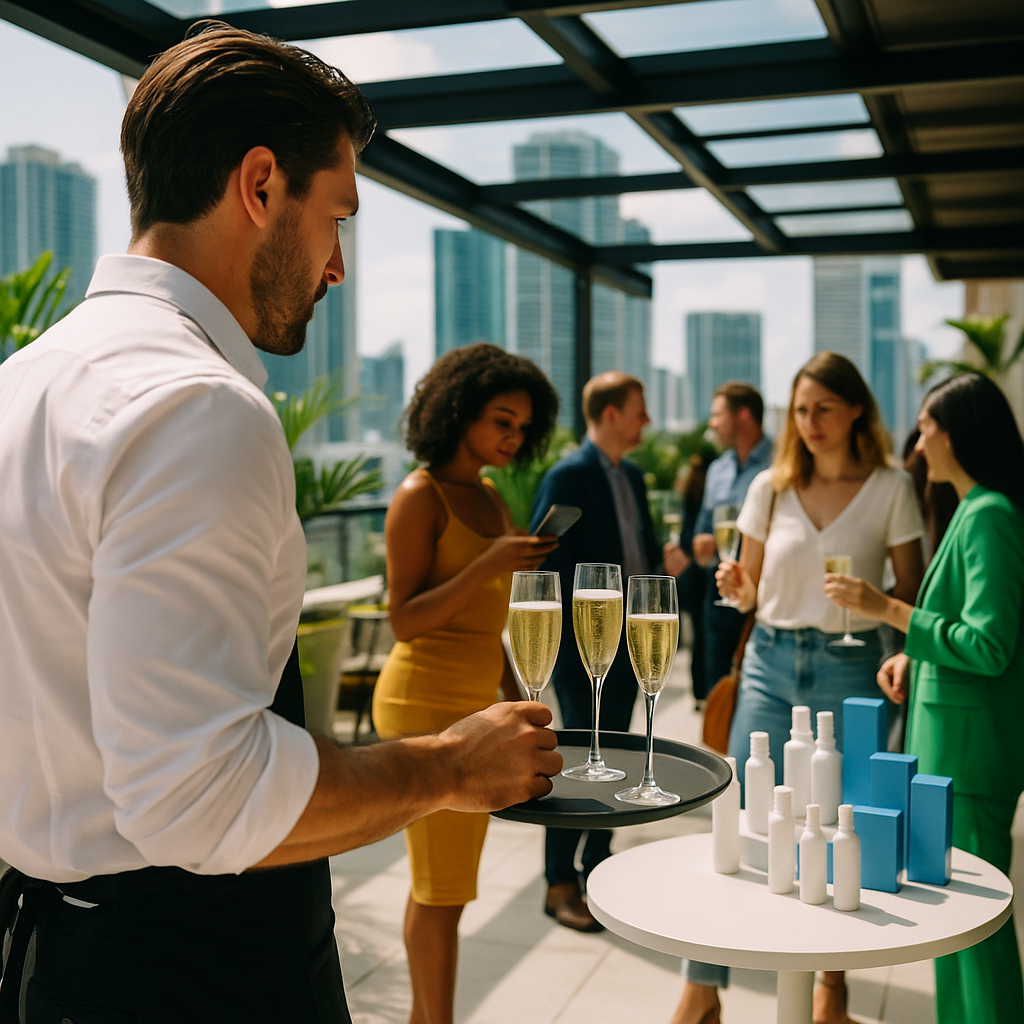
- Rooftops. Skyline and sunset are the draw. The trade-offs are wind, sun angle and load-in. Wind affects florals, signage, fabric, step-and-repeats and anything tall; anchor and weight accordingly. Freight elevator access and time windows often dictate what you can build at all.
- Galleries and studios. Clean walls, controllable light, strong neutral canvas for a brand's own palette. Usually the easiest place to art-direct. Ask early about wall attachment, floor protection, catering access and existing lighting you can or can't turn off.
- Beachfront and waterfront. Unmistakably Miami and hard to replicate elsewhere. Also the most logistically demanding: sand and salt air, power distance, permitting, and light that changes dramatically over the course of an evening.
- Warehouse and raw spaces. Maximum creative control, minimum infrastructure. Budget for power, climate, restrooms and sound treatment — raw space costs are back-loaded into production.
- Restaurants, hotels and members' clubs. Turnkey service and built-in atmosphere, with less freedom to reshape the room. Good when hospitality matters more than transformation.
Whatever the venue, confirm the rules before design: load-in and load-out windows, rigging and attachment policies, sound restrictions and curfews, available power, and whether outside vendors are permitted. Buildings and municipalities differ, and these details quietly determine what's actually buildable.
Make interaction produce something
"Interactive" is not a goal by itself. An activation earns its cost when the interaction does at least one of three things: teaches the product, produces a keepsake, or produces an image.
- Demonstration with a host. A trained brand rep who can explain the product in thirty seconds beats a touchscreen almost every time.
- Personalization. Engraving, custom labeling, on-site printing, a bespoke pour or blend. People photograph things that are theirs.
- Craft in motion. Live art, a chef finishing plates in front of guests, a performer working the room. Motion gives content creators something to shoot besides static objects.
- A takeaway that survives the night. Gifting works when it's genuinely usable. It stops working when it's a bag of things guests leave on the table.
Staff every touchpoint. The most common failure in activations isn't concept — it's an unstaffed station that guests walk past because no one invited them in.
Pace the night around light and arrivals
Guests don't arrive on the invitation time. Plan for a real arrival curve: a thin first thirty minutes, a dense middle, and a tail. That shape should drive the run of show.
- Shoot the room before guests arrive. The only time the build is pristine is before doors. Budget photography time for it.
- Use the golden hour if you're outdoors or on a roof. Sunset timing shifts through the year — check the actual time for your date and build the program around it rather than assuming.
- Put the program at peak density, not at the top of the night. Remarks delivered to a half-full room read that way in every clip.
- Keep remarks short. Two speakers, a few minutes each, is usually the ceiling before phones go back in pockets.
- Give the night an ending. A final moment — a reveal, a performance, a last pour — gives guests a reason to stay and a last piece of content on the way out.
South Florida production realities
The climate is part of the design brief, not a footnote.
- Heat and humidity. They affect florals, printed graphics, chocolate and plated food, hair and makeup, and how long guests will tolerate an outdoor space. Shade, airflow and hydration are production line items, not niceties.
- Rain. Afternoon storms are routine for much of the year and often brief. The plan is not "hope" — it's a defined trigger time, a covered alternative, and a crew that knows what moves and who moves it.
- Storm season. Broadly speaking, summer through late fall carries more weather risk. If the launch date lands there, build contingency into the contract conversation early.
- Wind. Anything vertical outdoors needs weight or rigging. Fabric, signage and lightweight structures are the usual casualties.
- Salt and sand. Hard on equipment, cabling and finishes. Factor cleanup and protection into the budget for waterfront builds.
- Traffic and parking. Arrival experience starts at the curb. Valet, rideshare drop points and clear directional signage do more for guest mood than most people credit.
Bring the right specialists in early
Most of the decisions above are cheap to make in pre-production and expensive to fix on site. Design, lighting and capture should be planned together rather than sequentially — the background that photographs well is usually the one the florals and the fixtures were built around from the start.
On our side, that typically means Floral Decorations shaping the physical set and the backgrounds guests will stand in front of, Photography & Videography covering both the controlled shot list and the candid coverage of the night, and Event Production holding the venue logistics, vendor timeline and run of show together so the creative concept survives contact with a load-in dock.
Frequently asked questions
When should we schedule a product launch in Miami?
Late fall through spring generally brings milder, drier weather and the busiest social and business calendar in South Florida — which also means venues, crews and rentals book further out. Summer offers more availability and often better rates, with heat, humidity and afternoon storms to design around. Neither window is wrong; they just require different plans.
How far in advance should we start planning?
It depends on scale. A cocktail-format activation in a turnkey venue can come together in weeks. Anything with custom fabrication, a raw space, permitting or press coordination benefits from months. The hard constraint is usually venue availability and the lead time on anything built rather than rented.
How do we get guests to post without it feeling forced?
Make it easy and worth doing. Good light, a clear background, something visually distinctive, and a moment that feels like it belongs to the guest. Signage asking people to post is far less effective than a room that's simply flattering to shoot in. If a hashtag or handle matters, make it legible in the frame rather than announced from a stage.
Do we need a stage and a formal program?
Often, no. Many launches land better as a hosted, roaming format with a short moment of remarks. A stage makes sense when there's a genuine reveal, a performance, or press expecting a formal beat. Otherwise it eats floor space and creates a wall between the brand and the room.
How do we know whether it worked?
Agree on the measure before the event, tied to whatever you ranked first at the outset — earned posts and tags, the volume and quality of owned assets delivered, attendance against the press or buyer list, or follow-up conversations booked. Pick it early, because the measure changes how you build the night.
The short version
A launch that photographs well isn't luck or a bigger budget. It's a ranked objective, one strong moment instead of five weak ones, light planned for faces, backgrounds someone actually checked, staffed interaction, and a run of show built around when people really arrive. Miami gives you the setting. The rest is production.
If you're planning a launch or activation in South Florida and want the concept, the build and the capture handled as one process, our Event Production team can walk the space with you and pressure-test the plan before anything gets ordered.