
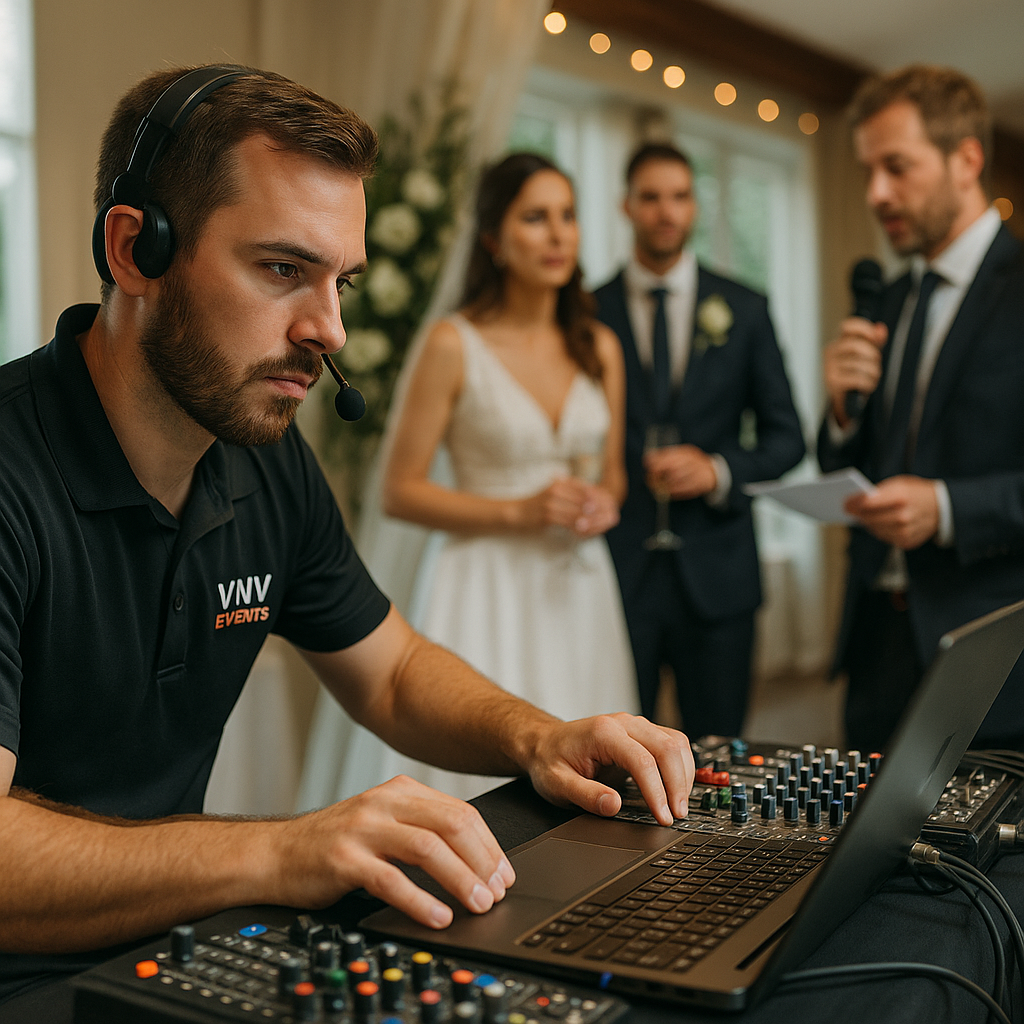
Guests will forgive a late shuttle, a warm signature cocktail, or a cake table that never quite got straightened. What they will not forget is standing in the fourth row of an oceanfront ceremony, watching two people say the most important sentences of their lives, and hearing none of it.
Wedding audio gets treated as a DJ line item. It isn't. The DJ handles the dance floor, and a good one handles it well. But the ceremony, the blessing, the welcome toast, the best man who has never held a microphone in his life, and the room's ability to actually hear all of it are a separate discipline with separate gear, separate placement logic, and separate failure points. This is what sound design covers, and it's usually the last thing on the planning spreadsheet.
Where wedding sound actually breaks
Most audio problems at weddings aren't caused by cheap equipment. They're caused by decisions made weeks earlier, or by nobody being assigned to make them at all. The recurring culprits:
- One system asked to do three jobs. A reception setup optimized for a dance floor is aimed, tuned, and positioned for a dance floor. Drag it outside for a ceremony and it will cover the front rows beautifully and abandon everyone behind them.
- Nobody riding the levels. A toast is live audio. Voices vary by 20 dB between a soft-spoken maid of honor and an uncle who leans in. Set-and-forget mixing means half the speeches are inaudible and the other half distort.
- Playback from a phone over Bluetooth. Convenient until a notification interrupts the processional or the connection drops between the aisle walk and the recessional. Wired feeds and dedicated playback devices exist for a reason.
- No plan for the handoff. Where does the microphone physically live between toasts? Who walks it to the next person? Ten seconds of fumbling kills the momentum of a moment you rehearsed for months.
- Ambient noise treated as background. Surf, wind through palms, a pool pump, hotel HVAC, landscaping crews, a nearby road. On a site visit at 10 a.m. these are barely noticeable. At 5:30 p.m. with a sea breeze up, they compete directly with a human voice.
Ceremony audio is a different problem than reception audio
A ballroom is a controlled room with power, predictable acoustics, and walls that keep sound where you put it. A lawn, a beach, a rooftop, or a garden is an open field where sound leaves and never comes back. Outdoors you lose the reflections that help a room feel full, so you need more coverage points at lower individual volume rather than one loud stack at the front.
Microphones: pick for the person, not the spec sheet
The officiant is the anchor. A lavalier clipped high on the lapel, close to the mouth, captures the officiant clearly and often picks up the couple as well because they're standing within a few feet. That's the baseline, not the whole plan. If the couple has written their own vows and speaks quietly to each other rather than out toward the guests, a lav on the officiant alone can leave the most important lines thin. A second discreet mic, or a mic on a low-profile stand positioned toward the couple, is worth discussing during the walkthrough.
Readings are their own consideration. A reader who steps to a stand needs a mic waiting for them at the right height, not a handheld passed across the aisle mid-ceremony. Musicians need their own inputs. A string trio playing acoustically may need light reinforcement outdoors; a soloist with a guitar definitely does, and their needs shouldn't share a channel with the officiant's.
Wind deserves specific attention in coastal and waterfront settings. Standard foam windscreens are designed for indoor plosives, not open-air breeze. Furry windscreens on lavaliers and proper protection on any stand-mounted mic are the difference between clean vows and a low roar underneath them.
Speaker placement: coverage, not volume
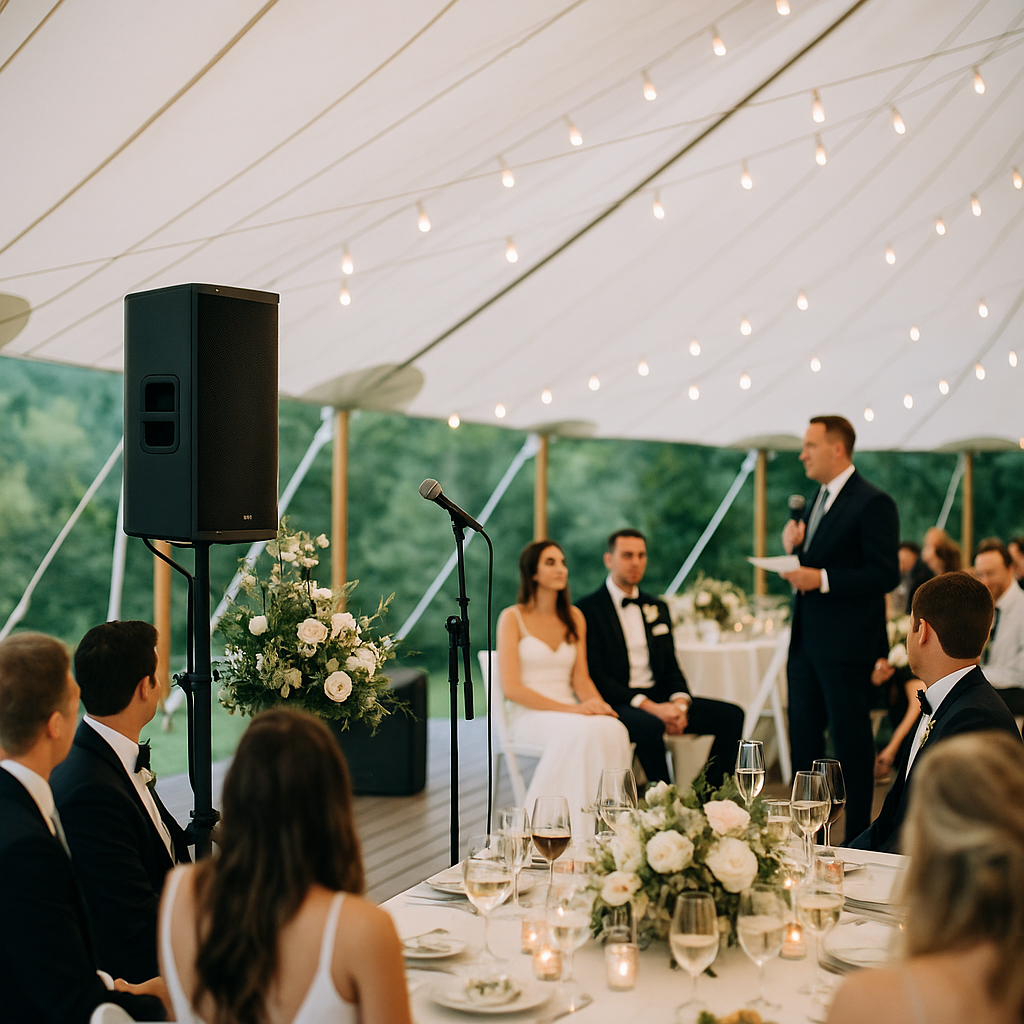
The instinct when guests in the back can't hear is to turn it up. That punishes the front rows and pushes the system toward feedback without meaningfully helping the back. Better approach: place speakers so that coverage is distributed. For a longer aisle or a wide seating arrangement, that often means multiple smaller speakers positioned along the sides of the guest area rather than two large ones at the altar.
Two placement rules do most of the work. Speakers stay ahead of the microphones, aimed away from them, so the system isn't feeding itself. And speakers get aimed across the seated guests at roughly ear height, not over their heads into the horizon. Elevating them slightly on stands and angling down covers far more people than the same speakers sitting on the grass.
Power and wireless: the two things that quietly fail
Waterfront lawns, private estates, and beach setups frequently have no usable power near the ceremony site. Extension runs across guest paths are a trip hazard and a liability. Battery-powered column speakers solve a lot of this cleanly, but they need to be charged, checked, and matched to the size of the guest count. This is a question to answer during the site visit, not on the morning of.
Wireless microphone systems share spectrum with everything else operating nearby: other production teams in an adjacent ballroom, venue paging systems, in-house AV. Frequency coordination before the event, and a scan on site, prevents the dropouts and static that show up in the footage forever. Fresh batteries per block, not per day.
Backup, defined properly
"We'll have a backup" means nothing unless it's specific. A real backup for a ceremony looks like a second wireless channel on a different frequency already assigned and tested, a wired handheld within reach of the officiant, and a technician who can switch sources in under ten seconds without leaving the position. If the plan is "we'd figure it out," there is no plan.
Speeches and toasts: the most under-planned audio of the night
Toasts are the highest-stakes live audio of the reception and typically get the least preparation. A few things consistently help:
- Use handhelds, not lavaliers. Toasts get passed between people. A handheld transfers in one motion, and it gives the speaker something to do with their hands.
- Run two microphones. One live, one ready. The handoff between the maid of honor and the best man becomes seamless instead of a pause with a hot mic scraping across a tablecloth.
- Coach the grip in thirty seconds. Most people hold a microphone at chest height, where it captures the tablecloth. Chin height, a few inches out, pointed at the mouth. A quick word before the first toast solves it for everyone who follows.
- Coordinate with the kitchen. Toasts during an active service window compete with plates, servers, and conversation. Aligning the toast block with a pause in service costs nothing and changes how the room listens.
- Cover the whole room, including the back corners. Guests seated furthest from the head table are often the ones who traveled the furthest to be there. Fill speakers or a distributed setup are worth the extra channels.
- Do a real sound check with the actual people. Not a "check one two" from the DJ. A thirty-second run with the people who will speak, at the time of day the room will be at, catches problems while they're still fixable.
Wedding microphone and sound system rental in South Florida
VNV Events handles wedding audio as production, not as an accessory to the playlist. Our DJ and karaoke services include ceremony microphone and speaker packages, wireless handhelds and lavaliers for toasts, battery-powered systems for sites without accessible power, and a technician assigned to the audio rather than splitting attention with the dance floor. We'll walk your venue, listen to the site at the hour your ceremony actually starts, and build the plan around what we hear.
Frequently asked questions
What type of microphone works best for a wedding ceremony?
A lavalier on the officiant is the usual starting point. It's visually discreet, it stays consistent as the officiant moves, and it typically picks up the couple standing nearby. Whether that's sufficient depends on how the couple speaks and how the ceremony is staged, which is why the microphone plan should be set after someone has seen the layout.
Can we rent sound equipment for an outdoor wedding without power on site?
Yes. Battery-powered speaker systems are built for exactly this, and they're common at beach, lawn, and garden ceremonies in the region. The relevant questions are guest count, the distance sound needs to travel, and how long the system runs before the reception takes over.
Won't the videographer's audio cover us?
Treat it as a second layer, not the primary one. Video teams capture excellent audio, but their gear is placed for the shot they're framing, and a camera at the back of the aisle is a long way from a whispered vow. A dedicated ceremony system gives the video team a clean source to work with, which is why our photography and videography and audio teams coordinate placement before the day rather than negotiating for the same square foot of aisle during the processional.
How early should the audio plan be finalized?
Early enough to include it in the venue walkthrough. Speaker positions, power access, cable paths, and microphone choices all depend on the physical space and the ceremony staging. Locking those in during the same visit where you're deciding on seating and décor saves a round of revisions later.
Are there noise restrictions we should ask about?
Ask the venue directly, and ask early. Municipalities, residential communities, and individual properties in South Florida vary in what they allow and until what hour, particularly for outdoor amplified sound. Your venue coordinator will know the specifics for that address, and the answer can affect both your timeline and your speaker plan.