
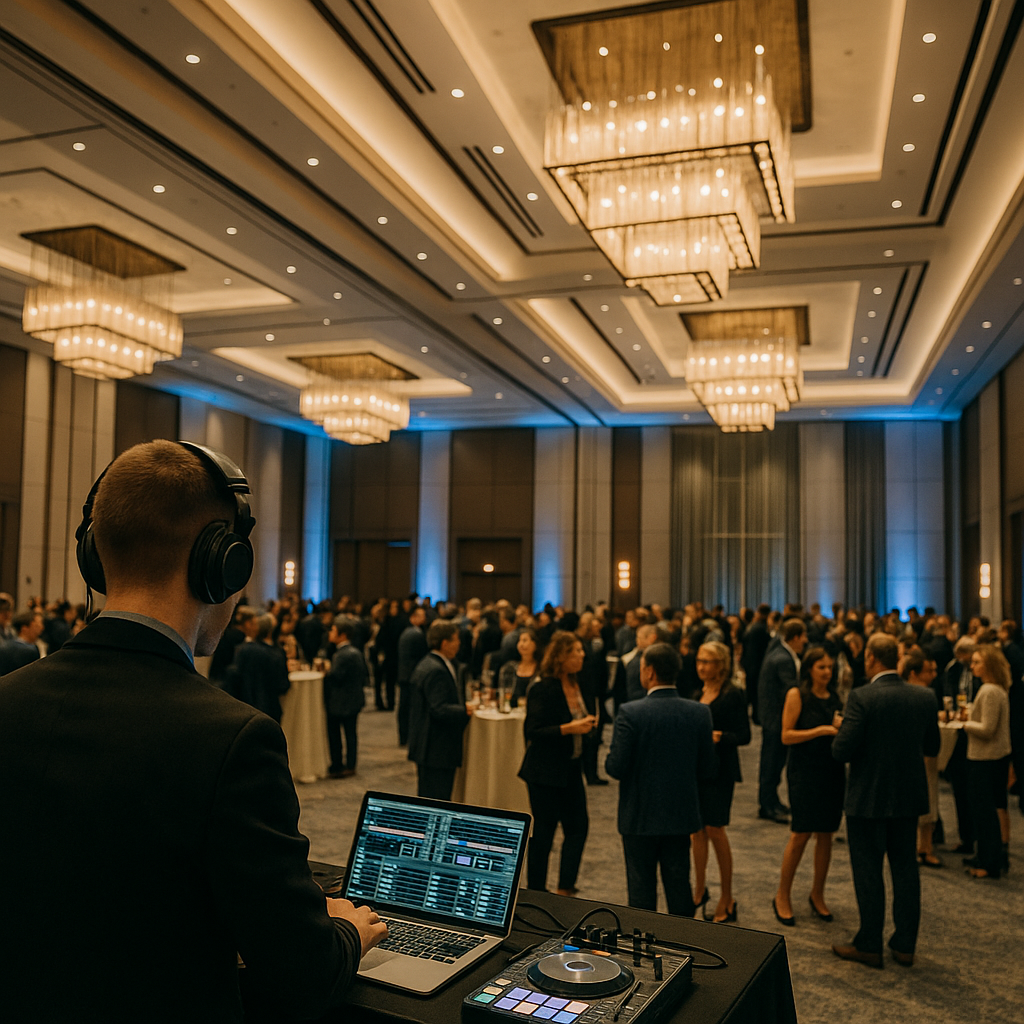
Who Actually Owes ASCAP for Your Company Party — It's Probably Not the DJ
Music Licensing for Corporate Events
The invoice almost never lands where people expect it to.
An office manager signs the ballroom contract in September. Somewhere in the venue paperwork is a line about the hotel's music licensing, and she files it away mentally as handled. The DJ gets booked. The party happens. Ninety people dance to ninety songs.
Four months later a letter arrives from a performing rights organization — addressed to the company. Not to the hotel. Not to the DJ. To the employer whose name was on the event, because that employer is the one who benefited from the music. Almost every part of the assumption that led there was reasonable. It was also wrong in the one place it mattered.
The short version, before the details
- The host organization is usually the responsible party. Not the entertainer, not the planner, not the AV vendor.
- A venue's blanket license frequently carves out rented function space. Hotel and convention-center licenses commonly exclude music performed during a client's own event.
- Your DJ cannot hand you a public performance license. No professional entertainer in the United States can — the right being licensed isn't theirs to pass along.
- "It's private, it's just employees" is not the shield it sounds like. Copyright law was drafted specifically to close that gap.
- There are four PROs, not one. Paying ASCAP does nothing about BMI, SESAC or GMR repertoire.
Why "private employee party" isn't a defense
The whole question turns on one statutory definition. Under 17 U.S.C. § 101, performing a work "publicly" means performing it at a place open to the public or at any place where a substantial number of people outside a normal circle of family and social acquaintances is gathered.
That second clause is the one that catches company parties. Congress said so on the record: the legislative history reproduced alongside 17 U.S.C. § 106 explains that a principal purpose of the definition was to make clear that performances in "semipublic" places — clubs, lodges, factories, camps, schools — are public performances subject to copyright control. A hundred coworkers in a rented ballroom are not a family gathering, however warmly the CEO opens the evening.
There is a genuine exemption for certain nonprofit performances in 17 U.S.C. § 110(4), but read its conditions before pinning hopes on it: the performance must involve no purpose of direct or indirect commercial advantage and no fee paid to any performer, promoter or organizer. The moment you pay a DJ, a band or a production company, that door closes. A holiday party thrown by a for-profit employer generally never gets near it in the first place.
Why your DJ can't license it for you — even a good one
This is the most common misconception in corporate event planning, and the PROs address it directly. ASCAP's position is that everyone who participates in or is responsible for a performance is legally responsible, and that because the business obtains the ultimate benefit, the business is the one that obtains the license. BMI is blunter still: writing about festivals and special events, it states that the obligation cannot be passed to anyone else even if the musicians hired are independent contractors — including when those contractors ignore instructions about what to play.
It helps to see what a DJ actually owns. A professional DJ buys or subscribes to music, maintains a library, and often pays for a commercial record pool. Every one of those is a copy right — permission to have the file. None of them is permission to perform the underlying composition to a room full of people. Those are different rights held by different owners.
There's a related wrinkle worth knowing, because it explains who comes calling. Sound recordings only carry a public performance right for digital audio transmissions under § 106(6). Playing a track through speakers in a ballroom isn't a digital transmission — so the record label isn't the party with a claim. The songwriter's composition is being performed, which is exactly why the letter comes from a PRO and not from a record company.
One more practical trap: consumer streaming accounts. Spotify states plainly that its service is for personal, non-commercial use and cannot be played publicly from a business. The same is true across consumer music apps. That's an account-terms problem sitting on top of the performance-license problem — two separate layers, and clearing one does nothing for the other. It's a reason to book professionals who run properly sourced libraries, which is how our DJ and karaoke team operates.
The venue question — and how to ask it properly
"Does the venue have a license?" is the wrong question. Most large venues do. The right question is whether that license covers your event.
It frequently doesn't. ASCAP's own guidance on campaign events explains the general rule cleanly: licenses held by convention centers, arenas and hotels typically exclude music used during conventions, expositions and other events, on the reasoning that the event organizer — not the venue — is the main beneficiary and the party in the best position to control what gets played. Swap "campaign rally" for "annual sales kickoff" and the logic is identical.
| Scenario | Who typically licenses | What to verify in writing |
|---|---|---|
| Background music in the hotel lobby and restaurant | The hotel | Nothing — outside your event |
| Your reception in the hotel's rented ballroom | Usually the host organization | Whether the venue license extends to licensee-hosted events in leased function space |
| Employees-only party at your own office | The employer, via an annual business license | Whether the event is open to non-employees or off-premises |
| Conference, expo or trade show with outside attendees | The organizer | Which PROs are covered and whether the license is per-event or annual |
| Ticketed or fundraising event | The organizer | Admission charge and proceeds handling |
Get the answer by email, name the date and the room, and keep it. A verbal "you're covered, don't worry about it" from a catering manager is not a defense in a copyright claim. Building that paper trail is a normal line item in event production and venue coordination, and it costs nothing but a message sent early.
Four PROs, four separate catalogs
ASCAP, BMI, SESAC and GMR each represent a distinct repertoire, and a songwriter belongs to one at a time. A license from one authorizes only that one's catalog — GMR makes the same point about its own blanket license, which covers the shares of songs it controls and nothing beyond them.
The practical consequence: a playlist assembled by an enthusiastic marketing team will almost certainly cross all four. ASCAP and BMI between them cover the large majority of commercially popular music, but SESAC and GMR hold catalogs containing extremely recognizable artists — the kind that show up on every "greatest hits of the decade" party playlist. Two licenses are better odds than one. They are not full coverage.
The one license type built for employee events
If your music use is ongoing rather than a single night — office background music, on-hold music, sales meetings, the annual party — an annual business license is usually the more sensible instrument. ASCAP sells this as its Music in Business license; BMI's counterpart is its business multiple-use agreement.
Read the exclusions before assuming it solves everything. ASCAP's Music in Business blanket agreement does not authorize performances as part of a conference, convention, exposition, meeting, seminar or trade show unless that activity is presented solely by the licensee, held entirely at the licensee's own business locations, and closed to the general public. Invite clients, vendors, press or the public, or move it to a rented ballroom, and you're likely looking at a different license class.
Karaoke stacks a second layer on top
Karaoke is where two separate legal questions get confused into one, and it's worth separating them if karaoke is on your run sheet for a corporate event.
Layer one is the same public performance question as any other music: the composition is being performed, so the same licensing analysis applies. Layer two is the karaoke tracks themselves. Those are separately produced accompaniment recordings sold under their own terms, and the industry has litigated the point aggressively — the producer of the "Sound Choice" catalog filed hundreds of suits against karaoke operators and the venues that hosted them over tracks copied from discs onto hard drives. The trademark theory largely failed on appeal; the Ninth Circuit agreed with the Seventh Circuit that there was no cognizable consumer confusion. But the exposure was real for years, and the copyright question underneath it never went away.
The operational takeaway is simple: ask your karaoke provider where the library came from and whether it's traceable to legitimately purchased originals. A vendor who can answer that in one sentence has thought about it. A vendor who's confused by the question has not.
What being wrong actually costs
Statutory damages under 17 U.S.C. § 504(c) run from $750 to $30,000 per work infringed, rising to as much as $150,000 per work where infringement is proven willful, and dropping to as little as $200 for genuinely innocent infringement. Courts may also award costs and attorney's fees under § 505.
Note the unit: per work, not per event. That's the detail that turns an unglamorous compliance item into a real number. And "willful" is doing heavy lifting — an organization that received a licensing notice, ignored it, and threw the party anyway is in a different posture than one that simply never knew.
A 15-minute compliance pass for your next event
- Email the venue. Name the date and the room. Ask specifically whether their PRO licenses extend to music performed during client-hosted events in leased function space, and which PROs are covered.
- Check what you already hold. Many companies have an annual business license nobody in the events chain knows about. Ask finance or legal.
- Classify the guest list. Employees only, on your premises, is a different license class than an event with clients, partners or the public.
- Flag admission and fundraising. Ticket sales or charitable proceeds change the analysis and deserve a specific look.
- Ask entertainment about sourcing, not licensing. The right question for a DJ or KJ is where their library comes from — the performance license was never theirs to supply.
- Close the gap. Single-event licenses exist for exactly this. They are ordinary purchases, not admissions of guilt, and they're cheapest bought before the event rather than after a letter arrives.
This article is general information about how music licensing works in the United States, not legal advice. Licensing categories, rates and exclusions vary by PRO, venue type and event structure — confirm the specifics with the relevant PRO or with counsel before your event.
Frequently asked questions
Our holiday party is employees only. Do we still need a license?
Very likely yes. A gathering of coworkers is not a normal circle of family and social acquaintances under § 101, and the nonprofit exemption in § 110(4) requires that no performer, promoter or organizer be paid — which a hired DJ defeats immediately. An annual business license is often the right instrument, provided the event stays on your own premises and closed to outsiders.
The hotel says it has an ASCAP license. Are we covered?
Ask a narrower question. Venue licenses commonly cover the venue's own music — lobby, restaurant, bar — while excluding music performed during a client's event in rented function space. Get the answer in writing, naming your date and room.
Can we just make our DJ sign something saying they're responsible?
You can put whatever you like in a vendor contract, and it may allocate risk between you and that vendor. It does not change who the PRO can pursue. BMI states directly that the obligation cannot be passed to anyone else, independent contractor status included.
We're paying for ASCAP. Isn't that enough?
Only for ASCAP repertoire. Each PRO licenses a separate catalog, and any modern party playlist will cross several of them. ASCAP plus BMI covers a large majority of popular music; SESAC and GMR represent the remainder, including household-name artists.
What if we only play instrumental or royalty-free music?
Then the analysis changes substantially. Production libraries and royalty-free catalogs are licensed at the source, and music written and owned by the performing artist needs no PRO clearance. It's a legitimate route for background-music portions of an event — it just tends not to survive contact with a dance floor.
How far ahead should we sort this out?
The moment the venue contract is signed. That's when you know the date, the room and the guest profile, and it's early enough that a single-event license is a routine purchase rather than a scramble.
The decision this actually comes down to
Nobody gets in trouble for playing music at a company party. They get in trouble for assuming someone else handled it — and "someone else" is almost always the party with the least legal exposure and the least ability to fix it.
Send one email to your venue this week. Ask whether their license covers music performed during your event, in your room, on your date. If the answer is no, buy the license. If the answer is yes, save the email. The entire exposure closes in the time it takes to write two sentences.
Plan the music, and the paperwork, in the same conversation
We coordinate entertainment and venue logistics together, which means licensing questions get raised while there's still time to answer them cheaply — not after the event. Talk to us about DJ and Karaoke Services or full Event Production for your next corporate event.
Visuals