
The Wireless Microphone Rules Most Event Hosts Don't Know Exist
Spectrum, Compliance and Live Audio
A microphone that powers on, shows five bars and passes soundcheck can still be illegal to operate — and the ceremony is where you find out.
The decision that creates that moment happens weeks earlier, usually in a planning email, when someone writes "don't worry about mics, we already have four." Nobody asks what frequency they transmit on. Nobody asks what else in the building is transmitting. Then the officiant's lavalier turns to static halfway through the vows, and 140 guests watch a groom mouth words nobody can hear.
Wireless microphones in the United States don't operate on private property. They operate on borrowed slices of public spectrum, under rules that changed in 2010, again in 2017, again in 2020, and again in late 2024. Here is what those rules actually require, and which ones decide whether your ceremony audio survives.
Rule 1: Some microphones became illegal on a specific date, and they still work
After the 2017 broadcast incentive auction, the FCC repurposed most of the 600 MHz band for mobile broadband. The frequencies from 617–652 MHz and 663–698 MHz are no longer available for wireless microphone operation, and the transition deadline for users to get off them was July 13, 2020. Manufacturing, importing or selling gear built for that band was prohibited even earlier.
An older 700 MHz ban is still in force: the FCC prohibited wireless microphones, in-ear monitors, intercoms and cueing equipment in the 698–806 MHz band back in 2010, because that spectrum went to broadband and public safety.
This is the trap. A banned transmitter doesn't refuse to power up. It transmits happily into a band now occupied by carrier traffic, where a nearby cell site can flatten your receiver's front end without warning — and where the FCC states that unlawful operation in the 600 MHz band may result in fines or additional criminal penalties. Inherited gear, marketplace bargains, and the two handhelds that live in a venue's storage closet are exactly where this lives.
What to do: read the tuning range printed on the receiver, or check the model against the manufacturer's own frequency table. If any part of the range falls in 617–652 MHz, 663–698 MHz or above 698 MHz, that unit is retired — not "used carefully."
Where wireless microphones may legally operate now
| Band | Who may use it | Practical notes |
|---|---|---|
| TV channels 2–36 (54–72, 76–88, 174–216, 470–608 MHz) | Unlicensed (Part 15) and licensed (Part 74) | Where nearly all event gear lives. Unlicensed is capped at 50 mW EIRP; licensed users get up to 250 mW conducted power in 470–608 MHz. |
| 614–616 MHz (600 MHz guard band) | Unlicensed only | 20 mW EIRP. Two megahertz — a handful of channels, not a plan. |
| 617–652 MHz and 663–698 MHz | Nobody | Prohibited since July 13, 2020. |
| 653–657 MHz (duplex gap) | Licensed only | 20 mW EIRP. |
| 657–663 MHz (duplex gap) | Unlicensed only | 20 mW EIRP. |
| 698–806 MHz | Nobody | Banned since 2010. |
| 902–928 MHz, 1920–1930 MHz, parts of 2.4 GHz and 5 GHz | Unlicensed | No TV-channel headaches, but shared with Wi‑Fi, cordless phones and everything else in a crowded ballroom. |
| 941.5–959.85 MHz segments, 1435–1525 MHz, 6875–6900 and 7100–7125 MHz | Licensed (Part 74) only | Restricted eligibility; short range at 7 GHz. |
Band assignments and power limits above are drawn from 47 CFR § 15.236 for unlicensed operation and 47 CFR Part 74, Subpart H for licensed low power auxiliary stations. Two details surprise people: the top of the usable UHF television range is now channel 36, not 51, and channel 37 (608–614 MHz) is not on the list at all — it is reserved for radio astronomy and medical telemetry.
Rule 2: An empty-looking channel is not automatically a legal channel
Scanning a room and picking whatever looks quiet feels like due diligence. It isn't sufficient. Both the unlicensed and licensed rules require operation at least four kilometers outside the protected contour of a co-channel TV station — 41 dBu for UHF channels 14–36, with separate contours for VHF (§ 15.236(e)).
That's a geographic restriction, not a signal-strength one. A television channel can read as clean on your scanner inside a concrete ballroom while you are standing well inside its protected contour. In a dense broadcast market like South Florida, this is the difference between "we found eight open channels" and "we found eight channels we're allowed to use," and it's a question that belongs in technical production planning rather than in the last twenty minutes before doors.
Rule 3: If your microphones are unlicensed, nothing owes them protection
This is the rule with the sharpest teeth, and almost nobody outside the AV trade knows it. Unlicensed wireless microphones — which is most event gear — share the television bands on an equal basis with unlicensed white space devices and with each other. No priority. No recourse. If a neighboring ballroom's system lands on your ceremony frequency, the remedy is that both of you move.
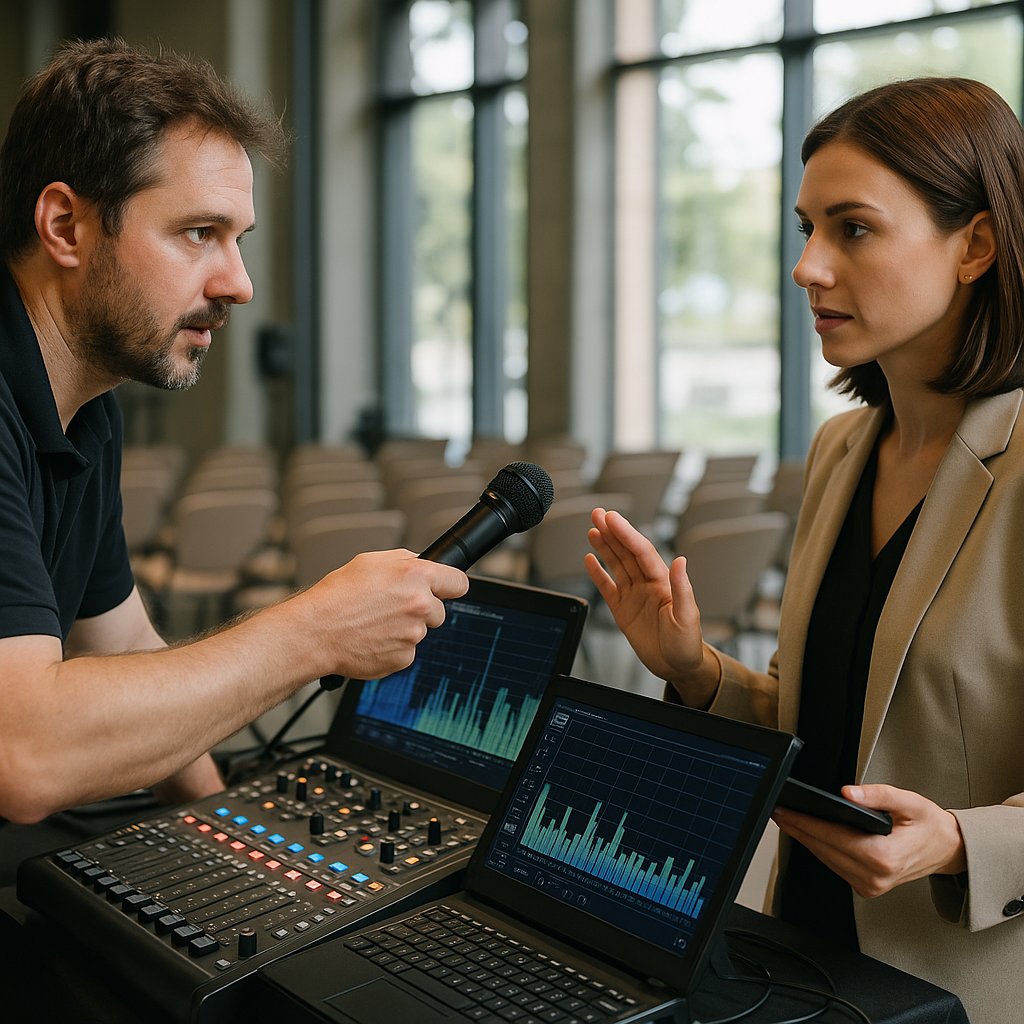
The practical consequence is that coordination is a negotiation with other humans in the building, not a setting on a receiver. Before doors, that means asking the venue and every other vendor: house AV, translation receivers, the photo booth's wireless, the video crew's camera hops, the band's in-ear monitors. Assistive listening systems are a separate category under the FCC's rules and are excluded from the wireless-microphone section entirely — which means they can be on frequencies your scan won't flag as "someone else's mic."
Rule 4: The 50-microphone line decides whether you can reserve spectrum
There is a licensing tier above the unlicensed default. In 2014 the FCC expanded Part 74 license eligibility to professional sound companies and owners and operators of large venues that routinely use 50 or more wireless microphones, where those microphones are integral to the productions they host. Previously the door was open mostly to broadcasters and film and television producers.
A Part 74 license buys two things that matter operationally: higher permitted power in the UHF band, and the right to register operating locations, channels and times in a white space database so that unlicensed white space devices must stay off those channels. The FCC maintains the list of approved white space database administrators.
Most weddings and corporate breakouts never approach 50 channels, so the honest answer for a typical event is: you are operating unlicensed, and your protection comes from coordination discipline rather than from paperwork.
Rule 5: Very large unlicensed events can register — but the calendar is the constraint
For qualifying major events and productions, unlicensed wireless microphone operations can be registered for database protection, and registration requests are filed with the FCC well in advance — the standard window is at least 30 days before the event, per the Commission's unlicensed wireless microphone registration process. That is a production timeline decision, not a load-in decision. If a 40-channel general session is booked six weeks out, the spectrum conversation belongs in that same week — which is why multi-presenter corporate programs should treat RF planning as a deliverable with a due date, alongside stage plots and run of show.
Rule 6: The rules changed again in November 2024
Most compliance checklists circulating online stop at 2020. They're out of date. In a Report and Order effective November 18, 2024, the FCC authorized Wireless Multichannel Audio Systems (WMAS) — wideband digital systems that pack many audio channels into a single 6 MHz television channel instead of stacking narrowband transmitters across several. WMAS is permitted both licensed and unlicensed, must be capable of at least three audio channels per megahertz, and unlicensed WMAS wider than 1 MHz may run up to 100 mW EIRP in the TV bands.
The same order removed the database-access requirement for unlicensed microphones operating in the 600 MHz guard band and duplex gap. For event work the takeaway is directional: as more channels are demanded in less available spectrum, spectral efficiency is becoming the design constraint, and equipment purchased today will be judged on how many reliable channels it delivers per television channel.
The dropout diagnosis: what actually goes wrong on the night
Illegal frequencies are one failure mode. These are the others, roughly in order of how often they ruin a ceremony:
- Intermodulation. Multiple transmitters mix and generate phantom signals on frequencies you never assigned. This is why "we just spread them out evenly" fails at six channels and above — spacing has to be calculated, not eyeballed.
- Antenna placement. Receiver antennas buried behind a rack, laid on the floor, or pressed against an LED video wall will drop signal that a coordinated frequency plan would otherwise have carried cleanly. Get them up, in the open, and in line of sight of the stage or altar.
- Bodies. A lavalier transmitter on the small of a back, with the officiant turned away from the receiver, is transmitting through a bag of saltwater. Human bodies absorb RF, and a ceremony is 20 minutes of people turning their backs to the room.
- Distance from the receiver, not from the console. An outdoor ceremony 60 metres from the reception rack is a range problem, even though the console is right there.
- Batteries. Fresh cells per event, or metered rechargeables with logged runtime. "It was fine last Saturday" is not a battery plan.
- Late arrivals. The scan you ran at 2 p.m. in an empty room is not the RF environment at 7 p.m. with the video crew, the photo booth, the translation kit and 200 phones in it.
The five operational decisions worth making before the room fills
- Decide whose microphones are being used, in writing, at contract stage. Client-supplied or venue-supplied gear needs its frequency range verified before the day, not discovered at load-in.
- Scan the room dressed and powered. LED walls up, uplighting on, Wi‑Fi access points live, other vendors' transmitters on. Then coordinate — and rescan if the room changes.
- Publish a frequency plan to every vendor in the building. One sheet, one owner, no improvising after doors.
- Carry a coordinated spare, not just a spare. A backup handheld on an uncoordinated frequency is a second problem. And for ceremonies, a wired mic on the podium is the cheapest insurance in live audio.
- Match the mic to the moment. Ceremony lavaliers, handhelds passed between toast-givers, and DJ and karaoke microphones handled by guests all stress the system differently — karaoke in particular means untrained hands, high gain and a long night on the same channels.
FAQs
How do I tell whether a microphone I already own is banned?
Find the tuning range on the receiver or in the manual. If any part of it falls between 617–652 MHz, 663–698 MHz, or above 698 MHz, it can't be operated. The FCC advises contacting the manufacturer when the range isn't clear, since that is the most effective way to determine whether a specific model was affected by the auction.
Do I need an FCC license for a wedding with four microphones?
Almost certainly not. Most event microphones operate unlicensed under Part 15. Part 74 licensing is aimed at broadcasters, film and television producers, and sound companies or venues routinely running 50 or more units. The absence of a license doesn't remove any of the frequency, power or location restrictions.
Are 2.4 GHz or 900 MHz microphones a safe way to avoid all of this?
They avoid the television-band rules, not interference. 2.4 GHz shares space with Wi‑Fi, and a ballroom full of phones and a venue's access points is a hostile neighbourhood. They can be a good fit for short-range, low-channel-count uses; they are rarely the answer for a large multi-channel program.
What does frequency coordination actually mean?
Selecting a set of frequencies that are legal at that location, unoccupied at that time, and mathematically spaced so the transmitters don't generate interference against each other — then documenting it and sharing it with everyone else transmitting in the building.
Something is dropping out mid-event. What happens now?
A technician on site swaps to a pre-planned alternate frequency, checks antenna position and battery status, and identifies whether a new transmitter came online nearby. The reason this is a staffing decision and not a troubleshooting tip: it takes seconds when someone with a scanner is standing at the rack, and it takes the rest of the ceremony when nobody is.
Can I just reserve a channel for my event?
Licensed users can register operating locations and times in a white space database. Unlicensed operations can be registered only for qualifying major events, with filings made well in advance. Neither reserves spectrum against another wireless microphone — only against unlicensed white space devices.
This article is general information about federal spectrum regulation, not legal or regulatory advice. Rules change, and enforcement outcomes depend on specific facts. For binding guidance, consult the FCC directly or qualified counsel, and verify current rule text at eCFR.
The question that prevents all of it
You do not need to memorise band edges or contour values. You need to ask one question, early enough that the answer can change something: "What frequencies are these microphones on, and who else in this building is transmitting?"
If the person holding the microphones can't answer, that isn't a technical detail left open. It's an unmanaged risk sitting directly on top of the two minutes of your event that nobody gets to redo.
Ask the frequency question early
Bring RF planning into your timeline before load-in, not during it. See our DJ and Karaoke Services for microphone-heavy programs, or Event Production for coordinated multi-channel setups.