
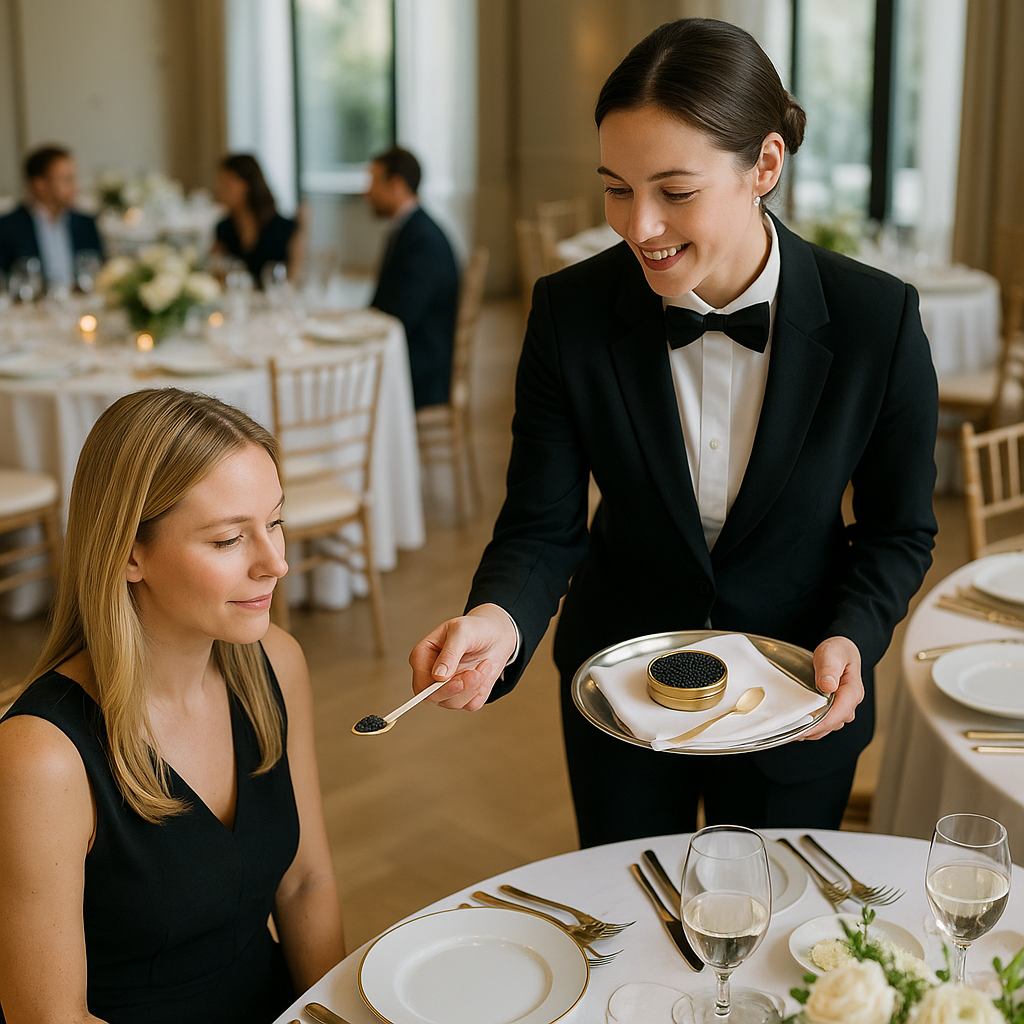
Your Guests Have Never Had Caviar. That's the Reason to Serve It.
VNV Events
Your Guests Have Never Had Caviar. That's the Reason to Serve It.
Hosts hesitate on this for a reason that sounds sensible: most of the room has never tried caviar, so why spend on something they won't appreciate? Run that logic on anything else and it collapses immediately. Nobody remembers the sixth time they had something. They remember the first. A room full of people who've never tried it is not a risk — it's the entire opportunity, and it's the one thing a familiar menu can never give you. What you do have to get right is the approach, because a first taste handled badly is worse than not offering it at all.
The barrier isn't the flavor. It's not knowing what to do.
Caviar Market's analysis of why caviar bars took off at weddings identifies the real dynamic: guests approach with curiosity, many have never tasted true sturgeon caviar, and others tried it once in a setting that felt stiff. Their conclusion is the whole strategy — offer it openly, with guidance and strong presentation, and you lower the barrier while raising the excitement.
Cooking With Janica frames the mental block plainly in her guide to serving it: caviar can feel intimidating and formal, but it is fundamentally just a delicious ingredient that adds salinity and umami, and it isn't reserved for black-tie occasions or the very wealthy.
So the job isn't convincing anyone that caviar is impressive. They already believe that. The job is removing the fear of doing it wrong in front of other people.
Choose varieties for beginners, not for the menu card
This is where hosts most often go wrong, chasing the most prestigious name instead of the most approachable flavor.
Caviar Market recommends balanced varieties such as Ossetra and Kaluga for exactly this audience, noting their clean, buttery notes read as approachable rather than aggressive. A stronger, brinier roe is a wonderful thing for someone with a reference point, and a confusing thing for someone without one.
If you're offering more than one, sequence matters. The International House of Caviar notes the customary approach when presenting a variety is to serve them in order of taste intensity, mildest first. That ordering does real work with first-timers — it gives them a baseline before it gives them a contrast.
Build the beginner's bite
Caviar Market makes a point about blinis that most guides skip: they're the most recognizable and beginner-friendly base precisely because the warmth and softness absorb some of the salinity, which softens the flavor for newcomers.
The assembly sequence, per the pairing guidance from Eat Healthy 365: blini, a small smear of crème fraîche, a generous but not heaping spoonful of caviar, and a light sprinkle of a single garnish if desired.
Two calibration notes that matter more with first-timers than with anyone else:
- Keep the portion honest but small. OM Caviar's guidance is half a teaspoon to a teaspoon per bite, with the roe sitting on top as the star rather than buried under crème fraîche in three layers — a thin layer reads as elegant, a heap as wasteful. Caviar Market puts a proper bite at roughly 5 to 10 grams, small enough that guests comfortably come back for a second.
- Go light on aggressive garnishes. Meredith Marks Caviar recommends keeping the spread minimal and skipping intense additions like lemon or raw onion with delicate roe, since they overpower it. For someone forming a first impression, a sharp garnish is the difference between "that was lovely" and "I don't think I like caviar."

The gateway bites
The fastest way to disarm someone who's nervous about caviar is to serve it on something they're not nervous about.
Eat Healthy 365 calls the potato chip its favorite pairing to introduce to newcomers — a humble, salty, crispy chip with a dollop of crème fraîche and a spoonful of caviar produces a contrast of texture and flavor that lands immediately. Meredith Marks Caviar suggests the same trick.
Caviar Market explains why the physics work: the beads are cool and delicate, and they pop against crisp blinis or warm mini potatoes, and that temperature-and-texture contrast is what wakes up the palate. Warm base, cool roe. It reads as a technique rather than a shortcut, and it converts skeptics faster than any classical presentation.
Format matters as much as product
A plated course puts a first-timer on the spot. A station lets them opt in.
Caviar Market makes the practical case: caviar is served in small portions, which means a guest can sample it without committing to a full plate — you get impact without overloading the catering plan. And the format changes the room's behavior. Instead of everyone crowding the bar, guests circulate, engage, and slow down.
Two operational decisions follow from that:
- Self-serve raises participation and consumption. Caviar Market notes that when guests control their own portions they tend to be generous, and that a station near the entrance gets nearly everyone to stop while one tucked into a corner sees light use. Plan the quantity around the format you choose, not the other way round. We cover the placement logic in our guide to station placement.
- Pre-loaded spoons control portions and protect the product. The same source suggests pre-plating small mother-of-pearl spoons instead of a communal tin when you want consistency — it also protects the texture of the beads. With a nervous crowd, a pre-loaded spoon removes the last bit of hesitation, because there's no decision left to make.
Guidance, not a lecture
Guests need one sentence, not a seminar. Eat Healthy 365's advice is to gently encourage guests to build their own bites and give them the sequence — that's the whole intervention.
What works at a station: a small card with the order of assembly, staff who can answer "what do I do?" in one line without making the asker feel foolish, and someone going first. The same social mechanic that drives every guest station applies here — once a few people have gone, the hesitation disappears.
What doesn't work: an attendant explaining sturgeon species to someone holding a blini. Save it for the guest who asks.
The rules that protect the first impression
These aren't etiquette. Each one exists because breaking it changes how the caviar tastes — which matters most for the person who has no baseline to forgive it against.
- Never a metal spoon. Meredith Marks Caviar explains that metal reacts with the salt and oils and leaves a bitter, metallic finish; mother-of-pearl, glass, bone, or horn keep the flavor clean. Give each guest their own spoon.
- Keep it cold, on ice, in the tin. OM Caviar specifies serving between 28 and 32°F with the tin nested in crushed ice, because warm caviar loses its texture.
- Open at the moment of service. Eat Healthy 365 is explicit: never open the tin until you're ready to serve.
- Separate the garnishes. Each accompaniment in its own vessel with its own spoon, so nothing mixes before it reaches the plate.
[TITULO DEL CASO REAL]
[Contexto del evento y perfil de los invitados.] [Qué montamos.] [Reacción o dato de repetición.]
Why this ends up being the thing people talk about
Caviar Market's observation about why the format endures is worth ending on: it feels personal, because it signals the host chose something deliberate rather than defaulting to standard catering.
Add the first-time factor and the effect compounds. A guest who tries pasta at your event had pasta. A guest who tries caviar for the first time at your event will tell that story with your name attached to it. That's not a menu decision. It's the only line item on the whole event that buys a memory nobody in the room already has.
Frequently Asked Questions
What caviar should I serve to guests who have never tried it?
Balanced varieties like Ossetra or Kaluga, which have clean, buttery notes that read as approachable rather than aggressively briny. If you're offering more than one, serve them in order of intensity from mildest to strongest so guests build a reference point before they hit a contrast.
Should I serve Beluga caviar?
It's far more restricted than most menus suggest. Legal supply in the United States is extremely limited, so treat any Beluga offer as something to verify carefully rather than assume. For a first-time audience it also isn't the point — the approachable varieties serve them better than the most famous name.
How much caviar per guest for a first-time crowd?
A proper bite is roughly 5 to 10 grams, which is small enough that guests comfortably return for a second. Overall quantity depends heavily on format: self-serve stations drive higher consumption because guests control their own portions, and a station near the entrance sees far more traffic than one in a corner.
What's the easiest way to introduce someone to caviar?
On a warm blini or a salty potato chip with crème fraîche. The blini's warmth absorbs some of the salinity and softens the flavor for a newcomer, and the temperature and texture contrast between a warm base and cool roe is what makes the bite land. Keep garnishes minimal — sharp additions like raw onion or lemon overpower delicate roe.
Do guests need to be told how to eat it?
One sentence, not a lesson. Give them the assembly order on a small card or from staff, and have someone go first. The hesitation is about doing it wrong in front of other people, not about the food itself, so the fix is social rather than educational.
Why can't you use a metal spoon with caviar?
Metal reacts with the salt and natural oils in the roe and leaves a bitter, metallic finish. Mother-of-pearl, glass, bone, or horn keep the flavor clean. It matters most with first-time guests, who have no baseline to recognize that the off taste came from the spoon rather than the caviar.
Sources
- Caviar Market — Why Caviar Bars Became a Leading Wedding Trend
- Caviar Market — How to Plan a Caviar Bar
- Caviar Market — Portioning and Station Placement
- Cooking With Janica — How to Serve Caviar
- Eat Healthy 365 — Guide to Caviar Pairings and Accompaniments
- OM Caviar — Caviar Pairing for First-Timers
- Meredith Marks Caviar — Serving Ware and Service Rules
- International House of Caviar — How to Serve and Store Caviar
Most of your guests will be trying this for the first time
Tell us your guest count and how adventurous the room is. We'll pick the variety, build the bite, and staff it so nobody has to ask what to do. Around 200 events a year across Broward, Miami-Dade, and Palm Beach.
Request a Quote