Content Creator or Videographer: The Split the Wedding Industry Is Still Fighting About
VNV Events
Your ceremony ends at 6:12 p.m. By 6:40, three guests have posted vertical clips of your first kiss — shaky, backlit, with the officiant's shoulder blocking the frame. That version of your wedding is now the one your extended family will see first, and the only one that exists for the next four months while your cinematic film is in post. Nothing went wrong. You just didn't decide, in advance, who owned the first twenty-four hours.
That gap is the whole argument. A wedding videographer and a wedding content creator are not competing for the same job — they are competing for the same line in your budget, which is a different problem entirely. Here's how to decide which one you actually need, and what it costs you operationally to get it wrong.
The split, in plain terms: archive vs. distribution
Strip away the marketing language and the two roles are separated by one question: is this footage meant to last, or meant to travel?
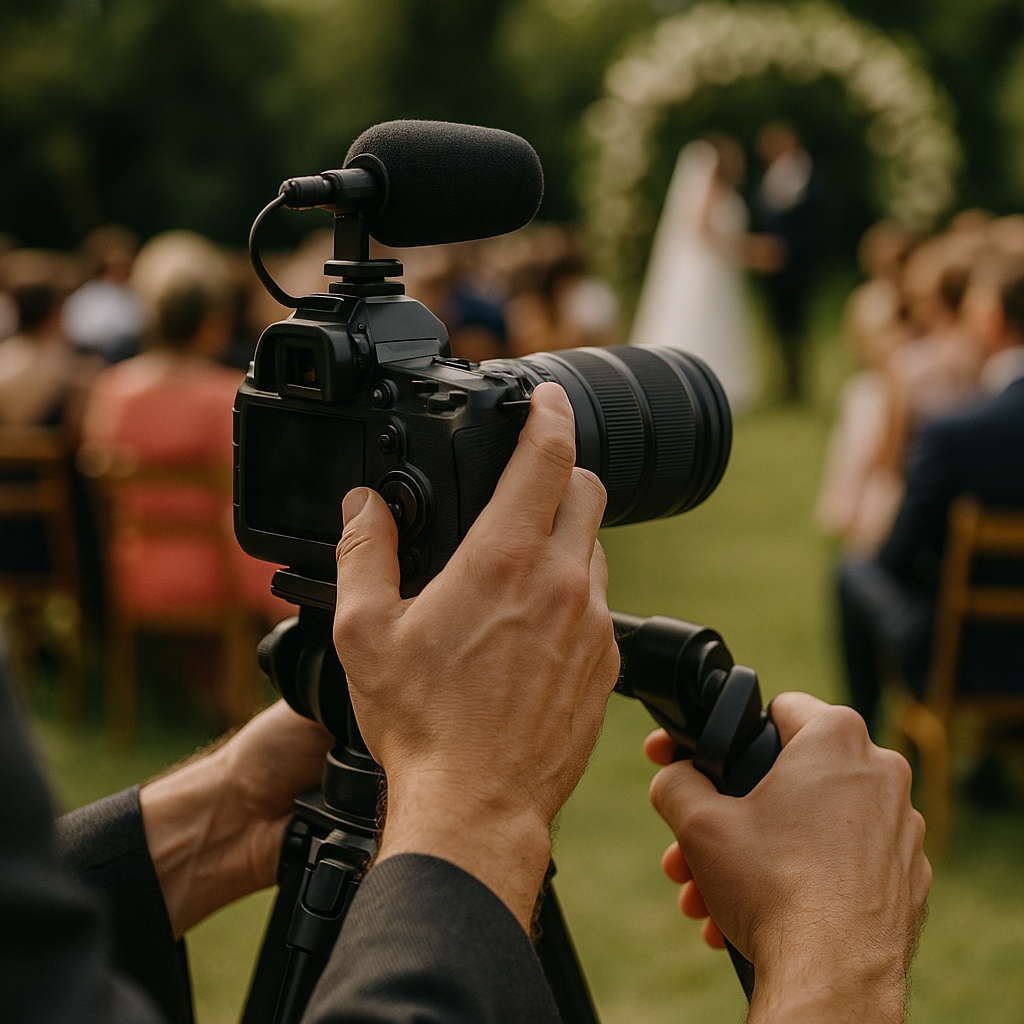
A videographer builds an archive. Cinema-grade sensors, dual-system audio, backup bodies, color grading, licensed music, a film you'll still be able to open in twenty years. A content creator builds distribution. Phone-native vertical capture, trending audio, fast cuts, published while the reception is still running.
The second difference matters more than most couples realize, and almost nobody asks about it before signing: the two roles hand you different legal objects. Under U.S. law, the person who creates a work is generally its author and first copyright owner — the narrow exception being a work made for hire, which requires either an employment relationship or an express written agreement fitting a statutory category (U.S. Copyright Office, Circular 30). Paying a professional does not automatically transfer copyright. What you're usually buying is a license — and the scope of that license is the real difference between "we can post this anywhere forever" and "we can post this on Instagram, once, with a credit tag."
Side by side: what each role is actually built to do
| Dimension | Wedding videographer | Wedding content creator |
|---|---|---|
| Primary output | Highlight film, feature edit, full ceremony and speech documents | Vertical Reels, Stories, TikToks, raw phone clips |
| Typical turnaround | Weeks to months, driven by ingest, sync, edit, grade, revision rounds | Same day to 72 hours; some deliver during the reception |
| Audio approach | Lavs on officiant and partners, board feed from the DJ, backup recorder | On-device mic; speech audio is usually unusable as a keepsake |
| Coverage philosophy | Anticipates the moment, holds position, protects the frame | Moves constantly, captures reaction and texture, follows energy |
| Music | Licensed sync tracks cleared for the film's intended use | Platform catalog audio — with real limits (see below) |
| What breaks if you skip it | No durable record of your vows in your own voices | No control of the narrative in the first 48 hours |
Neither column is a luxury version of the other. A content creator cannot retroactively produce a film. A videographer working a standard post schedule cannot retroactively own your wedding-night feed. If both outcomes matter to you, you're staffing two roles — and it's worth confirming exactly which of them your photography and videography coverage is contracted to deliver before you assume it covers both.
Four questions that actually decide it
- Whose voices do you need to hear in ten years? If the answer includes vows, a father's toast, or a grandparent who may not be here later, you need a videographer with dedicated audio. This is not a stylistic preference; it's the single capability phones cannot fake in a loud room.
- Is anyone waiting on the footage? A partner deployed overseas, a parent who couldn't travel, a business that needs the day documented — real deadlines argue for a creator or a contracted same-day edit, not a hope that post moves fast.
- Do you have a public-facing account? If either of you runs a business, a brand, or a monetized profile, your wedding content is commercial content, and the music rules change (again, see below).
- Who is going to be holding a phone anyway? If the honest answer is "my sister, all night," you're already paying for content creation — in your sister's attendance at her own family's wedding. Hiring the role gives it back to her.
Same-day wedding reels: what makes them possible, and what makes them fail
Same-day delivery is a production decision, not a talent decision. Three things have to be true before anyone can promise it:
- A defined cut-off. A reel published at 10 p.m. contains nothing that happened after roughly 8:30. Decide whether your grand exit or your cake needs to be in it — then either move the moment earlier or accept a next-morning delivery.
- Somewhere to edit. Editing on a phone in a parking lot is how you get a reel that looks like a parking lot. A power outlet and a quiet corner is a room-block detail, which means it belongs in the timeline your planning and vendor coordination team is already building, not in a text message at 7 p.m.
- Usable audio. The single biggest quality jump in a same-day edit comes from a clean board feed rather than room sound. That's a conversation with whoever is running audio and entertainment — and it's a five-minute conversation if it happens at the walkthrough, and an impossible one if it happens during cocktail hour.
The failure mode is almost never the editor. It's a timeline that never allocated the twenty-five minutes the edit requires, on a day where every other minute was assigned months in advance.
Wedding videography turnaround: why the film takes months
A multi-camera wedding generates hours of footage across several cards, plus separate audio from lav packs and recorders. Before a single creative decision is made, an editor has to offload and verify every card, sync audio to picture across the whole day, and build a rough assembly. Only then does the actual edit begin — followed by color, sound mix, music clearance, and your revision rounds. Weeks is normal. Months is common in peak season, when the same editor is holding four weddings.
You can shorten that timeline, but only by paying for parallel capacity or by cutting scope — a teaser contracted separately from the feature, for example. What you cannot do is compress it by asking nicely in September.
The corollary matters more than the wait: delivery is not preservation. A download link is not an archive. The Library of Congress's guidance for personal video is to keep at least two copies in physically separate locations, check them annually, and migrate to new media roughly every five years; the National Archives recommends three copies across different media types and locations, and warns against relying on the cloud alone. Ask your videographer how long they retain masters and in what format. Many delete originals after a set window — which makes the day you receive the files the day the responsibility becomes yours.
The fine print nobody reads until it matters
Music on your posts is not free just because the app offered it. Meta's own music terms state that users remain solely responsible for the music in content they post, and that use of music for commercial or non-personal purposes is prohibited without appropriate licenses (Meta Music Guidelines). A track being selectable in the in-app picker is not a clearance. If either of you posts from a business or brand account, the trending song that works on a personal profile can get the post muted, restricted, or worse.
Comped coverage creates a disclosure obligation. If a creator or vendor gives you discounted or free services in exchange for posts and tags — or if you're an influencer whose wedding is partly sponsored — the FTC treats that as a material connection that must be disclosed clearly and conspicuously, and the responsibility sits with the endorser and the brand, not the platform (FTC Disclosures 101; Endorsement Guides FAQ). "We'll shoot it for free if you tag us" is a business arrangement, and it should read like one.
Drone shots have two separate gates. Federally, operating the controls of a drone for business purposes requires a remote pilot certificate with a small UAS rating — or direct supervision by someone who holds one — and the aircraft must be registered (FAA Part 107). Separately, in Florida, Fla. Stat. § 934.50 restricts using a drone with an imaging device to record privately owned real property or its owner, occupant, or invitees with intent to conduct surveillance in violation of a reasonable expectation of privacy without written consent — and the statute presumes privacy where a person isn't observable from ground level. For a private estate wedding with neighboring properties, that's not academic. Ask for the certificate number and the venue's written permission, in that order.
Ownership language beats vibes. Find the clause that says what you may do with the files. "Personal use" typically excludes a business posting the same clip as an ad. If you want that right, negotiate it before the wedding, when you still have leverage.
This section is general information, not legal advice. Rules change, and their application depends on your specific contract, venue, and jurisdiction. For a decision with real money or real exposure attached, talk to a licensed attorney in your state.
How to allocate when you can't fund both
Context for the trade-off: The Knot's 2026 Real Weddings Study, drawn from 10,474 U.S. couples married in 2025, found couples hired an average of 13 vendors, with 88% booking a photographer. Videography is a much narrower choice — The Knot's own data puts it at roughly 37% of couples. Motion coverage is where budgets get cut first, which is exactly why the decision deserves deliberate thought rather than default.
- If the ceremony is the emotional center — handwritten vows, a family blessing, a language you want your kids to hear — fund the videographer. Everything else is recoverable; unrecorded vows are not.
- If the reception is the emotional center — a huge dance floor, a party you want to relive in motion — a creator plus strong photography often delivers more felt value per dollar than a short highlight film.
- If you need both and can fund one and a half — book the videographer for full coverage and contract a defined same-day deliverable as an add-on, rather than hiring a second vendor to work the same rooms. Fewer cameras in your aisle, one point of accountability, one timeline to coordinate.
Before you sign: the eight-line checklist
- Exact deliverables, with runtimes and aspect ratios named — not "a highlight film."
- Turnaround stated in business days, with what happens if it's missed.
- Usage rights: where you may post, whether commercial use is included, whether the vendor may use your footage in their marketing.
- Audio plan: who is lav'd, whether there's a board feed, whether a backup recorder is running.
- Backup capture: second camera body, dual card slots, and what happens on a hardware failure.
- Drone: certificate on file, venue written permission, and a stated weather/airspace fallback.
- Music: who clears it, and whether the delivered edit is safe for a business account.
- Archive: how long masters are retained, in what format, and how you get a re-download.
FAQs about wedding content and videography
Wedding content creator vs. videographer — what's the real difference?
Output and timing. A videographer produces a durable, professionally recorded film with clean audio, delivered over weeks. A content creator produces platform-native vertical clips, often the same day. One protects the memory; the other controls the narrative while people are still paying attention.
Do I need both for my wedding video coverage?
Only if you need both outcomes. If nobody is waiting on footage and you have no public-facing account, one videographer covers you. If a same-day reel is genuinely important, contract it as a defined deliverable rather than assuming it's included.
Can one person do both roles?
Sometimes — but the honest test isn't "can they," it's "when." A same-day edit takes an editor off the floor for a real block of time. Ask specifically who is shooting during that window. If the answer is "nobody," you've traded coverage for speed without being told.
Why is wedding videography turnaround so long?
Ingest and verification of multiple cards, audio sync across the full day, assembly, edit, color, sound mix, music clearance, and revisions — compounded by peak-season editing queues. Rush delivery is bought with capacity or scope, not urgency.
Do we own our wedding video?
Usually not the copyright. Under U.S. law the creator is generally the author and first owner absent a qualifying work-made-for-hire arrangement, so what you receive is typically a license. Read the usage clause and negotiate the rights you actually need before the day.
Can we use trending audio on our social media wedding content?
On a personal account, generally within the platform's terms. On a business or monetized account, treat it as a licensing question — Meta's terms put responsibility on the poster and prohibit commercial use without appropriate licenses. When in doubt, use cleared library music.
How do we make sure the files don't disappear in five years?
Keep multiple copies on different media in different physical locations, verify them once a year, and migrate before formats and drives age out. Don't treat a single cloud folder or a vendor's gallery link as your archive.
The decision, stated plainly
The industry fights about this because both sides are describing a real loss. Skip the videographer and you lose the voices. Skip the creator and you lose the week. The couples who regret their choice are almost never the ones who picked wrong — they're the ones who never picked at all, and let the default happen to them.
So make it explicit, today: write down which one you'd grieve more. Fund that first. Then contract the other as a named deliverable with a date on it, or consciously let it go. A wedding day is the one production you cannot reshoot — and the only version you'll have is the one somebody was assigned to capture.
Plan Your Perfect Wedding with VNV Events
Tell us which moments you'd grieve losing, and we'll map the coverage, the audio and the timeline around them — before the calendar makes the decision for you.
Request a QuoteVisuals