
The Drone Shot Your Venue Can't Legally Approve
VNV Events
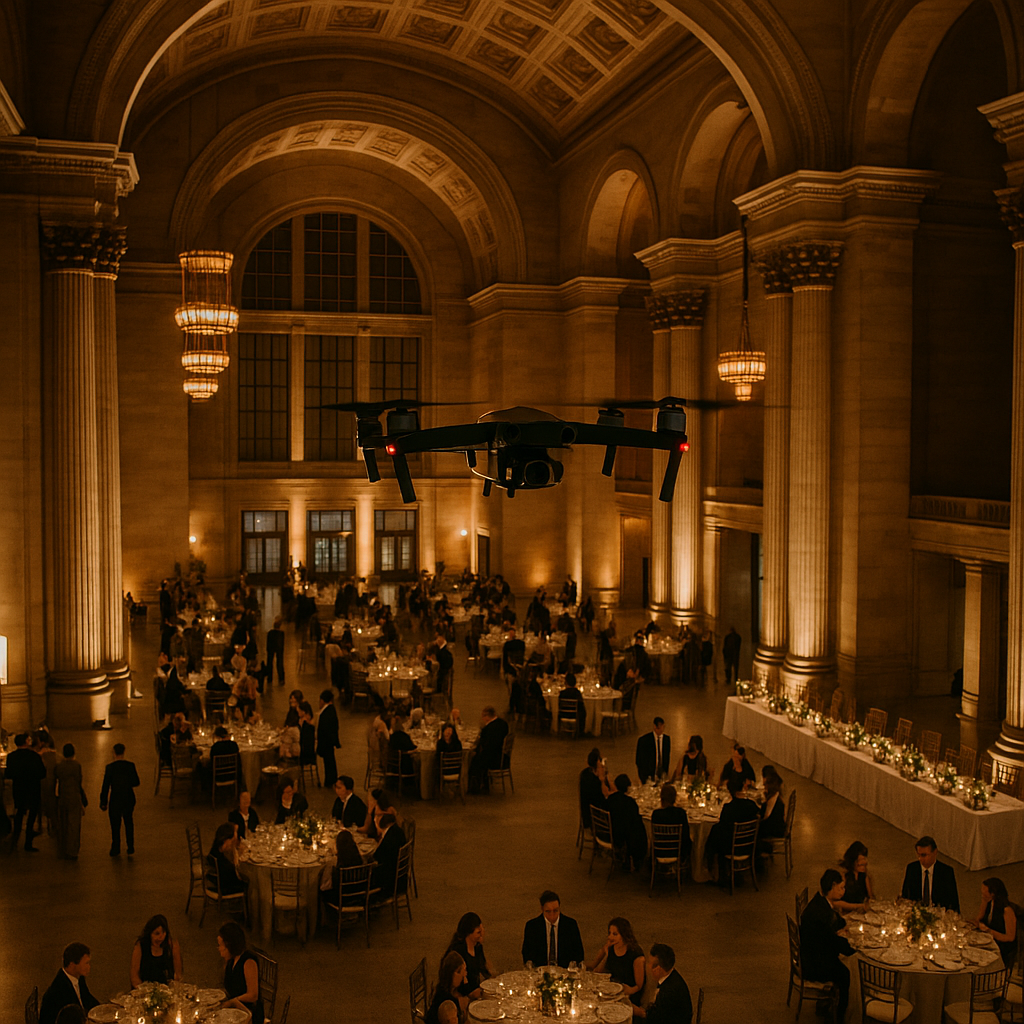
Six weeks before the wedding, the venue coordinator replies to the aerial question in one line: Drones are fine with us. The couple forwards it to the videographer, the shot list gets a "sunset pull-back over the reception," and everyone moves on. That email is worth exactly nothing in airspace terms. A venue can grant you permission to take off from its lawn. It cannot grant you permission to be in the sky above it — and the sky above most of South Florida already belongs to someone else's approval process.
That gap is where aerial coverage usually falls apart: not because anyone was reckless, but because the party who said yes had no authority to say it, and the party with authority was never asked.
Four different yeses, and only one of them comes from your venue
A legal aerial shot at a private event requires clearance from four separate places, and they don't talk to each other. Understanding which is which is most of the battle.
| Approval | Who actually controls it | What it covers |
|---|---|---|
| Pilot and aircraft eligibility | FAA — 14 CFR Part 107 | Remote pilot certificate, registered aircraft, Remote ID broadcast |
| Airspace access | FAA / air traffic — LAANC or DroneZone | Permission to occupy controlled airspace at a stated place, altitude and time |
| Flying above guests | FAA — Part 107 Subpart D | Whether the aircraft may pass over people who aren't part of the crew |
| Ground access | The venue or property owner | Where the pilot may launch, land, stand and store gear |
Your venue owns the last row. Nothing else. Conversely, a pilot with a flawless FAA record still needs the venue's blessing to set up on the terrace. Both halves are required, and only one of them is negotiable over email.
The rule that quietly kills the shot you actually wanted
The image most couples describe — the camera lifting off the dance floor and pulling back over a full reception — is the single hardest thing to do legally. Under § 107.39, a small drone may not operate over a human being unless that person is directly participating in the operation, is under a covered structure, is inside a stationary vehicle, or the flight qualifies under one of the four categories the FAA created in its operations-over-people rule.
Those categories turn on the aircraft, not the pilot's confidence:
| Category | Aircraft requirement | Over a crowd? |
|---|---|---|
| Category 1 | 0.55 lb or less at takeoff, no exposed rotating parts that could lacerate skin | Sustained flight over an open-air assembly only if the Remote ID requirements of Part 89 are met |
| Category 2 | FAA-accepted declaration of compliance; impact energy limited to 11 foot-pounds | Same Remote ID condition applies |
| Category 3 | Declaration of compliance; 25 foot-pound limit | Explicitly prohibited over open-air assemblies; otherwise closed-site or no sustained overflight |
| Category 4 | Airworthiness certificate under Part 21, plus maintenance recordkeeping | Per the approved flight manual, with the same Remote ID condition |
Note what the FAA did not do: it never defined an open-air assembly by headcount. There is no "under 80 guests is fine" line. It is a judgment about density and gathering, made in advance by the pilot and second-guessed afterward by an investigator. A seated outdoor ceremony of 120 people is, for planning purposes, a crowd.
There is also a separate rule for the getaway car. § 107.145 permits flight over people inside moving vehicles only within a closed or restricted-access site where those people have been put on notice, or where the aircraft does not maintain sustained flight over them. Chasing a convertible down A1A is not a compliant shot.
The practical translation: the beautiful aerial establishing shots — the property, the tented lawn from above, the coastline behind the ceremony site — are usually straightforward. The overhead crowd shot is the one to design around, not the one to assume.
Drone airspace in Fort Lauderdale: you are probably inside someone's ring
South Florida is one of the least forgiving places in the country to improvise. Fort Lauderdale-Hollywood International sits inside Class C airspace that the FAA has repeatedly reconfigured to manage converging traffic. Miami International's Class B shelf reaches roughly 20 nautical miles out and up to 7,000 feet. Fort Lauderdale Executive and North Perry each carry Class D rings, and North Perry alone hosts eight flight schools. Stack those together and large parts of Broward and northern Miami-Dade are controlled airspace from the surface up.
Controlled airspace doesn't mean "no." It means "not without authorization." LAANC — the Low Altitude Authorization and Notification Capability — is the FAA's automated channel for that, processing requests at or below 400 feet against published UAS Facility Maps and notifying the relevant tower. When the flight fits inside the pre-approved grid ceiling, approval comes back in seconds.
Two details decide whether LAANC authorization in South Florida is a formality or a problem:
- The grid ceiling, not 400 feet. Facility map cells near approach corridors are often capped at 100 or 50 feet, and some are zero. A zero-ceiling cell means no automatic approval at all — the request has to go through FAA DroneZone, which is a matter of weeks, not seconds.
- Authorizations are pinned to a place, altitude and time window. Move the ceremony to the west lawn, push the toast back ninety minutes, and the paperwork no longer matches the flight. It has to be resubmitted.
This is why the airspace question belongs in the venue-selection conversation, not the week-of-timeline conversation. Two properties five miles apart in Fort Lauderdale can have entirely different answers, and that's the sort of constraint worth surfacing with your planning and venue coordination team while the date and site are still movable.
The restriction that appears the week of your event
Airspace class is stable. Temporary flight restrictions are not, and they override everything you already have in hand.
The standing sporting-event TFR is the one that catches event crews. Under FDC NOTAM 4/3621, flight is prohibited within a three-nautical-mile radius up to 3,000 feet AGL of any stadium seating 30,000 or more during qualifying MLB, NFL, NCAA Division I football and major motor speedway events — from one hour before the scheduled start until one hour after it ends. Three nautical miles is about three and a half statute miles in every direction. A reception at a hotel near Hard Rock Stadium on a game Sunday is inside that bubble whether or not anyone at the event is thinking about football. Presidential and VIP movement TFRs, which South Florida sees regularly, work the same way and can be published with little notice.
An approved LAANC authorization does not defeat a TFR. And the FAA's posture on enforcement has hardened: in April 2026 it launched the Drone Expedited and Targeted Enforcement Response (DETER) program to resolve drone cases faster, and the published settlement policy pointedly excludes TFR violations from the reduced-penalty track. The old "educate first, penalize later" default is narrowing.
Operational rule: the TFR check is a day-of task, not a booking-day task. It gets re-run the morning of the event.
Sunset is the shot. Civil twilight is the rule.
In South Florida the light everyone wants sits in a fifteen-minute window that frequently lands right on the boundary between day and civil twilight. § 107.29 permits night and civil-twilight operations without a waiver, but only when the remote pilot has completed the required knowledge test or training and the aircraft carries lighted anti-collision lighting visible for at least three statute miles, flashing fast enough to avoid a collision. The pilot may dim it for safety; they may never switch it off.
Two consequences for your timeline. First, a stock navigation LED usually isn't sufficient — a compliant strobe is separate equipment that has to be on the aircraft before it leaves the case. Second, if your ceremony runs twenty minutes long, the aerial window doesn't simply shift; it crosses a regulatory line. Build the aerial slot with a buffer on both sides and treat it as a fixed appointment in the run of show, the same way you'd treat a first dance. That kind of sequencing sits naturally with production coordination, where the aerial window can be locked against the rest of the schedule rather than squeezed in around it.
Florida law sits on top of the federal rules, not instead of them
Clearing the FAA does not clear Florida. Two state statutes matter for private events.
- Fla. Stat. § 330.41, the Unmanned Aircraft Systems Act. It preempts cities and counties from regulating drone operation, licensing or flight paths, while leaving them authority over nuisance, voyeurism, harassment and similar conduct — and over launching and landing on public property they own. It also restricts flight over designated critical infrastructure facilities. HB 1121, effective October 1, 2025, raised that critical-infrastructure offense to a third-degree felony. In a region dense with substations, water treatment plants, port facilities and pipelines, this is a real constraint on where a pilot may route a transit leg.
- Fla. Stat. § 934.50, on searches and surveillance using a drone. It bars using a drone with an imaging device to record privately owned real property, or its owner, tenant, occupant, invitee or licensee, with intent to conduct surveillance in violation of a reasonable expectation of privacy without written consent. The statute presumes such an expectation where a person isn't observable from ground level by someone legally entitled to be there — regardless of whether they're visible from the air.
For an event, that second one is less about your guests than about the neighbors. A waterfront estate in Fort Lauderdale means adjacent pool decks and terraces inside frame at 200 feet. The compliant answer is a flight plan with defined headings and a camera that isn't pointed where it shouldn't be — decided in advance, not in the air.
This article is general information about publicly available regulations, not legal advice. Rules, airspace boundaries and statutes change. Verify current requirements with the FAA and the Florida Legislature, and consult a qualified attorney for guidance on your specific event.
What to decide, and when
Most aerial disappointments are scheduling failures, not legal ones. A short list of decisions, in the order they should happen:
- At venue selection: ask what airspace the property sits in and what the facility map ceiling is for that grid cell. A zero-ceiling site needs a DroneZone request measured in weeks.
- At booking: raise aerial coverage when you book photography and videography, so the shot list is built around what the airspace actually permits rather than edited down later.
- In the venue contract: get launch and landing area, crew access and equipment staging in writing. "Drones are fine" is not a term.
- Four to six weeks out: confirm the pilot's remote pilot certificate, aircraft registration, Remote ID status and liability coverage. Ask which operations-over-people category the aircraft qualifies for — the honest answer is often "none," which simply means the flight plan avoids overflying guests.
- Two weeks out: lock the aerial window against sunset and civil twilight, with a buffer. Decide the ground-camera fallback now, so a scrubbed flight costs you a shot, not a sequence.
- Event morning: re-check TFRs and re-file the airspace authorization if the location, altitude or window moved.
- Guest communication: a line on the schedule or a word from the officiant is worth more than it sounds. People who know a drone is coming don't reach for their phones during the vows.
Frequently Asked Questions
My venue said drones are allowed. Isn't that enough?
No. A venue controls its ground — where a pilot may launch, land and set up. It has no authority over the airspace above it. If the property sits in Class B, C, D or surface Class E airspace, the flight also needs FAA authorization, typically through LAANC. Venue permission and airspace authorization are two separate yeses, and you need both.
Can the drone fly over our guests during the reception?
Only under narrow conditions. Part 107 generally prohibits flight over people who aren't participating in the operation, aren't under a covered structure and aren't inside a stationary vehicle. The exceptions require the aircraft itself to qualify under one of four FAA categories, and Category 3 aircraft are barred from open-air assemblies outright. Most event drones don't qualify — which is why experienced pilots design the shot to orbit and pull away from the crowd rather than pass over it.
How far in advance does LAANC authorization need to be requested?
LAANC returns most approvals within seconds, and requests can typically be submitted shortly before flight. The timing problem isn't LAANC itself — it's discovering that your grid cell has a zero-foot ceiling, which removes the automated path entirely and pushes the request into a manual FAA DroneZone review that takes far longer. Check the airspace when you choose the venue, not when you build the timeline.
What actually happens if a flight goes ahead without authorization?
The FAA can pursue civil penalties, certificate suspension and, in serious cases, criminal referral. Its DETER program offers eligible first-time violators a faster resolution with reduced penalties in exchange for admitting liability and waiving appeal rights — but that track explicitly excludes TFR violations and other higher-risk conduct. Separately, an unauthorized flight can void an operator's insurance, which is usually the bigger exposure for the host.
Does golden hour count as night?
It can. Civil twilight and night both trigger the lighting and training requirements of § 107.29, including anti-collision lighting visible for three statute miles that cannot be switched off mid-flight. Since the best light often sits right on that boundary, confirm your pilot is equipped and trained for it rather than assuming the flight will finish in daylight.
What should I ask a drone operator before hiring one?
Ask for the remote pilot certificate number, the aircraft's FAA registration and Remote ID status, proof of liability coverage, and how they intend to obtain airspace authorization for your specific address. A capable operator will answer all four without hesitation and will tell you plainly which shots the site won't support. Vagueness on any one of them is the warning sign.
The question that separates a shot from a story
There is a version of this that ends with a couple watching a two-minute film that opens on the Intracoastal at golden hour and settles onto their ceremony site, and a version that ends with a pilot on a lawn explaining why the aircraft is staying in the case. The difference is almost never talent or equipment. It's whether someone asked about the airspace while the venue was still a choice.
So when a vendor promises aerial coverage, don't ask whether they can fly. Ask which grid cell your venue sits in, what the ceiling is, and what the plan is when the sun runs eight minutes late. If the answer is specific, you'll get your shot. If the answer is "the venue said it's fine," you're being handed a permission slip from someone who never owned the sky.
Planning aerial coverage in South Florida?
Bring us the venue and the date, and we'll work the airspace question into the plan while it's still easy to solve — not the week of your event.
Request a QuoteVisuals