
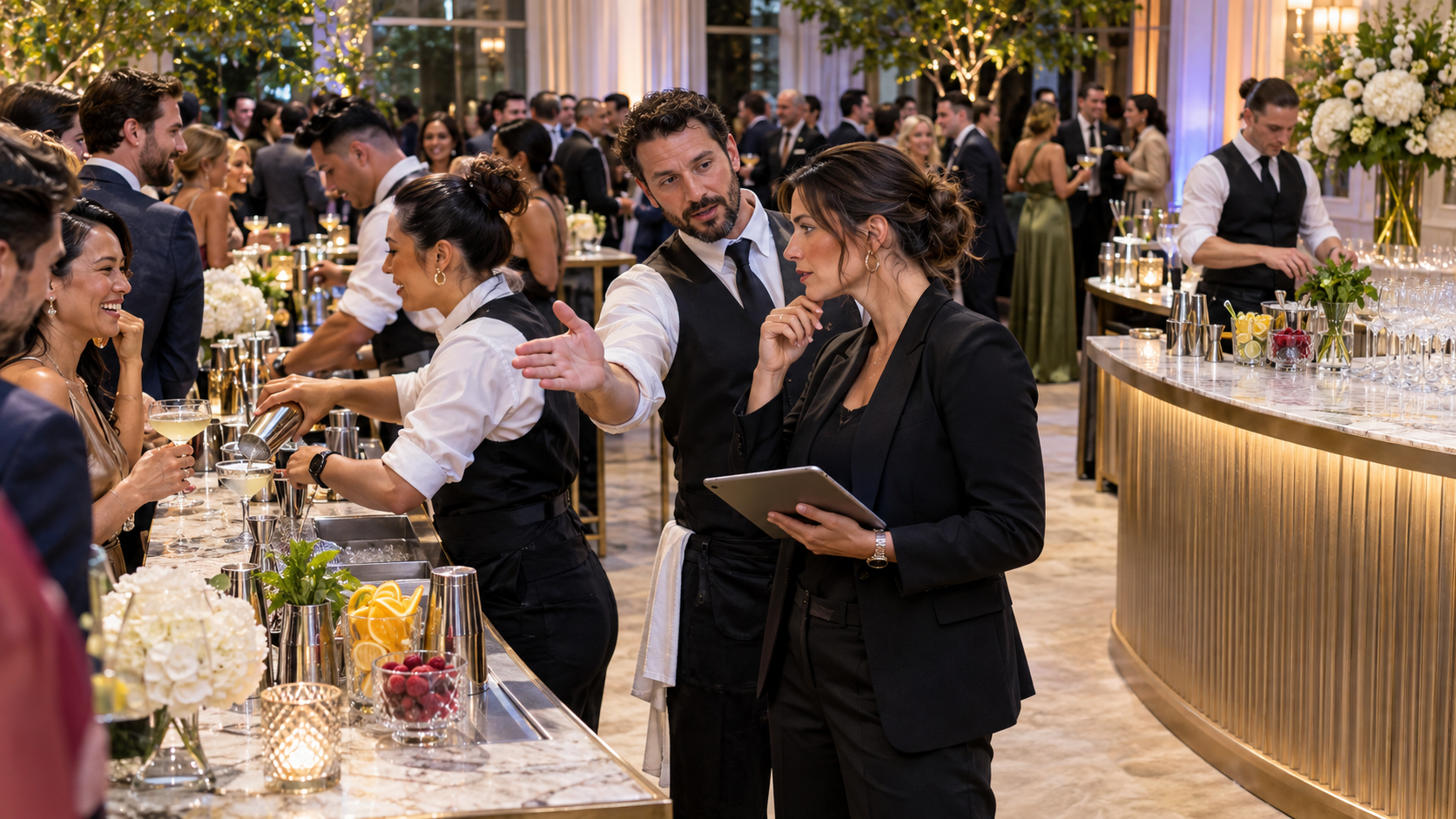
The Bar Line Is the Guest Experience: More Bars or More Bartenders?
Guests may not remember the centerpieces, but they'll remember standing in a bar line for most of cocktail hour. The bar is often the first real interaction guests have with an event, and when it backs up, the whole room feels it. Conversations stall, the energy drops, and people start wondering when dinner starts.
When a line forms, the instinct is to add something: another bar, more bartenders, or both. Either can help, but only if it fixes the actual constraint.
The Tension: Space vs. Speed
A second bar adds physical space, another point of service, and a way to spread guests across the room. It also adds cost, equipment, setup time, and another station to stock and staff.
More bartenders at one bar add speed, but only up to a point. Every bartender needs room to work, access to ice, glassware, product, and a clear place to hand off drinks. Put too many people behind one station and they start waiting on each other instead of the guests.
Service-operations research explains why this matters. Queueing studies published in peer-reviewed journals like INFORMS' Manufacturing & Service Operations Management show that wait times depend on how quickly guests arrive compared with how quickly they can be served. When arrivals outpace service capacity, lines grow quickly. The goal is to find what's limiting that capacity.
What Actually Controls Bar Speed
Before deciding on more bars or more bartenders, look at the factors that limit throughput.
Usable Bar Space
Measure the working area, not the bar's footprint. A long bar with a single ice well, one sink, and one pickup point may still only support a limited number of bartenders working efficiently.
Placement
A bar right at the entrance catches every guest as they walk in. A bar tucked in a corner creates a line that blocks walkways. Place bars where guests can approach from more than one direction and where the line won't interfere with entrances, restrooms, or the dance floor.
Menu Complexity
Beer and wine pour quickly. Shaken, muddled, or layered cocktails take longer. A long menu also slows guests down while they decide. A focused menu with a signature drink or two often moves faster than a full cocktail list.
Batching
Pre-batching signature cocktails before the event can turn a multistep drink into a quick pour over ice. It's one of the simplest ways to speed service without changing the guest experience.
Glassware and Ice
A bar that runs out of clean glasses or ice stops, no matter how many bartenders are behind it. Plan for enough glassware, backup ice, and someone assigned to restock and bus glasses so bartenders can stay focused on pouring.
Payment Flow
Cash bars and ticketed bars add a transaction to every drink. Card readers, ticket collection, and change all take time. If you're running a cash or ticketed bar, consider whether payment can be handled separately, or simplified with drink tickets distributed in advance.
Arrival Waves
Lines are often worst in the first 15 to 30 minutes, when everyone arrives at once and heads straight for a drink. After that, demand may level off. A temporary surge calls for a different fix than a bar that's slow all night.
A Practical Decision Framework
Ask these questions in order:
- Is the line a surge or all night? If it's mainly at arrival, try passed welcome drinks, a pre-poured station at the entrance, or opening the bar a few minutes before guests arrive.
- Are bartenders waiting on supplies? If they're hunting for ice, glasses, or garnishes, add a barback or support staff before adding bartenders.
- Is the menu slowing service? Simplify the menu or batch signature cocktails.
- Is payment the bottleneck? Streamline transactions or move payment away from the pour.
- Do bartenders have room to work? If one station can comfortably fit another bartender, add one. If they're already bumping into each other, the bar needs more space.
- Is the room too large or spread out for one bar? If guests are crossing the whole venue for a drink, or the line is blocking traffic, a second bar is likely the better choice.
When a Second Bar Makes Sense
- The guest count or room layout means a single bar creates a crowd in one spot.
- The existing bar has no space for another bartender to work efficiently.
- You want to separate service, such as a full bar and a beer-and-wine station.
- The event has multiple spaces, such as indoor and outdoor areas.
When More Bartenders Make Sense
- The bar has enough working space, ice wells, and pickup room for another person.
- Supplies and glassware are already well managed.
- The line is steady through the night, not just at arrival.
Often the best answer combines both with better support: the right number of bartenders, a barback restocking behind them, and a simplified menu built for speed. Hospitality research, including work from Cornell's Center for Hospitality Research, has long examined how service operations shape what guests experience, and the bar is one of the most visible places that plays out at an event.
FAQ
Is there a standard number of bartenders per guest?
Not one that fits every event. The right number depends on the menu, bar format, guest count, timing, venue layout, and support staff. Plan based on your event, not a rule of thumb.
Do passed drinks help?
Yes, especially during arrival. Passed welcome drinks or a pre-poured station can absorb the first wave so the main bar doesn't get overwhelmed.
Should the bar close during dinner?
That depends on your format and service plan. Some events keep the bar open, while others move to table-side wine service. Discuss it with your bar team early.
Plan the Bar Around the Bottleneck
A shorter line usually comes from the right fix, not just more of everything. To plan bartenders, barbacks, and service staff for your event, explore our event staffing options, or see our full range of event services, including catering and bartending.