
Your Event Sound Check Should Happen Before the Guests Arrive. Here's What It Actually Tests.
Setting the Stage for Success
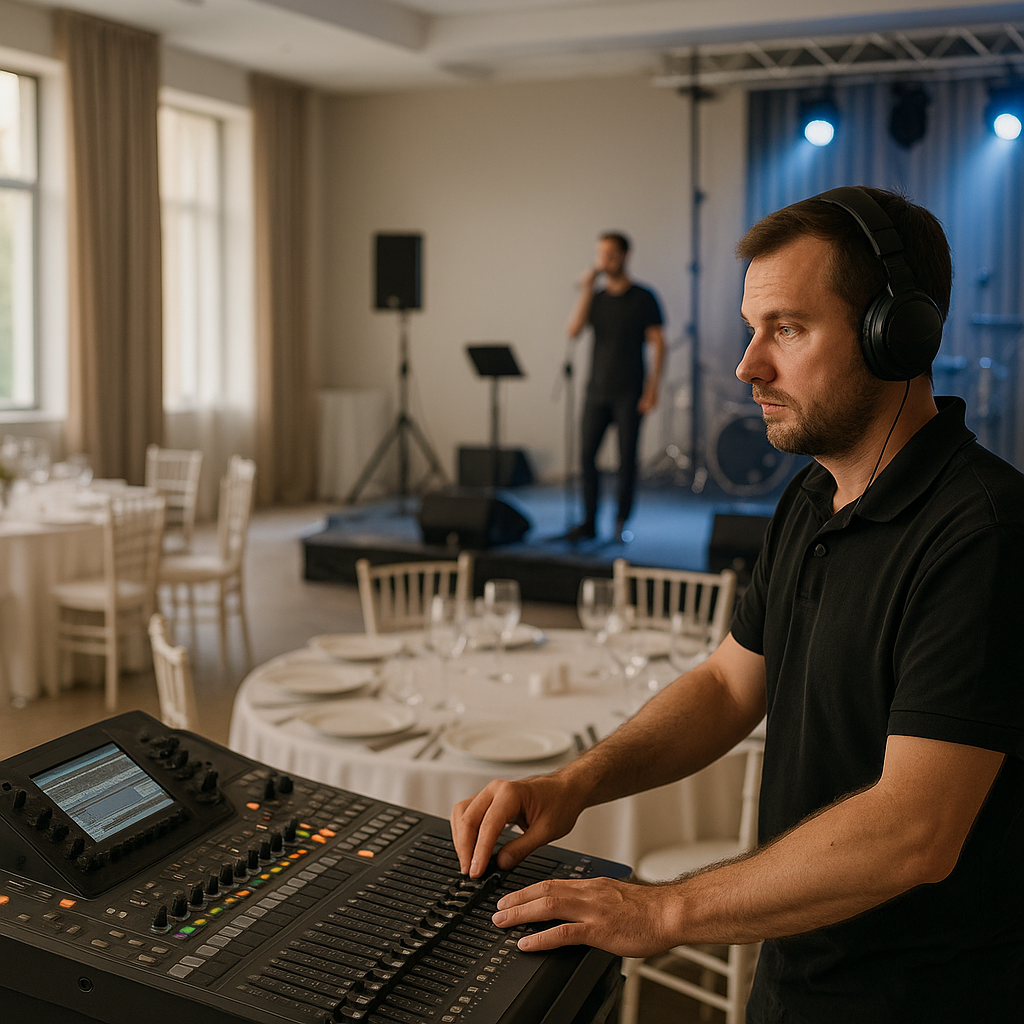
A sound check is not a mic test. It is a rehearsal of the room.
Nobody remembers the audio at a great event. They remember the toast that landed, the first dance that hit on cue, the CEO whose voice carried to the back table. What they remember at a bad event is the squeal during the vows, the presenter who kept saying "can you hear me?", the dead thirty seconds where the playlist should have been. Every one of those failures is catchable in the ninety minutes before doors open — but only if someone is actually testing the right things.
Most people picture a sound check as a technician tapping a microphone and saying "check, one, two." That is a line check, and it takes four minutes. A real sound check is a diagnostic pass on the whole chain: the gear, the room, the radio spectrum, the run of show, and the people who will hold the microphones.
Line check vs. sound check: two different jobs
Confusing these two is the single most common reason an event "had a sound check" and still fell apart.
- A line check confirms signal exists. Every microphone, every playback source, every feed from the video switcher reaches the console and produces a meter reading. It answers one question: is anything dead?
- A sound check confirms signal behaves. Levels, tone, coverage, feedback margin, wireless stability, and cue timing are all tested under conditions as close to showtime as an empty room allows.
You need both, in that order. Skipping straight to the second while a cable is bad wastes twenty minutes chasing a ghost.
What a sound check actually tests
1. Signal path integrity
Every input from source to speaker: microphone capsules, cables, stage boxes, direct boxes, the laptop running the slide deck, the tablet with the ceremony playlist, and any audio embedded in a video file. Embedded audio is the classic ambush — the deck plays perfectly on the presenter's laptop and arrives silent through the switcher because nobody tested that specific path.
2. Gain structure and headroom
Input gain is set so that a normal speaking voice sits at a healthy level and a sudden laugh, shout, or dropped microphone does not clip. Headroom is the safety margin between typical program level and distortion. Set gain for the quiet talker and the loud talker will overload; set it for the loud talker and the quiet one disappears. The sound check is where that compromise gets found deliberately instead of during a toast.
3. Gain before feedback
Feedback is not random bad luck. It is a signal loop: sound from the speakers re-enters an open microphone and oscillates at whichever frequency the room reinforces most. In live sound engineering, gain before feedback is the practical measure of how much a microphone can be amplified through a sound system before that loop starts, measured in decibels at the point where speaker output re-enters the mic and the system begins to ring.
The countermeasure is "ringing out" the room. QSC's live-sound guidance describes the process plainly: with the stage microphones open and gained up, the engineer pushes the main fader until the system just begins to feed back, identifies the offending frequency with a real-time analyzer, pulls the fader back, and then cuts that frequency in the output EQ — repeating until the system is stable at the level the event actually needs. Do that at 4:00 p.m. with an empty ballroom, or discover the same frequencies at 7:12 p.m. with 180 people watching.
4. Coverage across the room, not at the console
The mix position is usually one of the best-sounding spots in the building. It is also where nobody sits. A proper check includes walking the room: the back tables, the corners, the bar, under the balcony, the seats directly beside a speaker stack. What you are hunting for is level consistency and tonal balance — the difference between "clear everywhere" and "punishing in row two, unintelligible at table 18."
5. Speech intelligibility, tested by the actual speakers
A technician's voice through a microphone proves the microphone works. It proves nothing about the father of the bride who holds it at chest height, the executive who turns away from it to point at the screen, or the officiant with a soft voice and a beard against a lavalier. Whenever the schedule allows, the people who will speak should speak — into their own microphone, at their own position, at their own volume. Two minutes each is enough, and it doubles as a coaching moment on mic technique.
6. Wireless spectrum, scanned on site
Wireless microphones share crowded, regulated radio spectrum, and the legal landscape shifted meaningfully in recent years. The FCC notes that the 600 MHz frequencies corresponding to auctioned TV channels — specifically 617–652 MHz and 663–698 MHz — were repurposed for wireless broadband and are no longer available for wireless microphone operations, while TV channels 2–36 and narrow slices of the guard band and duplex gap remain usable. The Commission also warns that operating microphones unlawfully in the 600 MHz band can carry fines or further penalties.
Legality aside, spectrum is a moving target inside any venue: hotel systems, a conference next door, a broadcast truck in the loading dock. An on-site scan and frequency coordination during the check is what separates clean handhelds from mid-sentence dropouts.
7. The transitions themselves
Audio failures at events are rarely equipment failures. They are timing failures — the microphone that was muted when the host walked up, the playlist that started ten seconds late, the video whose audio came up under a live mic. Running the actual cue sequence with the person calling it is the part of a sound check most often skipped and most often missed. If your event planner builds a minute-by-minute run of show, the audio lead should be holding a copy of it during the check, not reading it for the first time at showtime.
The empty-room problem — and why the check still matters
Here is the honest limitation: the room you tune at 4:00 p.m. is not the room you mix at 8:00 p.m. Bodies absorb sound. As acoustic consultants at Acentech put it, people are sound absorptive, and a full audience produces a different sonic experience than a sparse one surrounded by empty seats. A hard, echoey ballroom will tighten up noticeably once it is full of guests, linens, and clothing.
That does not make the empty-room check pointless — it makes it a baseline. The engineer learns the room's problem frequencies, its reflective surfaces, its coverage gaps, and its feedback ceiling while there is still time to move a speaker or re-aim a stack. Then a smaller, faster adjustment happens once the room fills. Skip the baseline and you are making both sets of decisions simultaneously, in front of an audience, with no margin.
A realistic sound check sequence
Timings scale with complexity. A single-speaker dinner is quick; a multi-presenter conference with live music and video playback is not.
| Stage | What happens | What it proves |
|---|---|---|
| Power & grounding | Verify circuits, distro, and that audio and lighting are not fighting each other electrically | No hum, buzz, or mid-event breaker trip |
| Line check | Every input tested one at a time to the console | Nothing is dead or miswired |
| Gain structure | Set input gain and headroom per source | No clipping on peaks, no buried quiet sources |
| System EQ & ring out | Tune mains and monitors to the room, notch resonant frequencies | Usable volume without feedback |
| RF scan | Scan spectrum, coordinate and lock wireless frequencies | Stable handhelds and lavaliers |
| Coverage walk | Listen at real guest positions, front to back and side to side | Consistent, intelligible sound everywhere |
| Speech pass | Actual presenters or hosts speak on their own microphones | Intelligibility and mic technique under real conditions |
| Music pass | Program material at show level, including low end | Dance floor energy without mud or rattle |
| Cue rehearsal | Walk the run of show's audio transitions | No dead air, no hot mic, no late starts |
Five failures, and the step that catches each one
| What guests hear | Usual cause | Caught by |
|---|---|---|
| Squeal during a toast | Microphone brought into a speaker's coverage at a resonant frequency | Ring out plus coverage walk |
| Speaker cutting in and out | Wireless interference or a weak receiver position | On-site RF scan and coordination |
| Distorted, harsh vocals | Gain set too hot with no headroom for peaks | Gain structure pass |
| Video plays with no audio | Untested embedded-audio path from laptop or switcher | Line check on every source, not just microphones |
| Ten seconds of silence at a key moment | Cue never rehearsed with the person calling it | Cue rehearsal against the run of show |
Volume is a design decision, not a knob
Loud is not the same as good, and there is a public-health ceiling worth knowing. The World Health Organization's global standard for safe listening venues and events sets a maximum average sound level of 100 decibels, applied as a 15-minute time-averaged level measured on a moving-average basis that should never exceed 100 dB LAeq while the audience is present. The same standard also calls for live monitoring with calibrated equipment by designated staff and optimized venue acoustics and sound systems.
For a wedding or corporate event, the practical translation is simple: decide during the sound check what the dance floor peak will be and what the dinner-conversation level will be, and confirm both against the room rather than improvising them later. Guests should be able to talk at their table while the floor is full. That is an engineering outcome, not a compromise — and it is set in the empty room, not at midnight.
Who should be in the room during the check
- The audio lead, with the run of show in hand.
- The person calling cues — planner, coordinator, or stage manager — so transitions are rehearsed, not described.
- Key presenters or the host, briefly, on their own microphones.
- A venue contact who can authorize moving a speaker, opening a circuit, or adjusting house audio.
If the event involves staging, screens, or multiple technical vendors, the audio check should be scheduled inside the wider event production timeline rather than squeezed in after the room flip. Ninety uninterrupted minutes before guest arrival is worth more than three hours shared with a crew still setting tables.
A checklist to hand your audio team
- Confirm load-in and check window in writing, with the room in its final layout.
- Line check every input, including video and presentation audio.
- Set gain structure with deliberate headroom on speech channels.
- Ring out mains and monitors at the level the event will actually reach.
- Scan and coordinate all wireless frequencies on site, on the day.
- Walk the room and listen from real guest seats.
- Test with the actual speakers and the actual playback devices.
- Rehearse the audio cues in the run of show, in order.
- Agree on target levels for dinner, speeches, and dance floor.
- Confirm backups: spare handheld, spare batteries, secondary playback source.
Music-driven segments deserve their own pass. Speech and program music sit in different frequency ranges and demand different system behavior, so a room that is dialed in for toasts is not automatically ready for a set — one more reason the DJ and live entertainment portion of the night gets checked at show level, not politely at half volume.
What the technical guidance supports
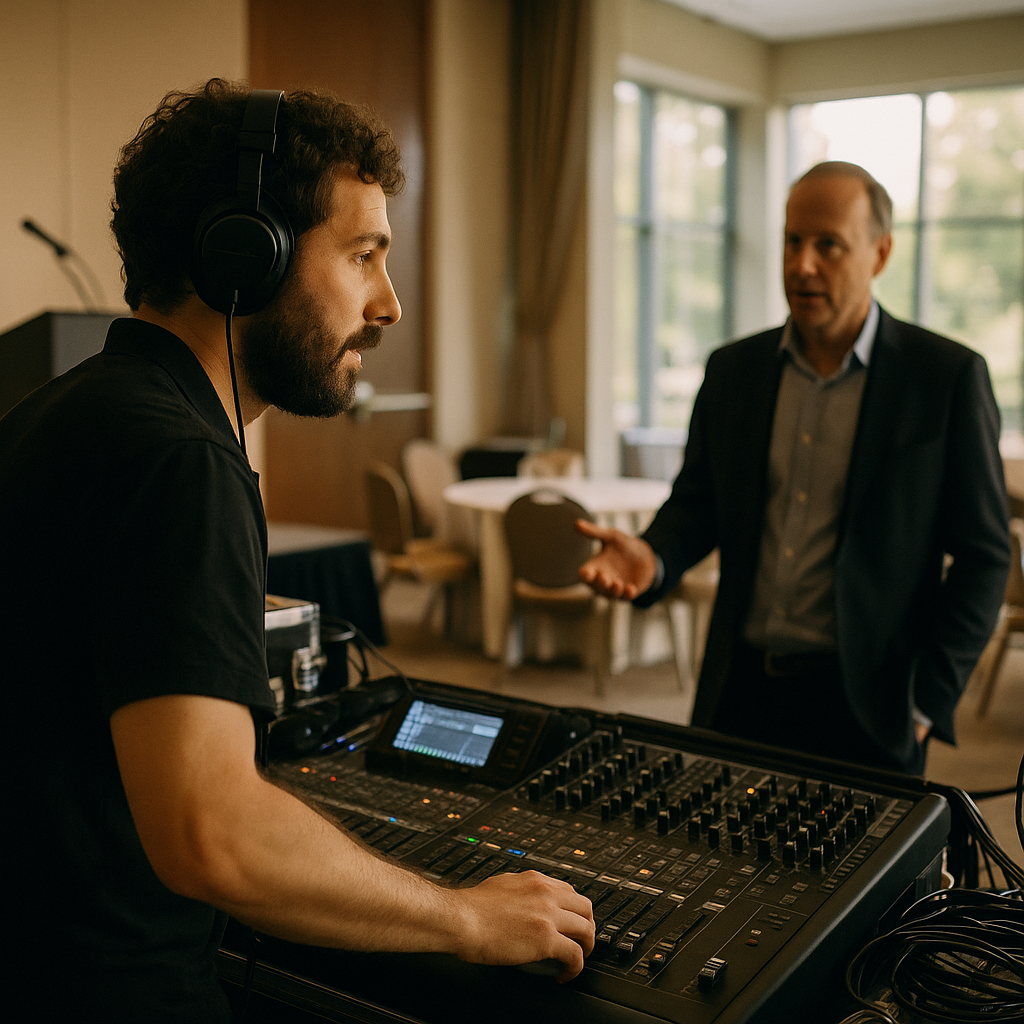
- Test the real signal chain and the real room. Shure's professional audio guidance recommends an advance site visit to identify acoustic, technical, structural and logistical issues, including existing wireless systems and frequencies that must be avoided. See the Shure Audio Systems Guide.
- Volume is also a safety decision. OSHA's occupational-noise guidance explains that exposure above 85 dBA can damage hearing and that duration matters, which is why show-level testing should include monitoring rather than guesswork.
- A phone app can screen, not certify. The NIOSH Sound Level Meter app can help identify potentially hazardous levels; NIOSH notes that calibrated professional instruments remain the appropriate choice for formal measurements.
FAQs about Event Sound Checks
How long should a sound check take?
It depends entirely on how many inputs and moving parts exist. A single microphone and a playlist can be verified in fifteen or twenty minutes. A multi-speaker corporate program with video playback, live music, and wireless lavaliers reasonably needs one to three hours, plus load-in time before that. The useful question is not "how long" but "how many sources, how many cues, and how complicated is the room."
When exactly should it happen?
After the room is in its final layout and before the first guest walks in — with buffer. A check that ends as doors open leaves no time to fix what it finds, which defeats the purpose. Build the window into the schedule and protect it.
Can we skip the sound check for a small event?
No, but it can be short. Small rooms are often acoustically worse than large ones — hard surfaces, low ceilings, speakers close to microphones — and a fifty-person room with one handheld can feed back just as viciously as a ballroom. Scale the length of the check, not its existence.
Do the presenters really need to be there?
Ideally, yes, for two minutes each. If their schedules make that impossible, the next best option is a briefing before they go on: how to hold the microphone, how close to speak, and where not to walk. Most speech problems at events are technique problems, not equipment problems.
The venue has a built-in sound system. Is that enough?
Sometimes, and it still needs checking. House systems are typically designed for background music and announcements rather than speeches, live performance, or a full dance floor, and their coverage may not match your seating plan. Test it against your actual program before assuming it will carry the night.
What happens if audio fails during the event anyway?
Redundancy and a human on the console. A technician who stays through the event can reroute to a spare microphone, swap a battery, or switch playback sources in seconds. The sound check reduces the odds of failure; on-site attention determines how long a failure lasts if one occurs.
Does the room really sound different once it fills up?
Yes. Guests, clothing, and soft furnishings absorb sound energy, which shortens reverberation and changes the balance — which is exactly why the empty-room check is treated as a baseline that gets refined, not a final setting that gets locked.
Let VNV Events Ensure Your Sound Is Perfect
From intimate gatherings to large corporate events, our team guarantees the highest quality sound design. Explore our DJ and Karaoke Services or Event Production options today.