
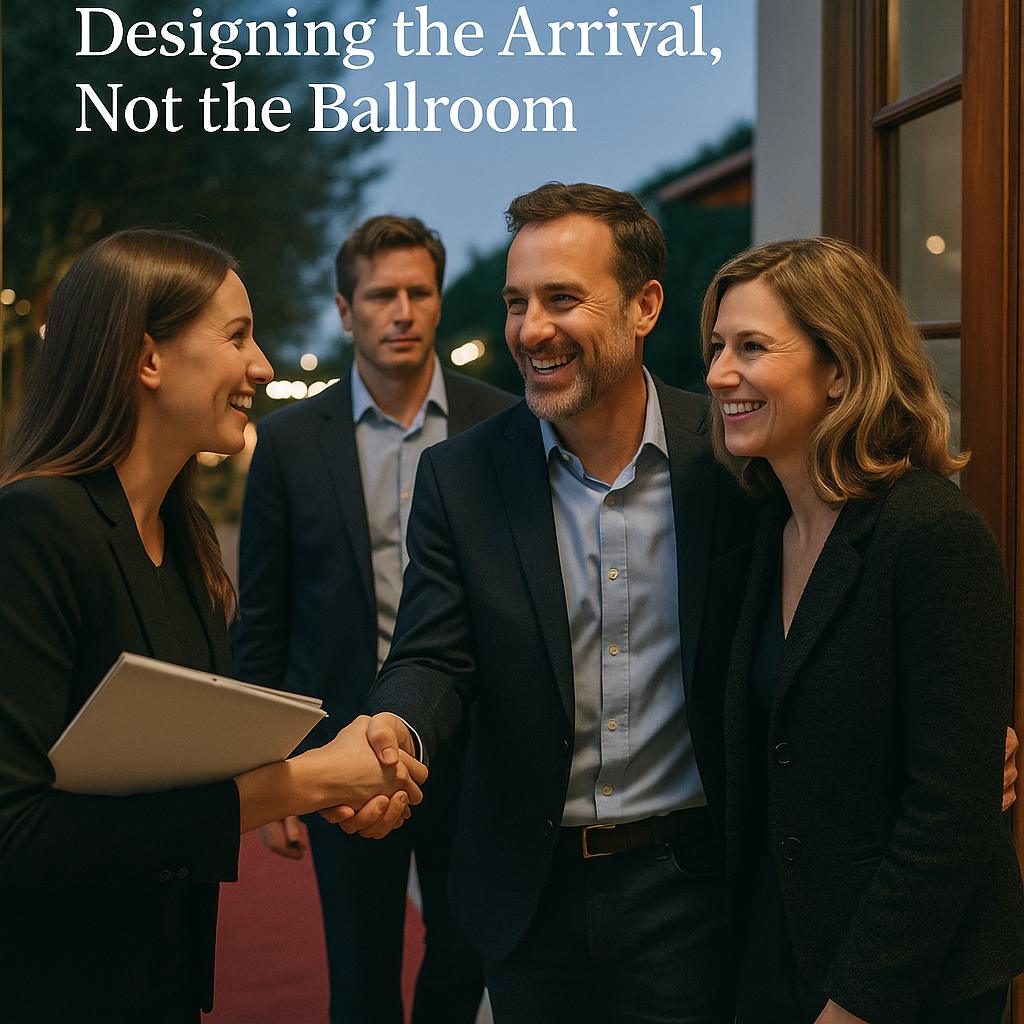
The First Twenty Minutes Decide Your Party: Designing the Arrival, Not the Ballroom
Somewhere in the budget for your holiday party there is a line item for greeters, and somewhere in the review process someone is going to ask whether you really need it. Say yes. Here is why: your 180 guests will not trickle in politely across an hour. Roughly two-thirds of them will hit the door inside a twenty-minute window, most of them straight from a parking garage, most of them holding a coat, a gift, or a phone with the invite on it. What happens in that window is the party your CFO will remember — not the entrée, not the band, not the room you spent four months choosing.
The door is a throughput problem before it is a hospitality problem
Arrival failures are almost never failures of warmth. They are failures of arithmetic, and the arithmetic is unforgiving because it compounds at the front of the line.
Take a 200-guest corporate reception with a single check-in table. Even a fast, well-drilled attendant needs roughly 12 seconds per guest — find the name, confirm the table, hand over the badge or place card, say something human. At one station, the two-hundredth guest clears the table forty minutes after the doors open. Add a second station and it is twenty. Four stations and it is ten, which is the only version where nobody is standing in a hallway wondering whether they should have skipped this.
That math is the whole argument for professional event staffing at the door. Greeters are not decoration. They are parallel processing capacity, and capacity at the entrance is the single cheapest thing you can buy at a party — cheaper per guest than upgrading the linens, and considerably more visible.
Two structural facts make the front door disproportionately expensive to get wrong:
- Impressions form faster than you can intervene. Research by Willis and Todorov at Princeton found that trait judgments formed after a 100-millisecond exposure to a face correlated highly with judgments made with unlimited time. Your guest has decided how this evening feels before your greeter finishes a sentence.
- Pre-process waits feel longer than in-process waits. David Maister's "The Psychology of Waiting Lines" lays out the principles service designers have used for forty years: unoccupied time feels longer than occupied time, uncertain waits feel longer than known finite waits, and anxious waits feel longest of all. A guest waiting to be acknowledged is in the worst category of wait there is.
The practical translation is blunt. Someone should make eye contact with every guest within a few seconds of the threshold, whether or not that person can be checked in yet. Acknowledgment starts the clock. Silence extends it.
Your entrance is a life-safety position, not just a welcome position
This is the part of arrival design that gets skipped in the pretty renderings, and it is the part with statutory teeth.
The Florida Fire Prevention Code adopts NFPA 101, the Life Safety Code, which classifies a gathering of 50 or more people for eating, drinking, or entertainment as an assembly occupancy. Under NFPA 101 sections 12.7.6.1 and 13.7.6.1, assembly occupancies require at least one trained crowd manager, with additional crowd managers where the occupant load exceeds 250, generally at a ratio of one per 250 occupants. NFPA's own analysis traces the modern requirement directly to crowd crush at the main entrance during the Station nightclub fire, and notes a principle worth taping to your floor plan: people leave the way they came in.
Which means the place where you are tempted to put your check-in table, your gift stack, your step-and-repeat, and your coat rail is the same place that has to empty the room in an emergency. Three decisions follow from that, and none of them cost money:
- Do not build the registration footprint inside the egress path. Set tables perpendicular to the wall, not across the door swing, and never let a queue form across an exit.
- Confirm the occupant load with the venue in writing before you finalize the guest list, not after the invitations go out. The authority having jurisdiction, not your caterer, sets that number.
- Know who your crowd manager is by name on the night, and make sure that person is not simultaneously running your seating chart.
A door team that understands the venue's egress plan is a different product from a door team that looks nice in a blazer. When we scope a corporate event, the entrance is treated as a coordinated position with the floor plan, not as an afterthought bolted onto the guest list.
The accessible arrival is the arrival
There is a version of this article that puts accessibility in a compliance sidebar. That version is wrong, because the accessible route is usually also the route that solves your bottleneck — it is flat, wide, marked, and staffed.
The U.S. Access Board's guidance on passenger loading zones sets concrete dimensions worth knowing before you promise a client valet: a vehicle pull-up space at least 96 inches wide and 20 feet long, with an adjoining marked access aisle at least 60 inches wide that runs the full length of the pull-up space, does not overlap the vehicular way, and connects to an accessible route. The Access Board's companion guidance on accessible routes covers the walking surfaces, doorways, and level changes that route depends on.
For events built out temporarily — tented arrivals, parking-lot drop-offs, a lobby reconfigured for one night — the ADA National Network's planning guide for temporary events makes the core point plainly: the accessible route to entry points must be free of stairs unless a ramp, lift, or elevator is provided, and ideally people with disabilities use the same entrance as everyone else, with signage directing the public to accessible parking, drop-off points, and entrances.
Practically, that means one staffed decision at the curb. A greeter posted outdoors — not indoors behind glass — who can say "drop-off is the near lane, the ramp is to your left, coats are just inside" removes the single most common arrival stall: a car idling while four people decide where to go. That position pays for itself in traffic flow alone, before it does anything for hospitality.
The first drink is a staffing decision, not a bar decision
Maister's principle that people want to get started is the operational reason for a passed welcome tray. A guest holding a glass is inside the experience. A guest waiting for the bar to open is still outside it, and the bar line is where your arrival bottleneck goes to reproduce itself.
The tactic is simple: two servers with trays working the check-in queue and the first ten feet past it, with one non-alcoholic option on every tray, not on a separate table. The staffing decision behind it is not simple, because alcohol at a Florida corporate event sits inside a real regulatory frame.
- Who holds the license matters. In Florida, a licensed food caterer serving alcohol at a catered event generally operates under a 13CT alcoholic beverage catering license issued by DBPR's Division of Alcoholic Beverages and Tobacco, subject to the revenue and recordkeeping conditions the Division enforces. Confirm in writing whether the venue, the caterer, or a separate licensee is serving.
- Server training is a defined program, not a vibe. Under Florida's Responsible Vendor Act, participating vendors must train staff on the laws covering alcohol service and its effects, with non-managerial employees who serve alcohol required to complete the employee training course within 30 days of starting.
- Florida's exposure rules are narrower than most people assume — and still real. Under Florida Statute 768.125, serving a person of lawful drinking age does not by itself create liability, but willfully and unlawfully furnishing alcohol to someone underage, or knowingly serving a person habitually addicted to alcohol, can.
The arrival consequence: whoever checks IDs at a mixed-age company party should be a trained server or a door position with that job explicitly assigned — not a volunteer from marketing holding a clipboard. Our catering and hospitality team and door staff are scoped together for exactly this reason, so the first-drink flow and the ID position are one plan rather than two.
This section describes operational practice, not legal or tax advice. Licensing, permitting, and code requirements vary by venue, county, and authority having jurisdiction — confirm your specific obligations with the venue, DBPR, your local fire marshal, and your own counsel.
What each arrival position actually prevents
Use this to defend the line item, or to decide what to cut when the budget moves.
| Position | Where it stands | What it prevents |
|---|---|---|
| Curb greeter | Outdoors, at drop-off or garage exit | Idling cars, guests entering through the wrong door, an unstaffed accessible route |
| Check-in attendants (2–4) | Parallel stations, never a single line | The forty-minute queue; the guest who leaves before the toast |
| Coat and bag attendant | Immediately past check-in, off the egress path | Guests carrying coats through cocktail hour; a pile-up at the exit |
| Welcome-tray servers (2) | Working the queue and the first ten feet | Bar lines at minute six; guests standing empty-handed |
| Floor lead / crowd manager | Sightline on the door and the room | Overcrowding at the entrance; nobody owning the room when something changes |
| Roaming host | The dead zone between entry and the room | The solo arrival who stalls in the doorway and never joins anyone |
Notice that only one of those six positions is the one clients picture when they hear "greeter." The other five are the ones that make the party work, and they are the ones that get coordinated with the room by the planning and floor coordination team.
Rehearse the twenty minutes, not the timeline
Most event timelines start at doors and describe what happens on stage. Invert it. Walk the arrival backwards, on site, with the people who will work it:
- T-90 minutes: Walk the guest path from the parking space to the first drink. Time it. Note every point where a guest has to make a decision without a person or a sign to help.
- T-60: Set check-in stations and confirm nothing sits in an exit path. Confirm the crowd manager and the ID position by name.
- T-45: Test the check-in list on the actual device, on the venue's actual connection. Print a paper backup. It will be used.
- T-30: Brief every door position on the same three answers: where the restrooms are, where coats go, and what time dinner is called. Guests ask those three questions more than all others combined.
- T-15: Trays loaded, non-alcoholic option on every tray, curb greeter outside and visible from the drop-off lane.
- Doors +20: The floor lead makes one call — collapse a check-in station and redeploy that person to the floor, or hold. Deciding this in advance is what keeps the second half of arrival from being staffed for the first half.
Frequently Asked Questions
How many people do I actually need at the door for a 150-guest holiday party?
Run the arithmetic against a target, not a budget. If you want the last guest checked in within ten minutes of the rush, and each check-in takes roughly 12 seconds, you need enough parallel stations that 150 divided by your station count lands under that ten-minute clock — two stations minimum, three if there are badges, gifts, or seating cards involved. Then add the positions that are not check-in: curb, coats, trays, floor lead.
The venue says they provide staff. Is that the same thing?
Sometimes, and it is worth reading closely. Venue-provided staff are typically scoped to the venue's operation — bar, banquet service, building rules. Arrival staffing is scoped to your guest list, your check-in method, your seating, and your run of show. Ask the venue directly which door positions they cover, whether their people manage your check-in list, and who their designated crowd manager is. Whatever is left over is what you are hiring for.
Do private corporate parties really trigger crowd manager requirements?
Assembly occupancy classification under NFPA 101 turns on the use and the number of people, not on whether the event is ticketed or private. A private company party of 50 or more people eating, drinking, and being entertained in a ballroom is an assembly occupancy. Confirm the specifics with the venue and your local fire marshal, since the authority having jurisdiction determines how the code is applied at that address.
Can we skip formal check-in for an internal company event?
You can skip badges. You should not skip counting. Check-in is how you reconcile the actual headcount against your catering guarantee, how you know whether the second seating is needed, and how you keep an open ballroom from filling with people who were not invited. A greeter with a tablet and a name list is fifteen seconds of guest experience and the only reliable headcount you will get.
If I can only add one thing to the budget, what is it?
An outdoor curb position. It solves the traffic stall, it staffs the accessible route, and it is the only position that reaches guests before they have formed an impression of the evening. Everything else improves a party that has already started.
Staff the Door Before You Upgrade the Ballroom
Send us your guest count, your venue, and your doors-open time. We will map the arrival — curb position, check-in station count, coat flow, first-drink service, and the floor lead who owns the first twenty minutes — and tell you exactly where your bottleneck will form. Start with event staffing, and let the ballroom be the second decision.
Visuals