South Florida Is Arguing About Decibel Meters. Your Reception Timeline Is the Collateral.
Sound and Media · Local Guide
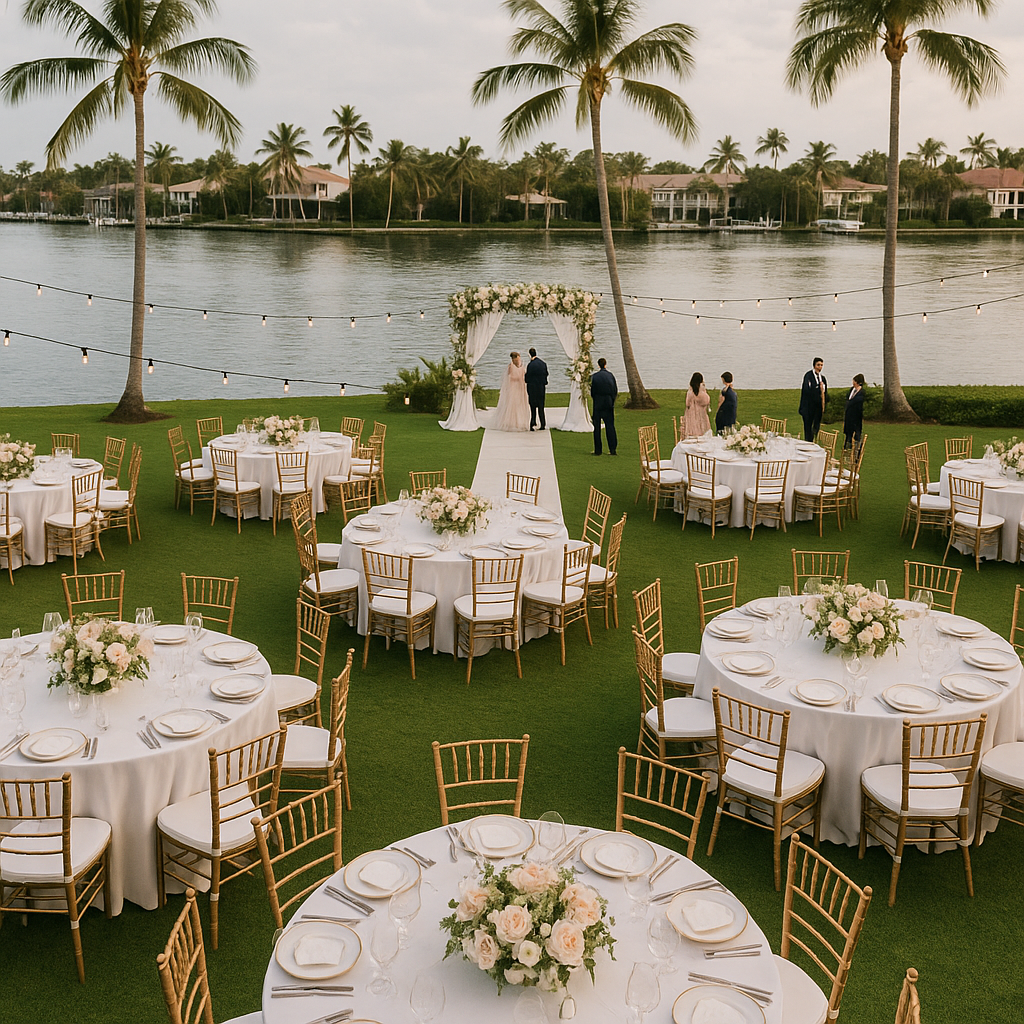
At 10:41 p.m. on a Saturday in the Redland, a couple has to choose. The dance floor is finally full, the father-daughter dance hasn't happened yet, and the venue's amplified-sound cutoff is 11:00 p.m. sharp — not a suggestion, not a fade-out, a hard stop written into the property's Certificate of Use. One of those two things is getting cut. Nobody decided that at 10:41. It was decided months earlier, in a zoning ordinance nobody read, and then quietly ratified every time the timeline got pushed fifteen minutes.
The real fight isn't about volume. It's about who gets to define "loud."
South Florida is in the middle of a genuine policy argument about how noise should be measured. Residents in unincorporated Miami-Dade have been pushing the county to enforce noise with sound level meters instead of an officer's judgment, because the county's core rule — Section 21-28 of the county code — simply prohibits "unreasonably loud, excessive, unnecessary or unusual noise" and attaches penalties of up to a $500 fine and up to 60 days in jail. There is no number in it.
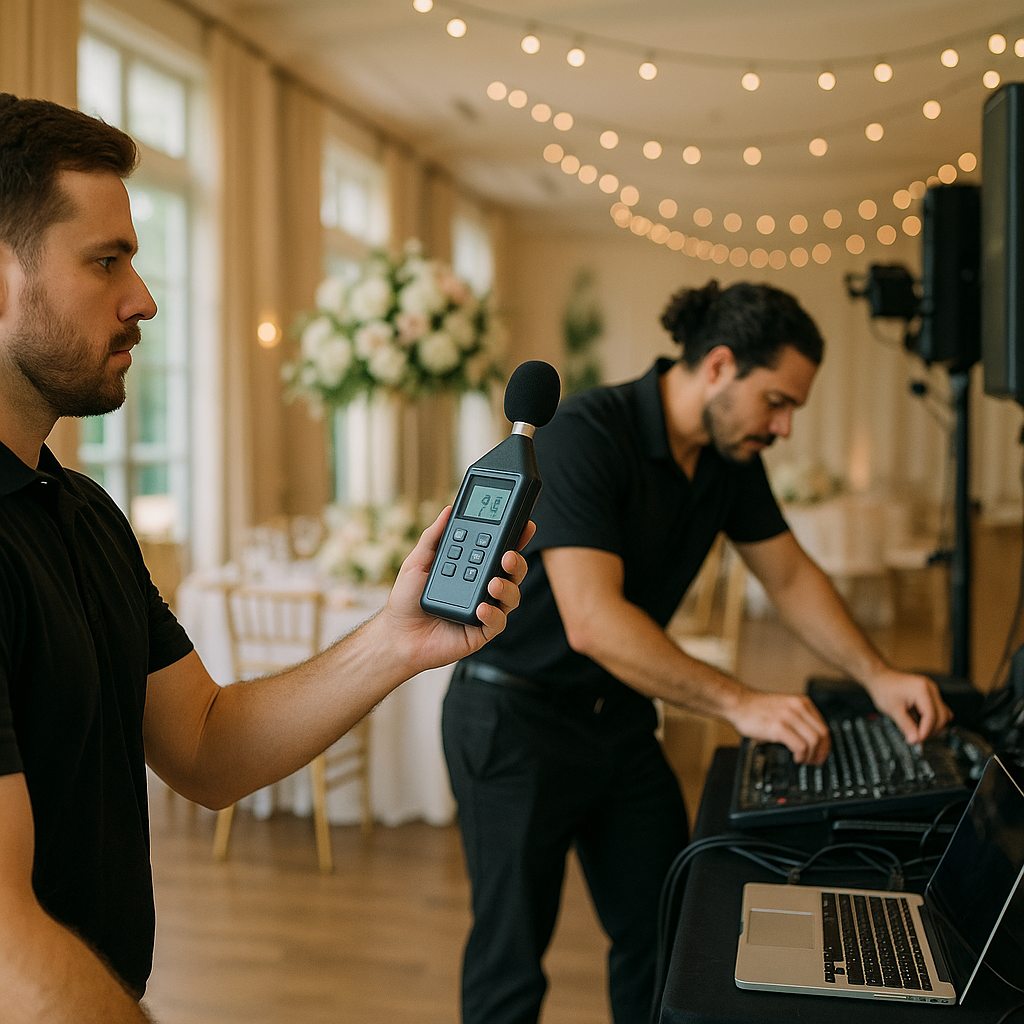
Broward's larger cities went the other direction years ago. Fort Lauderdale rebuilt its noise chapter around measured limits, and in a 2024 amendment added dBC limits alongside dBA specifically to capture low-frequency energy — the bass from a music system — which travels farther and passes through walls more easily than the midrange a standard A-weighted reading emphasizes. Hollywood took a third path and pushed the obligation onto the operator: any nonresidential establishment producing amplified musical entertainment must be equipped with a noise level detection device, with fines escalating from $100 to $500 to $1,000 for repeat violations inside six months.
None of this is academic when you're holding a microphone. The practical consequence is that four venues within a forty-minute drive of each other can be governed by four incompatible standards — and your reception timeline is what absorbs the difference.
Three rules can apply to the same lawn at the same time
The mistake that ends receptions early is assuming one authority governs the property. Usually more than one does. Miami Beach states it plainly: a special events permit does not grant the applicant the ability to violate the noise ordinance, both the county ordinance and the city's own Article IV apply on public and private property inside city limits, and the ordinance is in effect 24 hours a day.
| Where you're standing | What actually controls the music | What it means for the timeline |
|---|---|---|
| Unincorporated Miami-Dade, agricultural zoning (farm and barn venues) | Rural Event Venue rules under Ordinance 20-108 | Event hours 9 a.m.–11 p.m. No outdoor amplified sound or alcohol and food service between 11 p.m. and 9 a.m. |
| City of Miami | Chapter 36, plus county Section 21-28 | Amplified sound plainly audible at 100 feet is prima facie evidence of a violation — no meter required. |
| Miami Beach | Chapter 46, Article IV (Sections 46-151 to 46-162) | Responsibility is shared: the premises manager, the performer or DJ producing the sound, and whoever controls the volume are all on the hook. |
| Fort Lauderdale | Chapter 17, Noise Control | Measured dBA and dBC limits, plus an audibility test: not plainly audible past 50 feet by day, 25 feet after 10 p.m. |
| Hollywood | City noise ordinance | Detection device required for amplified entertainment; extended-hours licenses can be adjusted or denied after violations. |
Broward has a county noise article of its own, but for most receptions the binding constraint is municipal, and it is usually stricter than the county floor. Ask which city you are actually in before you ask what time the music stops. Weston, Sunrise, Davie and Southwest Ranches all write their own rules.
The rule that ends receptions is "plainly audible," not a decibel number
Couples fixate on decibels because decibels sound objective. But in most of South Florida, an officer doesn't need a meter to write you up. Under Fort Lauderdale's specific restrictions, sound that is plainly audible for one minute or longer at 25 feet from the source property line between 10 p.m. and 7 a.m. is the violation. Not "unbearable." Audible. A guest singing karaoke through a wedge monitor on a patio can trip that standard while the dance floor itself measures politely.
This is why the loudest thing at your reception is rarely the problem. The problem is the direction of the sound and the frequencies inside it. A subwoofer aimed across an open lawn toward a canal doesn't lose much energy before it reaches the houses on the far bank; the same subwoofer tucked against a wall, aimed into the guest count, dies fast. Fort Lauderdale's dBC addition exists precisely because that low end is what neighbors report. Speaker aiming, subwoofer placement and gain structure are production coordination decisions made during load-in, not volume decisions made at 10:30 p.m. after somebody has already called it in.
For reference on what these numbers mean physically rather than legally: OSHA's permissible workplace exposure limit is 90 dBA over eight hours, with hearing conservation triggered at 85 dBA, while NIOSH recommends staying below 85 dBA for the same period. Those are occupational standards, not event limits — but they're a useful sanity check that a dance floor running comfortably above 100 dBA is loud by any measure, ordinance or not.
Build the timeline backward from the cutoff, not forward from cocktail hour
Almost every reception timeline is written forward: doors, entrances, dinner, dances, open dancing. That structure guarantees that whatever slips lands on the last hour — which is exactly the hour the ordinance is going to take from you. Build backward instead, and treat the cutoff as a fixed wall.
| Clock (11 p.m. cutoff) | What's happening | Why it sits here |
|---|---|---|
| 10:58 | Final song ends | The song ends before the cutoff. It does not begin at 10:58. |
| 10:45 | Last high-energy dance set | Peak floor, no formalities left to protect. |
| 10:30 | Karaoke or feature moment closes | Vocals through monitors are the most complaint-prone sound of the night. |
| 10:00 | Bar and food service pace checked | At a Miami-Dade rural venue, service stops at 11 p.m. too — not just music. |
| 9:15 | All formal dances and toasts complete | Anything irreplaceable is finished with 105 minutes of slack. |
| 8:45 | Timeline audit with the DJ | The one deliberate checkpoint where you decide what gets cut, calmly. |
The 8:45 audit is the item most couples skip and most regret skipping. Somebody — usually your planner tracking the municipal rule — should state out loud how many minutes of runway remain and which two items are expendable. Decisions made at 8:45 are choices. Decisions made at 10:41 are losses.
Ask the venue these five questions before you sign
- "Which municipality are we in, and does its ordinance use a decibel limit or an audibility test?" The answer changes what your sound team can do. Meters can be managed; audibility at 25 feet is managed by placement and direction.
- "Is your Certificate of Use current, and what does it say about hours and guest count?" For Miami-Dade rural event venues, the CU must be renewed annually, guests are capped at 150 under ten acres and 300 at ten acres or more, and only one event per day is permitted, up to three per week. A lapsed CU is your problem on the day.
- "Does the cutoff apply to indoor amplified sound, or only outdoor?" Many rules restrict outdoor amplified sound only. If there's an enclosed space, moving the last hour inside is a real option — plan the room flip in advance, not in a panic.
- "Who takes the complaint call, and what is your escalation policy?" Some venues cut power at the first complaint. Get that in writing before it happens.
- "What are the load-out restrictions?" This is the sleeper. Fort Lauderdale prohibits loading, unloading and handling crates and containers between 10 p.m. and 7 a.m. within 250 feet of a residential use. Music stopping at 11 doesn't mean trucks can be loaded at 11:15.
What a sound team actually does when a complaint lands
Turning the master fader down is the least effective response available, and it's the one untrained operators reach for first. It kills the party without fixing the cause, because the cause is usually a subwoofer firing across an open property line or a monitor pointed at a fence.
The useful moves are structural: reduce low-frequency output specifically rather than overall level, re-aim or relocate the sub so the neighboring property sits off-axis, bring the mains in closer to the guests so you can drop output without dropping perceived energy on the floor, and move vocals — DJ mic work and karaoke especially — off open-air monitors. A karaoke set is disproportionately risky outdoors: it's intermittent, human, and instantly identifiable at a distance, which is exactly what makes a neighbor pick up the phone rather than shrug.
The second useful move is timeline triage. If a complaint arrives at 10:15 with the parent dance still unplayed, that dance happens next, at moderate level, and the open dancing takes the hit. That decision has to belong to someone before the night starts.
Frequently asked questions
What time does the music actually have to stop?
It depends entirely on the property. At Miami-Dade rural event venues, outdoor amplified sound and alcohol and food service are prohibited between 11 p.m. and 9 a.m. Elsewhere, a 10 p.m. or 11 p.m. threshold typically tightens the standard rather than banning sound outright — after that hour, audibility distances shrink and measured limits drop. Your venue's contract or Certificate of Use is the controlling document, and it may be stricter than the ordinance.
Is there one decibel limit for a wedding in Miami-Dade?
No. Miami-Dade's general noise rule is qualitative, not numeric — which is the substance of the current public debate. Some municipalities within the county do set measured limits. Verify at the city level for your specific address.
Can we buy our way past the cutoff with a permit?
Sometimes a temporary permit or variance exists, but it is granted by the municipality, not the venue, and it takes lead time. Miami Beach is explicit that a special events permit alone does not authorize violating the noise ordinance. Treat any "we can usually go later" assurance as unverified until you see the document.
Who actually gets cited — us, the venue, or the DJ?
Potentially all three. Miami Beach's noise article assigns liability jointly to whoever manages the premises, the performer or DJ producing the sound, and whoever controls the volume. In practice, the citation lands where the officer stands, and the contractual fallout lands on the host.
Does karaoke count as amplified sound?
Yes. Any sound reproduced or reinforced through a speaker is amplified sound under these ordinances. Outdoors, karaoke is among the highest-risk formats because human vocals are recognizable at long distances and cut through ambient noise in a way instrumental music doesn't.
What happens if we ignore a first complaint?
Escalation is designed to be expensive. Hollywood's structure moves from $100 to $500 to $1,000 within a six-month window and can affect a venue's extended-hours license, which means your venue has a strong incentive to shut you down early to protect itself. Miami-Dade's code allows for a fine up to $500 and up to 60 days in jail.
This article is a planning reference, not legal advice. Ordinances are amended frequently — Fort Lauderdale's changed in 2024, and Miami-Dade's is under active public discussion — and municipal rules override general assumptions. Confirm current requirements with the city or county with jurisdiction over your venue address before finalizing a timeline.
Know your cutoff before you build your timeline
Tell us the venue address and we'll work backward from the rule that governs it — DJ, karaoke, sound placement and a run-of-show that puts every irreplaceable moment safely ahead of the wall.
Visuals