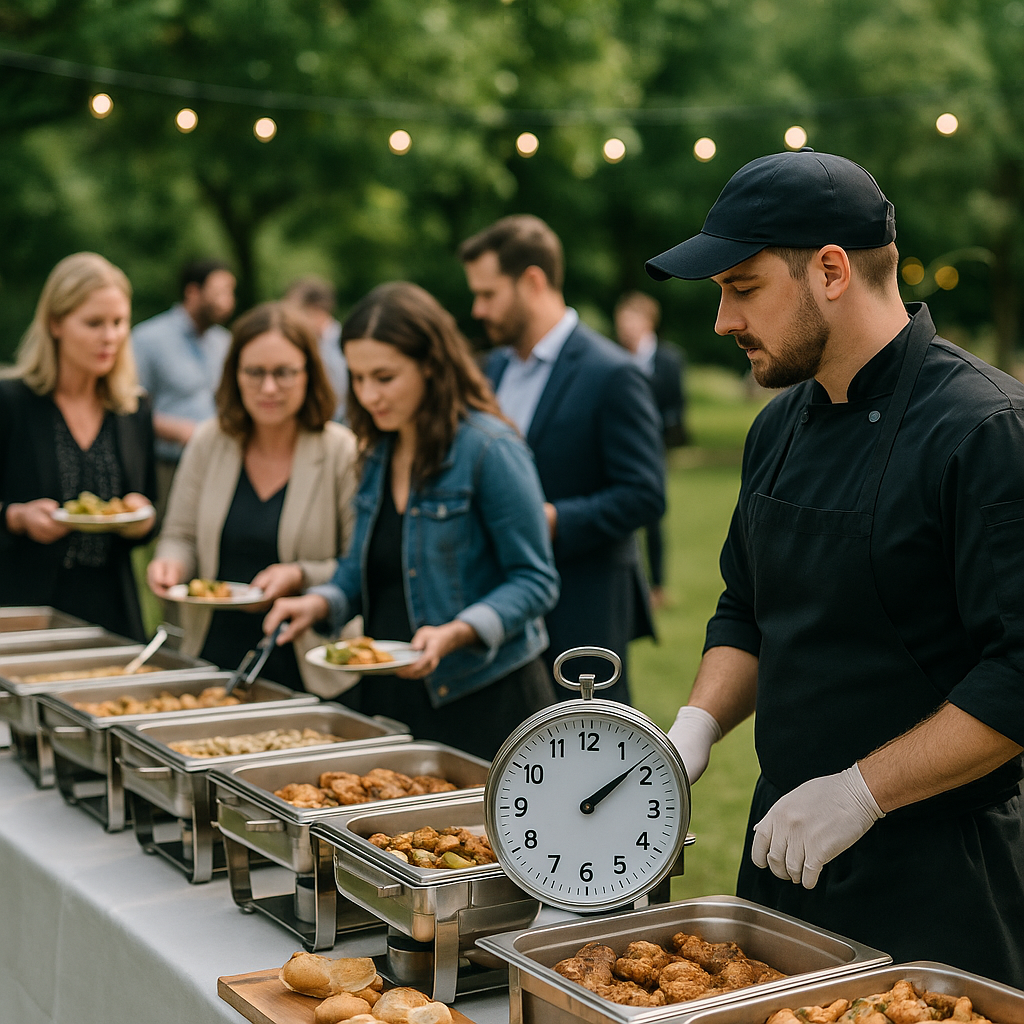
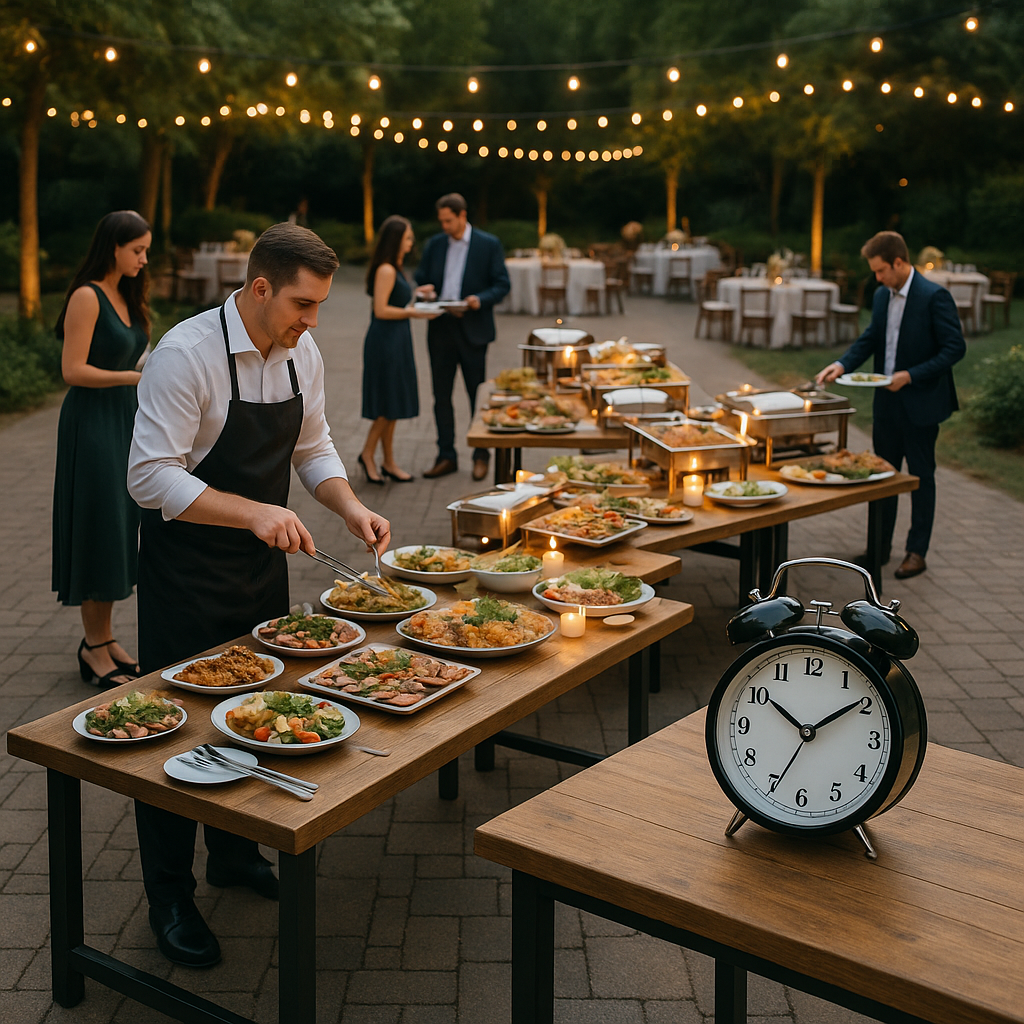
The 4-Hour Clock on Your Buffet: How Time-as-Control Rules Shape Outdoor Food Stations
At an outdoor event in South Florida, the biggest food-safety risk on a buffet usually isn't the menu. It's time. Heat, humidity, a long cocktail hour, a delayed toast, or a passing afternoon storm can stretch how long food sits out. That's why professional caterers plan stations around a clock, not just a layout. This guide explains what the "4-hour rule" actually means, where it comes from, and how it shapes batch sizes, replenishment, staggered stations, and late-night service.
Where the 4-Hour Rule Comes From
The 4-hour limit isn't a general rule of thumb. It is a specific provision in the FDA Food Code, Section 3-501.19, called Time as a Public Health Control (TPHC). The Food Code is a model code that states adopt, sometimes with changes. In Florida, the DBPR Division of Hotels and Restaurants regulates public food service establishments, and according to the division, it adopted the 2017 FDA Food Code effective November 1, 2019.
Normally, foods that need time and temperature control for safety (TCS foods), such as cooked proteins, rice, pasta, cut fruit, dairy-based dips, and seafood, must be held hot or cold. TPHC lets a licensed operator use time instead of temperature as the safety control, but only under strict conditions.
What the Rule Actually Requires
Under the 4-hour option in Section 3-501.19, as summarized in Florida's DBPR Time as a Public Health Control written-procedures form (HR 5022-090):
- The food must start at a safe temperature. Cold food at 41°F or below, or hot food at 135°F or above, at the moment it leaves temperature control.
- The food must be marked. Each pan or tray is labeled to show the time four hours after it left temperature control.
- The food must be served or discarded within four hours. Anything left at the deadline is thrown out, along with any unmarked or improperly marked food.
- There is no reset. Once time is being used as the control, the food may not go back into a refrigerator or hot box to "restart" the clock.
- Written procedures come first. The operator must have written procedures prepared in advance and available to the inspector. Florida's Rule 61C-4.010 allows operators to use the DBPR form as a guide or another format that covers all required elements.
The Food Code also includes a 6-hour option for certain cold foods. That option requires the food to start at 41°F or below and never exceed 70°F, which is hard to guarantee at an outdoor station in Florida. Most outdoor event planning works with the 4-hour version.
Two corrections to common myths: the four hours are total, not "four hours at a time," and the clock starts when food leaves temperature control, which may be in a prep tent well before the buffet opens.
The 4-Hour Rule vs. the "2-Hour Rule" You've Heard Of
Guests often know a different number. The CDC and USDA advise home cooks to discard perishable food left out for two hours, or one hour when the air temperature is above 90°F. That consumer guidance uses slightly different temperature points (40°F and 140°F) and assumes no written procedures, monitoring, or labeling.
TPHC is a regulated, documented system for licensed food operations. It is not permission to leave food out longer without thought. If your event is self-catered, potluck-style, or handled by someone without TPHC procedures in place, the more conservative 2-hour / 1-hour guidance is the sensible baseline, especially on a hot afternoon.
How the Clock Shapes Outdoor Station Design
Smaller batches
Because the deadline applies to each pan, a large tray put out at 7:00 p.m. must be finished or discarded by 11:00 p.m., even if guests barely touched it. Smaller pans, sent out more often, mean each batch spends less time on the line, less food is wasted at the deadline, and the station looks fresh for late arrivals instead of picked over.
Replenishment with a plan
Good replenishment is scheduled, not reactive. Typical practices include:
- Pan swaps, not top-offs. Replace a pan with a fresh, newly marked one rather than pouring new food on top of old. Mixing batches makes the discard time impossible to track.
- Visible time labels. Stickers, time tape, or a station log so any staff member can see the discard time at a glance.
- A named owner per station. One person responsible for watching times and pulling expired pans.
Staggered stations
Opening every station at once starts every clock at once. Staggering stations, for example cold appetizers during cocktail hour, hot entrées after toasts, and desserts later, spreads the clocks across the evening. It also smooths guest flow and reduces lines, which matters when guests are standing in the heat.
Temperature control still matters
TPHC is optional. Many stations keep food under temperature control instead, using chafers, induction or hot-holding equipment, and ice beds or chilled wells for cold items. Outdoors in South Florida, direct sun, wind affecting fuel-based warmers, and humidity all make holding temperatures harder to maintain. A caterer should be able to explain which items are held hot or cold and which, if any, are on a time control.
Late-Night Service Timing
Late-night food is where the 4-hour clock is easiest to overlook. If the dinner buffet opened at 7:30 p.m. under time control, that food reaches its limit around 11:30 p.m. It can't be chilled and brought back out as a midnight snack. Plan late-night bites as a separate service:
- Fresh pull or fresh prep. Late-night items should come from temperature control or be prepared close to service, not from dinner leftovers.
- Built for short windows. Late-night stations often run 30 to 60 minutes, which suits small, hand-held portions made to order or batched in small quantities.
- Timed to the program. Line up service with the moment guests actually want it, usually after the dance floor peaks, rather than an arbitrary hour.
Questions to Ask Your Caterer and Venue
- Which items will be held hot or cold, and which, if any, will use time as the control?
- Do you have written TPHC procedures, and who on site is responsible for marking and discarding?
- How will you protect stations from direct sun, rain, and wind at this site?
- Does the venue have its own food-handling, outside-catering, or open-flame requirements?
Requirements can differ by license type, venue, and jurisdiction, and they change over time. For anything specific to your event, confirm with your venue and the authority having jurisdiction, which in Florida is generally the DBPR Division of Hotels and Restaurants for licensed public food service.
At VNV Events, we plan station layouts, batch sizes, and service timing together with the event program, so the food stays safe and the buffet looks as good at the last song as it did at the first toast.
FAQs
How long can food sit out at an event?
It depends on who is serving it and how. A licensed operator using written Time as a Public Health Control procedures may hold certain foods out of temperature control for up to four hours total, then must serve or discard them. For home-style or informal events, the CDC and USDA recommend discarding perishable food after two hours, or one hour above 90°F.
What is time as a public health control?
It is an FDA Food Code provision (Section 3-501.19) that allows licensed food operations to use a strict time limit instead of hot or cold holding. Food must start at a safe temperature, be marked with its discard time, and be served or discarded within the limit, with written procedures available to inspectors.
Can food go back in the fridge to restart the 4-hour clock?
No. Once time is being used as the control, the food may not be returned to temperature control to extend its life. When the time is up, it is discarded.
How can I ensure catering station food safety?
Use smaller batches, swap pans instead of topping them off, label discard times, stagger station openings, maintain proper holding temperatures for items under temperature control, and plan late-night food as a separate, fresh service. Confirm site-specific requirements with your venue and the authority having jurisdiction.
Visuals