
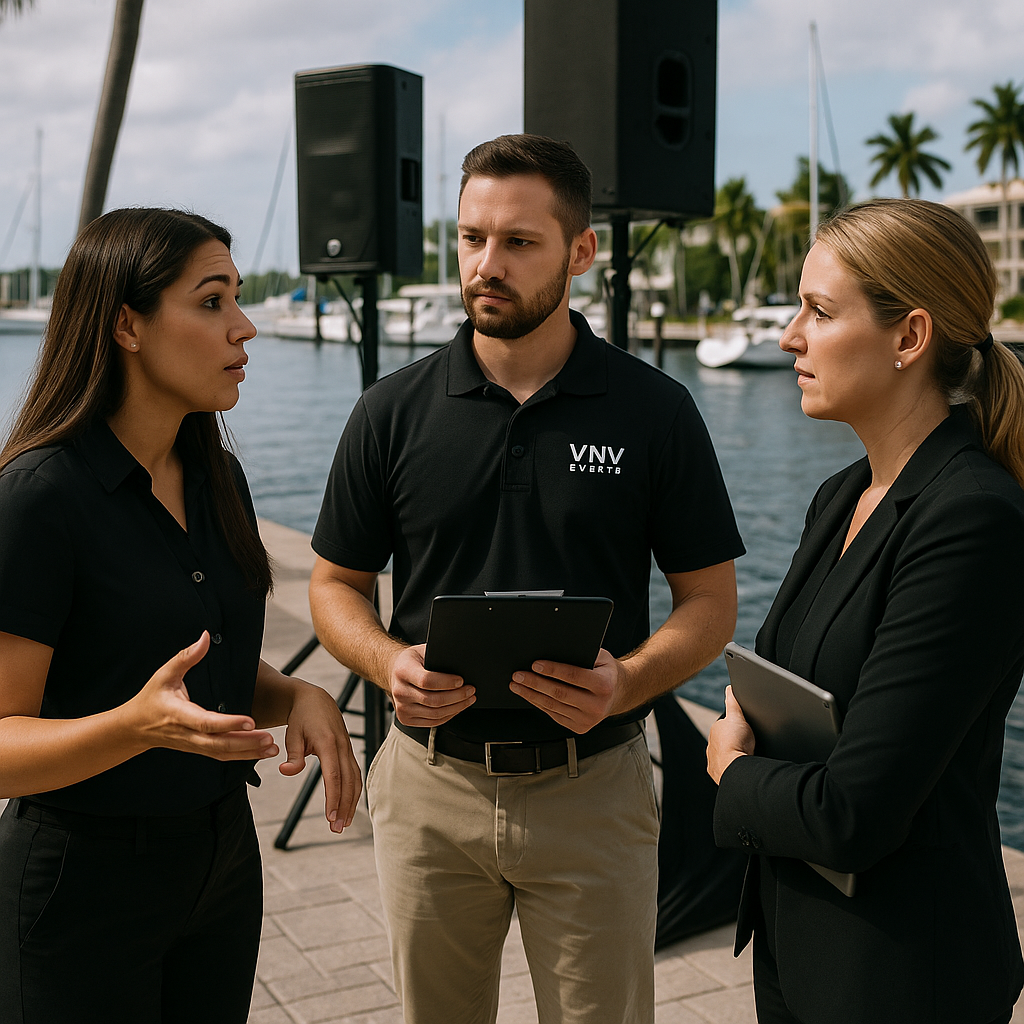
On paper, a waterfront site sells itself. Open sky, a working marina behind the head table, sunset in the direction of the ceremony. Then load-in day arrives and the same features that made the photos work start making decisions for you: the breeze picks up at 3 p.m., the truck can't get within 200 feet of the setup, and the sound that felt reasonable on the deck is landing in someone's living room across the canal.
Broward's waterfront inventory — the Intracoastal, the New River, the canal system that reaches well inland, and the lakefront clubhouses west of I-95 — is genuinely excellent for events. It also punishes plans built on averages. What follows is the operational side of these venues: the wind, access and sound realities that tend to surface late, and how experienced teams design around them early.
Why waterfront sites behave differently
Three physical conditions drive almost every waterfront problem worth planning for.
First, there is nothing upwind. Wind crossing open water arrives without the buildings, tree lines and terrain that slow it down inland, so a site two miles from the coast and a site on the seawall can feel like different weather on the same afternoon.
Second, water is an efficient surface for sound. It absorbs and scatters far less than grass, landscaping or built structures, which means your music carries much farther in the direction of the water than the volume at the dance floor suggests.
Third, the ground moves. Floating docks rise and fall with the tide, gangway slopes change over the course of an evening, and dock and deck surfaces frequently rule out staking anything.
Everything below is downstream of those three facts.
Wind: plan for the load, not the forecast
The forecast tells you what the day looks like. What you actually need to know is how much surface area you're putting into the air and what happens to it when the breeze doubles for twenty minutes.
Time of day matters more than most timelines admit
Coastal South Florida commonly sees a sea breeze that builds through the day and eases after sunset. Early mornings and evenings are frequently the calmest windows; mid-to-late afternoon is often the least forgiving. That pattern is worth checking against your own site and season, but it should inform when you set delicate décor, when you raise a tent top, and whether a 4 p.m. outdoor ceremony is the right call for that specific location.
Know what has sail area
Walk your design and flag anything that catches wind: tent tops and sidewalls, draping, market umbrellas, signage and easels, projection screens, floral installations on stands, arbors, tall centerpieces, loose menus and escort cards, and open flame of any kind. Each of these is a decision, not a given. Low-profile arrangements, weighted or clipped linens, heavier cocktail table bases, hurricane glass around candles, and slot-mounted cards instead of loose paper solve most of it at the design stage rather than during service.
Ask your tent and rigging vendors the hard questions
On seawalls, pavers and decks, staking is often impossible, so structures depend on ballast — which adds significant weight in concentrated points. That weight matters on docks and elevated decks, and the venue or dockmaster is the right party to confirm what a surface will carry. Before you sign, ask the vendor three things in writing: what the ballast plan is for this specific surface, at what conditions they will not install or will strike the structure, and who has the authority to make that call on event day. A tent decision made at 2 p.m. by a person who was named in advance is a plan. The same decision made at 2 p.m. by a group text is not.

Access: map two routes, not one
Guest access and crew access are separate problems, and the second one is where budgets and timelines quietly break.
Measure the real load-in distance. The distance from where a truck can legally park to where the bars actually go determines cart trips, crew size and setup hours. A 30-foot difference is noise; a 200-foot cart path with a gangway in the middle changes the labor plan. Measure it during the site visit rather than estimating it from a photo.
Confirm the surfaces and the openings. Gate widths, dock and gangway load limits, service elevator dimensions at hotel and club properties, and whether wheeled carts can cross the surfaces in question. Floating docks change slope with the tide, which affects both crew hauling equipment and guests with mobility needs.
Build in bridge and traffic buffer. Routes along the Intracoastal and the New River involve drawbridges, and marine traffic can hold up a truck or a vessel at exactly the wrong moment. Buffer is cheaper than a late ceremony.
Check what else is happening on site. Many waterfront locations share parking with public boat ramps, parks and restaurants. Peak weekend ramp traffic is a real variable for guest arrival, valet staging and vendor parking, and it's worth asking the venue what a typical Saturday looks like at your event hour.
If a vessel is involved, boarding time is a hard deadline. Capacity is fixed, boarding takes longer than planners assume, and departure doesn't wait. Guest communication has to be far more explicit than for a land venue — including where to park and how long the walk to the dock actually is.
Finally, confirm the unglamorous infrastructure: restroom availability, where power comes from, where a generator can sit without pointing exhaust and noise at guests, and how trash and kitchen waste leave the property. On marinas and docks, these answers are often "not where you assumed."
Sound: the party isn't the problem, the direction is
Sound over water travels farther and with less loss than sound over land, and it can carry across a canal to homes that feel far away from the event. The practical consequence is that measuring level at the dance floor tells you very little about what your neighbors are hearing.
A few approaches that consistently work better on open water:
- Aim inland. Orient the dance floor and speaker coverage so the primary throw is away from open water and residential frontage.
- Go distributed, not loud. Several smaller speakers placed closer to guests deliver the same perceived energy at a lower overall output than one stack fighting the distance.
- Control the low end. Bass carries the farthest and is what people notice from across the water. Subwoofer placement and level deserve as much attention as the mains.
- Walk the perimeter during sound check. Listen from the property line and, where possible, from the far side of the water at the levels you actually plan to run.
For ceremonies, wind is the enemy of intelligibility. Handheld and stand-mounted microphones in a breeze produce the rumble that ruins vows in the video. Lavalier or headset microphones with proper windscreens, a backup channel, and a plan for the moment a boat engine passes mid-sentence will do more for the ceremony than adding speakers.
Noise limits, curfews and amplification rules differ from one property and municipality to the next, and they change. Get the specific requirements for your site from the venue in writing during contracting, and design the audio plan to sit comfortably inside them rather than testing the edge on event night.
The conditions nobody puts on the run sheet
- Tides. Check the tide chart for your date. Unusually high tides can affect low docks, seawall-adjacent walkways and some parking areas.
- Salt and moisture. Salt air and overnight condensation are hard on consoles, cabling, lighting fixtures and generators. Cover gear during breaks, and factor cleaning and protection time into strike.
- Sun angle. A west-facing ceremony that photographs beautifully at 7 p.m. can put your guests squarely in the glare at 5:30. Confirm the sun's position at your actual ceremony time, not in general.
- Insects at dusk. Near mangroves and still water, lighting choices and treatment timing affect guest comfort more than décor does.
- Rain plan as a place, not a hope. A rain plan is a specific covered location, a stated decision time and a named decision-maker. Fast-moving cells are normal here; scrambling in real time is optional.
Not all "waterfront" venues are the same category
Comparing waterfront options in Broward means comparing different operating models, not just different views:
- Private clubs tend to have established vendor requirements, in-house services and firm internal processes. Your flexibility is defined by their standards.
- Municipal marinas and waterfront parks often involve permitting, shared public access and defined hours, with more setup freedom but more coordination.
- Hotel and resort decks and terraces bring reliable infrastructure and service elevators, plus other guests, other events and shared loading.
- Private docks and estate properties offer the most design latitude and the least built-in infrastructure — power, restrooms, kitchen space and parking all have to be brought in.
- Charter vessels impose fixed capacity, fixed timing and the most demanding load-in of the group, in exchange for an experience nothing on land replicates.
- Inland lakefront clubs soften the wind and sound exposure of a coastal site, but open water is still open water — the same design principles apply at lower intensity.
Whichever category you're in, the questions are the same: what does the surface allow, how does equipment get in and out, and where does sound go?
FAQs
What types of events are best suited for waterfront venues?
Ceremonies, cocktail receptions, seated dinners and brand or client events all work well, because the setting does much of the visual work for you. The better question is which parts of your event belong outdoors. Many strong waterfront programs keep the ceremony and cocktail hour on the water and move dinner and dancing to a covered or enclosed space — protecting the audio, the linens and the timeline while keeping the reason you chose the site.
Are there restrictions when planning events at marina venues?
Frequently, yes — commonly around amplified sound and end times, alcohol service, open flame, anchoring or ballasting structures, vessel movement during the event, and what can be attached to docks or railings. These vary by property and jurisdiction and can change, so treat them as contract items: request the current written rules before you sign, and confirm them again as the date approaches.
How do I manage sound effectively at an outdoor event?
Reduce the distance sound has to travel rather than increasing volume. Use multiple speakers positioned near guests, orient coverage away from open water and homes, manage the low end carefully, and sound check at your real event levels while listening from the property line. For spoken word, use microphones designed for wind and always carry a backup.
When should I book a site visit — and who should be there?
Before contracting, and with your production team present, not just the planner and the client. A venue walk-through that includes the people responsible for tent, power and audio surfaces the load-in distances, surface limitations and sound orientation issues while you still have the leverage to choose a different site or redesign the layout.
Getting it right on the water
Waterfront and marina events reward preparation more than almost any other setting in South Florida. The wind, the access constraints and the way sound moves over water are all predictable enough to plan around — as long as someone is doing that work months before the date rather than on the morning of.
If you're evaluating a waterfront site in Broward and want production judgment in the room before you sign, VNV Events can walk it with you.
Build the waterfront plan as one system
Bring access, power and staging into the conversation with event production, confirm the physical setup through event rentals, and review coverage with the DJ and sound team.