Beach Events in Turtle Season: The Lighting Rules That Can End Your Reception at 9 PM
Oceanfront weddings · Permits, lighting and run-of-show
A couple books a Saturday in late June. Ceremony on the sand at 7:30, sunset photos, dinner under bistro string lights, first dance at 9:15. Then the special event permit comes back with a condition nobody read out loud: no lighting associated with the event is authorized after 9:00 p.m. during marine turtle nesting season. Not dimmed. Not amber. Off. The first dance is now happening in the dark, or it is happening somewhere else. That decision — which is not a lighting decision, it's a timeline decision — is the whole article.
The 9 p.m. condition is a permit term, not a suggestion
Florida's standard special event permit conditions for marine turtle protection attach to beach events during nesting season and state plainly that no event lighting is authorized after 9:00 p.m. Miami Beach wrote the same cutoff into its own code in October 2024, when the City Commission strengthened its Turtle Nesting Protection Ordinance: under Ordinance 2024-4652, special event lighting cannot be visible from the beach after 9 p.m., any authorized lighting must be low-wattage, long-wavelength, shielded and directed away from the beach, and beach events with lighting needs require a permit from the Florida Department of Environmental Protection.
The state's Model Lighting Ordinance (Chapter 62B-55, F.A.C.) goes further in the template most coastal governments copy from: special event lighting that may be directly, indirectly, or cumulatively visible from any portion of the beach is not authorized at nighttime during nesting season. "Cumulatively" is the word that catches people — twelve small fixtures that each look harmless can add up to a glow that a compliance officer will treat as one violation.
Underneath all of it sits real enforcement authority: sea turtles are protected by the federal Endangered Species Act and by Florida's Marine Turtle Protection Act (§ 379.2431, F.S.), which restricts disturbing, molesting or harassing turtles, nests and eggs, and protects nesting habitat itself.
Your season depends on which side of a county line you're standing on
There is no single statewide date range, and the differences are large enough to change which venue you book. Confirm the current rule for your exact address before you sign anything — FWC maintains an interactive map of local lighting ordinances, and municipalities amend these regularly.
| Jurisdiction | Nesting season used for lighting rules | Practical effect on an evening event |
|---|---|---|
| Broward and Palm Beach counties (also Martin, St. Lucie, Indian River, Brevard) | March 1 – October 31 | Eight months of the calendar. A March beach ceremony in Fort Lauderdale is already inside the season. |
| Miami Beach (city ordinance) | April 1 – October 31 | Stricter than the state default for Miami-Dade; also applies to properties west of the Coastal Construction Control Line. |
| Miami-Dade and most other coastal counties (state default) | May 1 – October 31 | April is generally outside the season, but city rules can and do override. |
Broward has been running this longer than most. Under the Broward County Beach Lighting Management Plan, every coastal municipality must adopt and enforce a lighting ordinance, and the county's Sea Turtle Conservation Program runs night beach lighting surveys from March through September, documenting non-compliant properties by street address with photos. Fort Lauderdale's compliance process issues an inspection notice with ten days to fix the problem, then escalates to a Special Magistrate hearing where daily fines can be imposed. Venues carry that history. If a hotel has been cited before, its risk tolerance for your uplighting plan will be close to zero.
The sunset math nobody runs until it's too late
The 9 p.m. cutoff is fixed. Sunset is not. That gap is your entire window of lit, on-sand reception time, and it swings by more than an hour across the season.
- Late June: sunset lands near 8:15 p.m. in South Florida. You get roughly 45 minutes of illuminated evening before everything goes off.
- Late August: sunset near 7:50 p.m. — about 70 minutes.
- Mid-October: sunset near 7:00 p.m. — close to two hours, on the last stretch of the season.
Pull the exact figure for your date from the U.S. Naval Observatory's sun and moon data service before you build a run-of-show. A June date and an October date are not the same event with different weather; they are structurally different timelines, and the June one has to move dinner earlier or move the reception off the sand. This is the single most useful thing a planner can do at the date-selection stage, which is why it belongs in the conversation at date, permit and venue planning — not in a lighting revision three weeks out.
"Turtle-friendly" is a technical spec, and most rental inventory fails it
FWC's Wildlife Lighting Criteria come down to three words: keep it low, keep it long, keep it shielded. All three, not one of three.
- Long wavelength. The source must emit greater than 560 nanometers and be absent wavelengths below 560 nm — amber, orange or red LEDs — without the use of filters, gels, or lenses. An amber gel taped over a white par can does not comply. Neither does a 2700K "warm white" LED, which still emits plenty of blue and green below the cutoff.
- Shielded. Fixtures must meet or exceed full cutoff, so no light is projected at or above 90 degrees and the lamp or glowing lens is never directly visible from the beach.
- Low. Mounted as low as the purpose allows, at the lowest wattage that does the job, using the fewest fixtures.
Two corrections worth making early with clients. First, FWC is explicit that the common belief that turtles cannot see long-wavelength light is false — amber is less disruptive, not invisible, and too many compliant fixtures can still cause disorientation. Second, decorative lighting that serves no safety purpose — uplighting on vegetation, string lights, runner lights — is the first category FWC tells beachfront properties to simply switch off. That is exactly the category most beach wedding mood boards are built from. FWC also publishes a list of Certified Wildlife Lighting fixtures, which is the shortest path to a spec a venue and a code officer will both accept.
The rules that apply to everything else you put on the sand
Lighting gets the headlines. The rest of the permit conditions decide your load-in schedule, and they are where production plans quietly break. Under the marine turtle protection conditions attached to beach event permits:
- Any structure left out overnight needs three feet of vertical clearance beneath it and at least seven feet of horizontal clearance between supports where they meet the beach, sited as far landward as possible. Anything that doesn't meet that must be removed by sundown each day.
- All staging and storage of equipment and materials must be off the beach.
- Heavy equipment is prohibited, and street vehicles can't be used to move gear except where beach driving is allowed by local ordinance.
- Ruts, depressions, holes and mounds must be filled and raked smooth with hand tools each evening. No excavation landward of the mean high water line.
- No water from the event area may run onto the beach where it could reach a nest.
- If an unmarked nest is exposed, or a dead, injured or sick turtle is found, the marine turtle permit holder must be notified immediately and a report sent to FWC within 24 hours.
Read the clearance spec again and picture a standard sailcloth tent, a dance floor and a generator. The realistic answers are a same-day strike, an elevated deck structure with engineered clearance, or moving the covered portion of the event landward — decisions that belong to temporary structures and rental logistics and to the production team that owns the load-in schedule, not to a florist the week of.
Separately, construction and excavation activities seaward of the Coastal Construction Control Line generally require a permit from FDEP unless specifically exempt, and the CCCL program exists in part to protect marine turtles. Above-grade temporary structures for special events routinely land in that review. Start that conversation months out, not weeks — FDEP's application guidance is the place to confirm what your specific site needs.
How to build a beach event that ends dark and still feels finished
The compliant version of this event is not a worse event. It's a differently sequenced one.
- Anchor the run-of-show to sunset, backward from 9:00. Ceremony at golden hour, cocktails as the sky drops, entrances and first dance before 8:45. Everything that needs to be seen happens while there's still legal light.
- Design a two-zone event. Ceremony and cocktail hour on the sand; dinner and dancing upland — ballroom, terrace, tented deck west of the beach — where lighting isn't visible from the shoreline. The transition becomes a designed moment instead of an apology. Confirm the upland zone's rules too: Miami Beach's ordinance now reaches properties west of the CCCL.
- Spec battery-powered, FWC-certified amber fixtures for anything that stays past sunset, and shield every one of them toward the water. Fewer fixtures, mounted low, is both the rule and the better look.
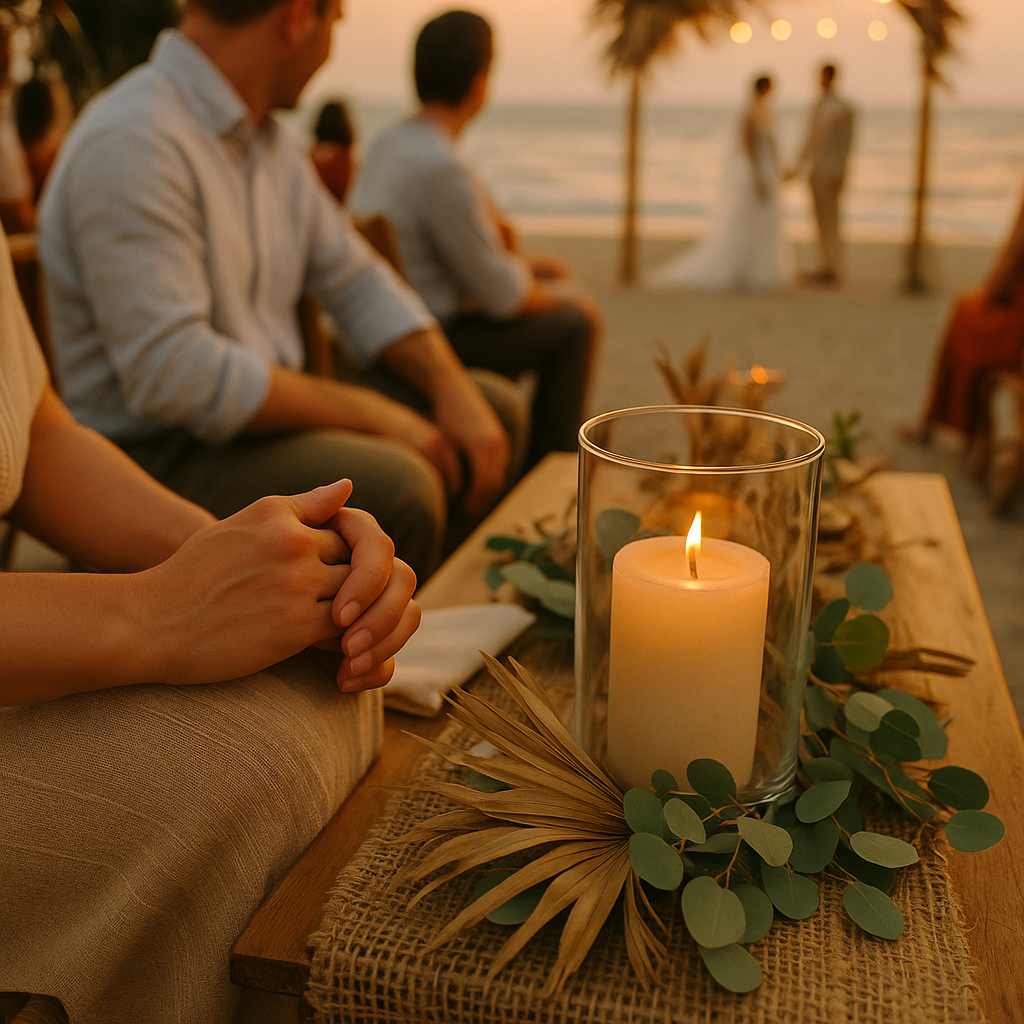
- Lean on light that isn't a fixture. Reflective and metallic tabletop, pale linen, white florals and moonlight do real work on a beach. Open flame is a separate fire-permit question at most venues — ask before you plan around it.
- Brief the guests and the vendors. Phone flashlights, ring-light selfies and a videographer's on-camera LED are all artificial light on a nesting beach. So is a photographer's flash. Put it in the welcome card and in the vendor call sheet.
- Write the strike plan into the contract. Hand-raking the sand at 11 p.m. is labor. Price it, staff it, and confirm who owns it before load-in day.
Why the enforcement pressure isn't easing
Florida is the center of gravity for this. FWC's statewide nesting survey recorded 66,476 green turtle nests in 2025 — the second-highest season on record — and 2,012 leatherback nests, a new statewide record. On the 27 core index beaches, loggerheads logged over 50,000 nests in 2025, returning to levels more commonly seen in the 1990s. More nests on more beaches means more monitoring, more night surveys, and less appetite from cities for a one-night exception.
Frequently asked questions
Can we just put amber gels on the uplights we already have?
No. FWC's criteria require a long-wavelength source above 560 nm with no wavelengths below it, without filters, gels or lenses. A gel over a white LED still leaks short-wavelength light. Rent or buy fixtures from FWC's Certified Wildlife Lighting list instead.
Our reception is on a hotel deck, not the sand. Does 9 p.m. still apply?
It depends on visibility, not on where your feet are. The governing test in the model ordinance and in Miami Beach's code is whether the light is directly, indirectly or cumulatively visible from the beach. A deck two hundred feet inland with a clear sightline to the shoreline can still be in scope. Get the venue's own ordinance status in writing early.
What if a nest is marked right where the aisle goes?
The nest wins. Nests are surveyed and staked by permitted marine turtle permit holders, and you design the layout around the stakes with adequate buffer — which is one more reason to finalize the floor plan close to the date rather than a year out on a rendering.
Can we do fireworks or a sparkler exit?
Treat both as prohibited on a nesting beach until a permitting authority tells you otherwise in writing. Miami Beach's updated ordinance restricts fireworks to offshore barges specifically to protect its nesting habitat, and a sparkler line is a moving artificial light source on sand.
Who actually gets fined — the couple, the venue, or the vendors?
Exposure varies by jurisdiction and by who holds the permit; local codes typically cite the property owner or the permittee, and the underlying state and federal wildlife protections apply to conduct, not job titles. Practically, the venue absorbs the ordinance citation and the permittee absorbs the permit violation, which is why the lighting plan should be attached to the permit application, not improvised on site.
Is there a season where none of this applies?
November through February is outside the nesting window everywhere in South Florida — and it's also the region's best weather. If an evening reception on the sand with full lighting is non-negotiable, the answer is a date change, not a lighting workaround.
This article is general information about publicly available regulations, not legal advice. Ordinances change and permit conditions vary by site and by year. Confirm current requirements with the permitting municipality, the county, FDEP and FWC — and get your specific conditions in writing — before committing to a date, a venue or a design.
Plan the beach date around the permit, not the other way around
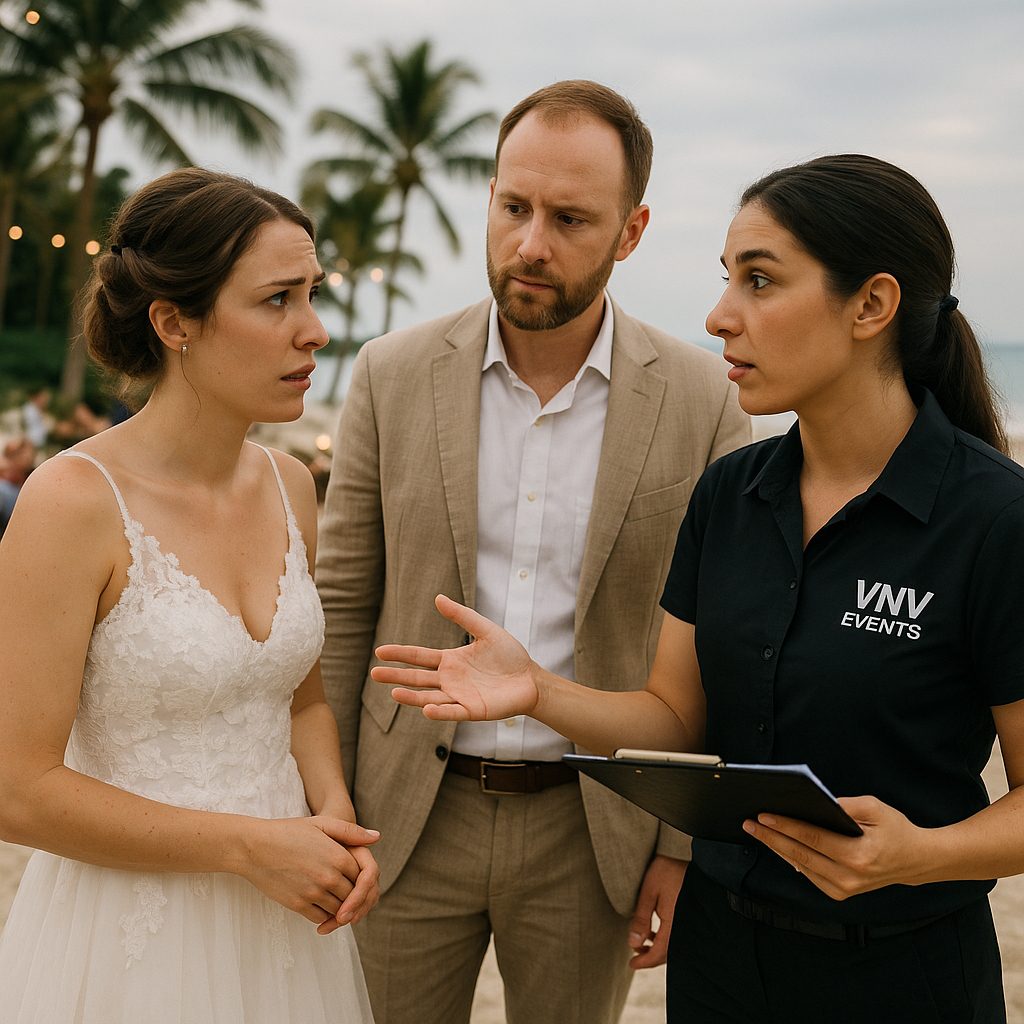
Most turtle-season problems are date problems disguised as lighting problems. VNV Events builds oceanfront run-of-shows backward from the local cutoff, specs compliant fixtures, and schedules load-in and strike around the sand conditions your permit requires — through our event production team and our planning team. Tell us your target month and stretch of coastline, and we'll tell you what the timeline actually allows.
Visuals