Cedar Doesn't Love Florida: Holiday Greenery vs. Tropical and Preserved
The garland looks perfect at Thursday load-in. By Saturday's cocktail hour it is shedding onto the head table, the room smells more like a warm attic than a forest, and someone from the venue is asking whether the fire inspector saw it. That is the actual decision behind holiday greenery in South Florida — not which greens look most like Christmas, but which ones will still look like Christmas at hour thirty of a three-day install.
Fresh cedar, fir and pine are not banned here and they are not automatically a mistake. They are simply the most fragile choice in the room, and the one that punishes long installs, unconditioned space and optimistic timelines. Tropical and preserved materials fail differently — and knowing exactly how each one fails is what lets you place it correctly instead of hoping.
What a South Florida December actually does to cut greenery
Start with the number that drives everything else. At Fort Lauderdale–Hollywood International, the 1991–2020 daily normals put December highs between 76°F and 79°F, with overnight lows in the low-to-mid 60s. That is not "mild winter." For a cut conifer bough, that is a full transpiration day, every day, with no cold night to slow it down.
The USDA's 2023 Plant Hardiness Zone Map places coastal Broward and Miami-Dade in zones 10b and 11a. Hardiness zones describe winter survival of living plants, not vase life of cut stems — but they explain the supply chain. Conifers are not a local crop, so every foot of fresh cedar garland arrives on a truck with days already on the clock. Cultivated greens, meanwhile, are a Florida industry: USDA floriculture data for the 2020 crop year credited the state with roughly 78 percent of the U.S. wholesale value of cut cultivated greens. Shorter chain, fresher stem, fewer unknowns.
Three material families, three different failure modes
Northern conifers: cedar, fir, pine, juniper
These fail by drying. Once a bough starts losing moisture faster than it can be replaced, needle drop accelerates and the material becomes both a housekeeping problem and a fuel load. Fresh conifer wants cold storage, hydration at the base where the design allows it, and the shortest possible gap between install and event. It does not want a loading dock, a sunlit terrace, or a Thursday install for a Sunday brunch.
Florida-grown tropical and cultivated greens
Monstera, palm, ruscus, leatherleaf and similar material handle heat and humidity far better — but they have a counterintuitive weakness: the cooler. Standard floral cold storage sits in the mid-30s Fahrenheit, and chilling-sensitive tropicals suffer tissue damage at those temperatures. A peer-reviewed review of tropical cut-flower postharvest handling documents chilling injury in heliconia, anthurium, bird of paradise and alpinia when they are moved in mixed cargo at conventional cold-chain temperatures. Tropicals also mark easily: standing surface moisture in still air invites botrytis, which is why Mississippi State Extension's care-and-handling manual for fresh-cut flowers and foliage treats airflow and sanitation as design decisions, not housekeeping.
Preserved and dried botanicals
Preserved eucalyptus, ruscus and magnolia are the default "solve everything" answer, and they solve a lot — until humidity gets involved. Glycerin-preserved foliage is stabilized with a humectant, and Mississippi State Extension is blunt about the consequence: treated foliage weeps solution in humid conditions, and those oily droplets can stain wood and textiles. On a shaded indoor mantel, that is a non-issue. Suspended over a client's rented linen at an open-sided December reception, it is a damage claim.
Side by side, for a real South Florida December
| Consideration | Fresh conifer (cedar, fir, pine) | Tropical / Florida cultivated greens | Preserved / dried |
|---|---|---|---|
| Primary failure mode | Dries out; needle drop; becomes fuel load | Chilling injury from cold storage; botrytis from trapped moisture | Weeping and staining in humidity; brittleness; dust |
| Cold storage | Wants it | Actively harmed by standard floral cooler temps | Irrelevant — store dry and dark |
| Multi-day and outdoor installs | Weakest choice | Strong, with airflow | Strong indoors; risky under open-sided cover |
| Reuse across a season | Effectively none | Limited | Best — if stored properly between dates |
| Fire-code posture | Most scrutinized; dryness is the trigger | Combustible decoration like any other | Combustible — "preserved" is not "flame resistant" |
| Best position | Short-window indoor focal moments, close to guests, installed late | Structural greenery, arches, tablescapes, tented and open-air work | Conditioned interiors, repeated activations, dry-mounted installations |
The code layer most décor conversations skip
Florida operates under the Florida Fire Prevention Code, 8th Edition (2023), which is the state-specific edition of NFPA 1 and NFPA 101 and took effect December 31, 2023. Local fire officials enforce it, and municipalities may layer their own amendments on top. Three practical implications for holiday décor:
- Dryness is the trip wire on natural cut greenery. The fire-safety logic is not about species, it is about moisture. The NFPA's own tracking of Christmas tree fires shows they are uncommon but disproportionately severe, and that the hazard climbs the longer dried material stays in place. A garland that sheds when a branch is shaken has changed categories.
- Decorative materials get tested, not trusted. The benchmark inspectors reference is NFPA 701, the flame-propagation test method for textiles, films and decorative materials. Preserved and dried botanicals do not pass by virtue of being preserved.
- Tents change the paperwork. Miami-Dade's short-term event permitting guidance expects flame-spread certification for tent structures, and Broward runs its own special-event permitting process with lead time built in. If greenery is going under cover, the tent and rental scope and the décor scope have to be reviewed together, not sequentially.
This is general information about how holiday décor interacts with fire and permitting requirements — not legal or code-compliance advice. The authority having jurisdiction for your specific venue and municipality makes the final call, and that conversation should happen before materials are ordered.
How to choose: match the material to the position
The useful question is not "traditional or tropical." It is: where will this piece physically stand, for how many hours, and who has to walk past it?
- Conditioned ballroom, single evening, late install. Fresh conifer is genuinely on the table here. Put it where guests will touch and smell it — entry moments, bars, a stair rail — and accept that it is a one-night material.
- Tented or open-air, December evening. Tropical and Florida-grown greens carry the structure. Keep preserved elements out of drip lines and off anything that will be laundered.
- Multi-week corporate activation or a lobby that has to hold from early December through the new year. Preserved and dried, installed dry, with a scheduled mid-run refresh. Fresh conifer will not survive the run, and pretending otherwise is how a year-end corporate program ends up re-buying greenery in week two.
- Mixed approach. The most durable holiday designs use preserved material for structure and volume, tropical greens for movement and scale, and a small, deliberate amount of fresh conifer placed where its scent and texture actually register.
Lead times and the decisions that actually lock
Two things drive the calendar: sourcing and inspection. Conifer volume for late December is committed well upstream, and permitting for tents and outdoor placement is not a same-week process. That means the greenery family should be settled before the floor plan is finalized — not after, when the only remaining variable is which vendor can still get cedar. Our planning team works these decisions in that order, and the floral decoration scope is where material choice, placement and install sequence get written down together.
FAQs
Can we use real cedar or fir at a South Florida holiday event at all?
Yes — with conditions. Keep the window short, install as late as the venue allows, keep it in conditioned interior space, and treat it as a single-use material. The problem is not cedar. The problem is cedar plus a three-day install plus an unconditioned terrace.
Does "preserved" mean fire-safe?
No. Preserved and dried botanicals are combustible decorative materials. Whether they are acceptable in a given space depends on the material, the treatment and the local fire official — the relevant benchmark is NFPA 701 flame-propagation performance, not the word "preserved."
Will preserved eucalyptus hold up under an open-sided tent in December?
It can look excellent, but glycerin-treated foliage can weep in high humidity and those droplets stain fabric and wood. Keep it off overhead positions above linen, seating and dance surfaces, or specify dried rather than glycerin-preserved material for those placements.
Why can't tropical greens just go in the cooler with everything else?
Because many tropicals sustain chilling injury at the temperatures that keep roses and standard foliage alive. Discoloration and blackening often appear after the cold exposure, not during it — which is why the damage shows up at install rather than at intake.
Can tropical greenery still read as "Christmas"?
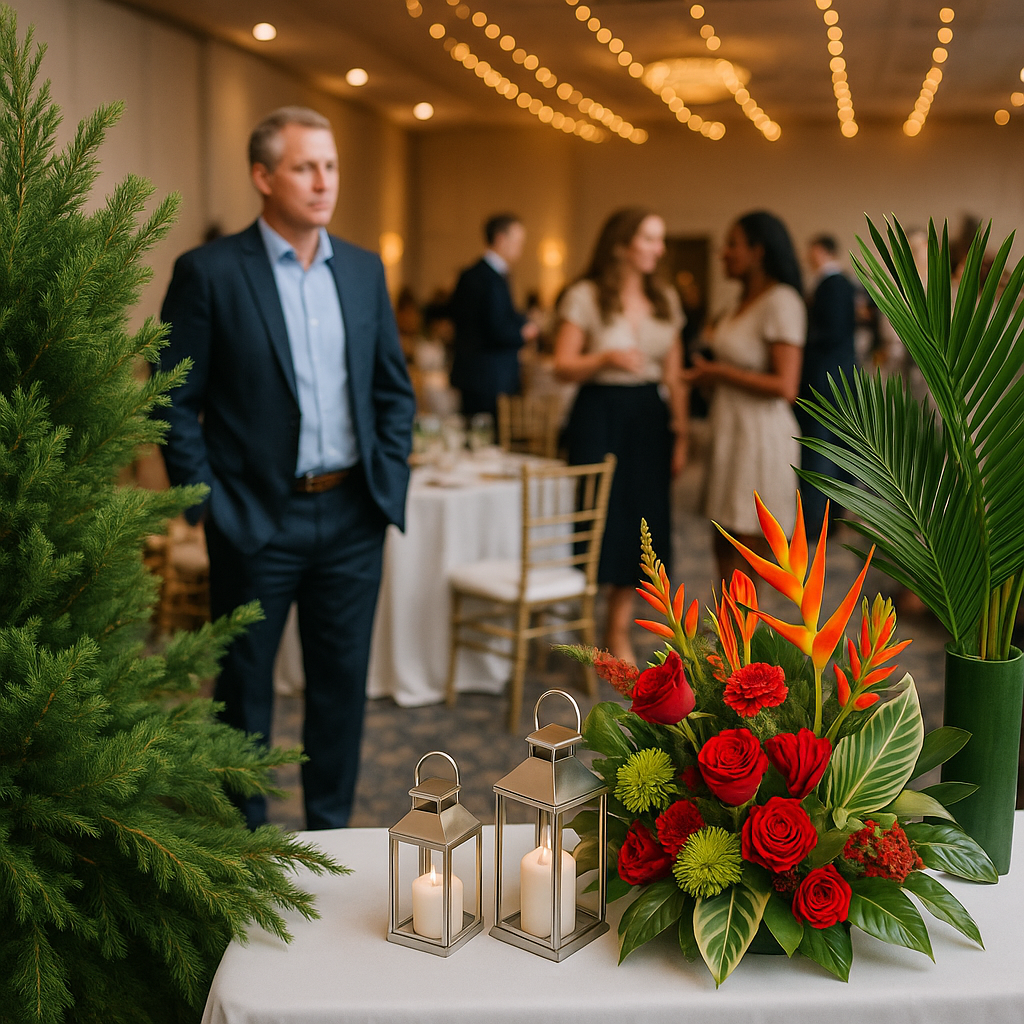
Yes, but the work happens in palette, repetition and form rather than species. Deep saturated color, metallic and candlelit texture, symmetrical repetition and generous scale read as holiday. Guests register the composition long before they identify the botany.
How far ahead should the greenery decision be made?
Before the floor plan is locked, and before any tent or outdoor placement goes to permitting. Material choice constrains placement, placement constrains permitting, and permitting constrains the calendar.
Choose your greenery by where it will stand, not by what it evokes. Cedar earns its place in a cool room on a short clock. Tropicals earn the tent and the long night. Preserved earns the weeks-long install — as long as it stays out of the humidity that undoes it. Decide the position first, and the material stops being a debate.
Design It for the Room It Will Actually Live In
Tell us where each piece has to stand, how long it has to hold, and what the venue's fire official expects — and we will build the holiday design around those constraints instead of around them. Start your floral conversation with us today!
Visuals