
Clear-Top, Sailcloth or Frame: What South Florida Humidity Does to Each One
The climate decision that comes before the style decision
Most tent decisions get made in the wrong order. A couple walks a February showcase, sees a clear-top glowing under string lights with palm silhouettes overhead, and books it for the second Saturday in September. Nine months later, at 8:40 p.m., a cold drop lands on the head table. Then another. The tent didn't leak — the sky was clear all night. What failed was a decision nobody made out loud: whether this event was going to be conditioned or open to the air. In South Florida, that single fork decides which roof works, and every aesthetic choice hangs off it.
The variable that ruins tents here isn't heat. It's dew point.
Relative humidity is a ratio and it moves all day. Dew point is the actual moisture load, and it barely budges between noon and midnight. The National Weather Service defines it as the temperature at which water vapor turns into liquid — condensation — and notes it will always be equal to or lower than the air temperature (NWS Tampa Bay, Dew Point Statistics). The same NWS office documents Florida summer dew points climbing above 80°F, with a Tampa station record of 86°F on August 6, 2000, and a stretch of seven straight days at or above 75°F in August 2024.
That number is the whole ballgame for a tent, because a tent is a thin membrane with almost no thermal mass. Any interior surface that falls below the dew point of the air touching it becomes a condensing surface. Two things push surfaces below dew point at an event:
- Radiational cooling after sunset. Under a clear sky, a roof membrane sheds heat upward and can drop several degrees below the surrounding air. When it crosses the dew point, the underside starts beading. This is the 9 p.m. "indoor rain" people blame on a leak.
- Air conditioning with an imperfect envelope. Chill the inside and every cold surface — frame legs, purlins, keder tracks, duct runs, the tent's own exterior skin — becomes a magnet for moisture from whichever side is warmer and wetter.
This is also why the most common piece of tent advice is half wrong. Fans move air; they don't remove water. When the dew point is in the mid-70s, a fan pushes saturated air across saturated skin and the evaporative cooling your guests are counting on simply doesn't happen — the same mechanism OSHA flags when it builds its outdoor heat guidance around water, rest and shade rather than airflow alone. Ventilation helps with stagnation and cooking odors. It does not dehumidify.
What each roof actually does at 2 p.m. and at 9 p.m.
Clear-top: a greenhouse by day, a condenser by night
Clear vinyl passes shortwave solar radiation straight through. Guests underneath don't just feel warm air — they absorb direct radiant load on skin, shoulders and the backs of necks, the same as sitting behind glass. Opaque white tops do the opposite: high solar reflectance is why the EPA describes reflective roof surfaces staying as much as 50–60°F cooler than conventional materials at peak summer. A clear top forfeits that advantage by design.
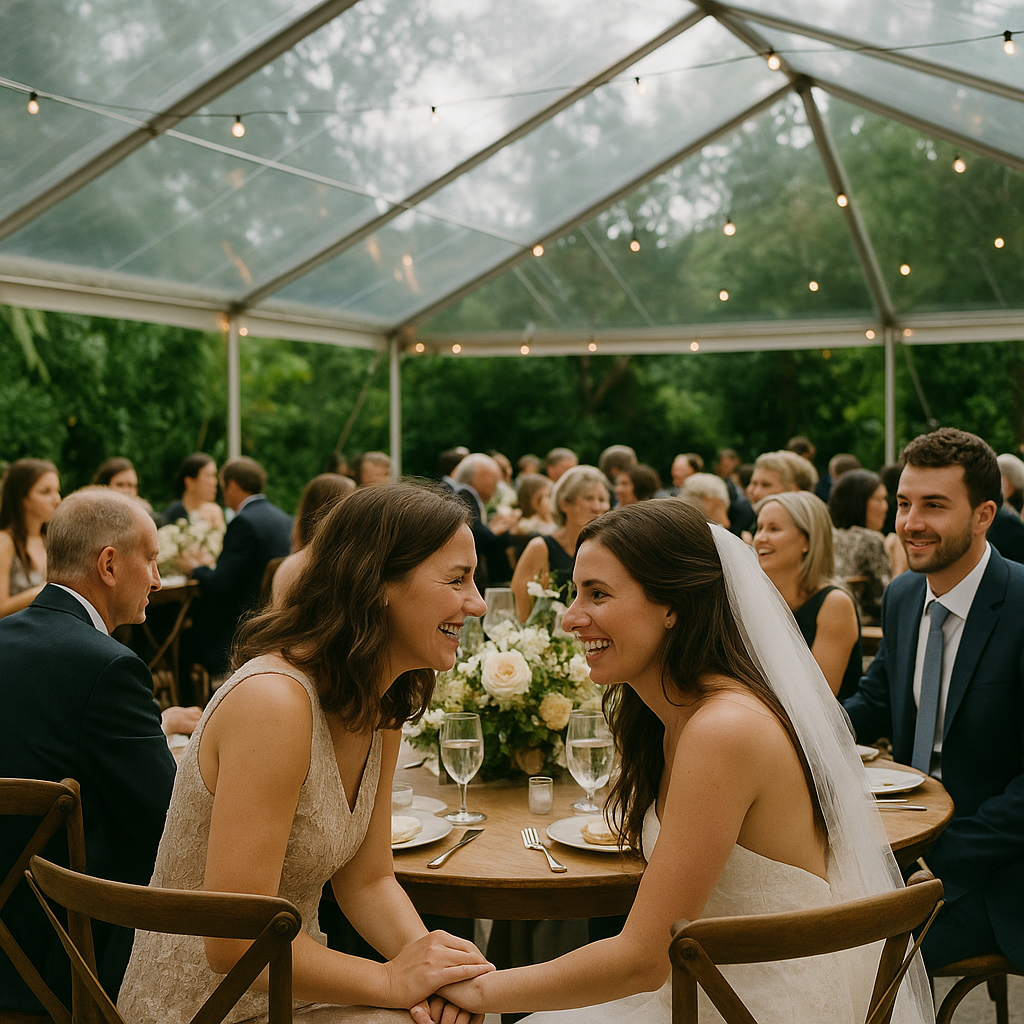
After dark, the clear top has the opposite problem. With nothing between the membrane and open sky, it cools fast, and the first droplets usually form at the low points of the roof panels and at the coldest metal in the structure. Clear-tops are not a mistake — they are spectacular for a 7:30 p.m. October dinner or a fully conditioned build. They are a mistake when someone assumes the tent alone will handle the climate.
Sailcloth: beautiful light, honest limits
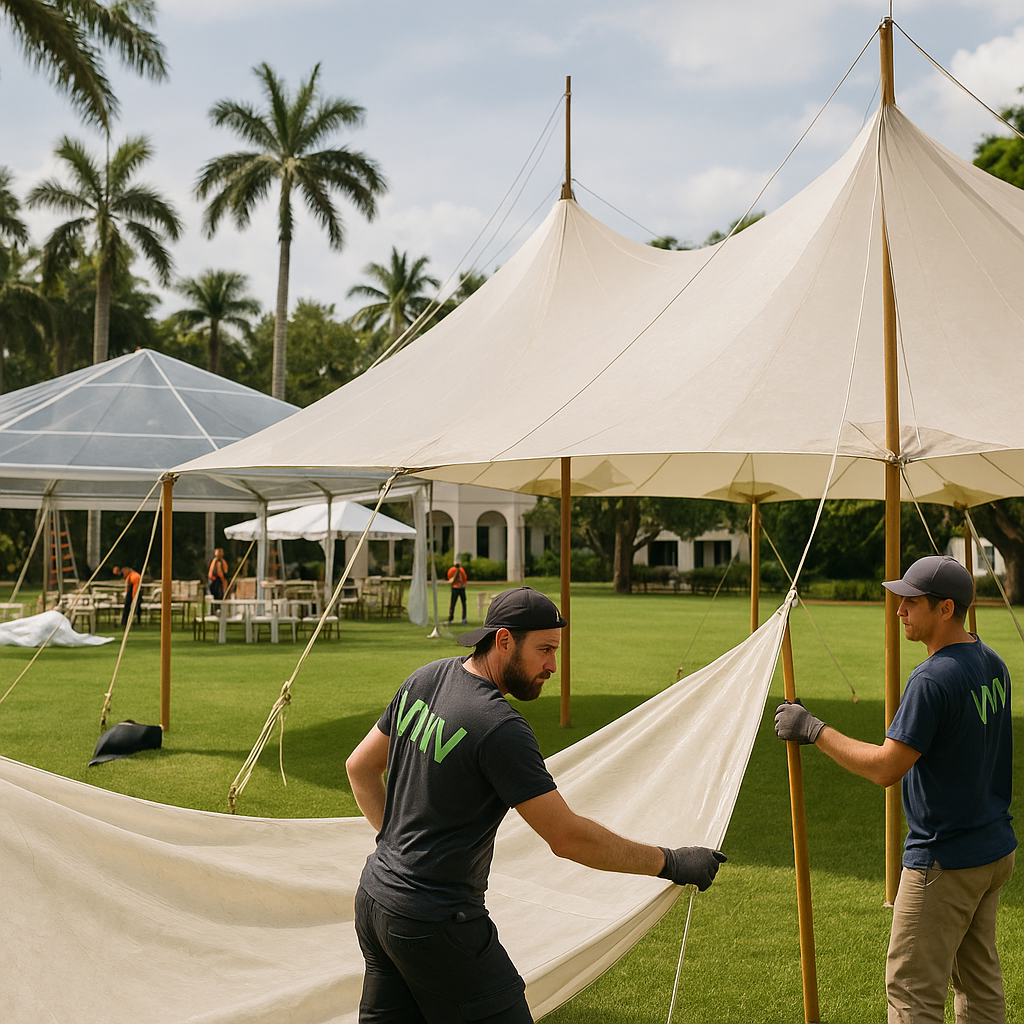
Sailcloth is a translucent tension structure. Diffused daylight and warm interior glow at night are the real draw, and the sculptural sag between poles photographs unlike anything else. Two limits matter here. First, it is a pole-and-tension system: center poles land in the floor plan, and the anchoring footprint extends well past the tent's shadow, which is a hard constraint on tight Broward and Miami-Dade properties. Second, sailcloth is the hardest of the three to seal properly, so it is the least suited to full mechanical cooling. Pick it when the plan is ambient air and a good breeze window — not when someone is going to ask for 74°F in August.
Frame: least romantic, most controllable
A frame tent carries its load in the structure, not in center poles or a wide guy-line spread. That gives you an unobstructed floor, ballast options on hard surfaces where staking isn't possible, and — the part that matters in this climate — an envelope you can actually close. Sidewalls seal, ducts enter cleanly, and the interior becomes a room instead of a shaded field. Frame tents also accept a clear roof section as a feature over a dance floor or bar without turning the whole structure into a solar oven.
Side by side, on the terms that matter
| Clear-top | Sailcloth | Frame | |
|---|---|---|---|
| Midday solar load | Highest — direct radiant gain on guests | Moderate — diffused, not blocked | Lowest with a reflective white top |
| After-sunset condensation risk | Highest and most visible | Moderate; fabric hides early beading | Moderate; shows first on metal, not fabric |
| Sealing for A/C | Workable in a frame version | Poorest fit | Best fit |
| Floor plan intrusion | None (frame-based) | Center poles | None |
| Anchoring footprint | Compact | Widest | Compact; ballast-friendly |
| Where it wins | Night receptions, conditioned builds, feature sections | Ambient-air events in cooler months, daytime luncheons | Any event that must hold a temperature |
Decide conditioned or ambient first. Everything else follows.
If the answer is conditioned, you are no longer buying a tent — you are building a temporary room, and it needs to behave like one:
- Solid sidewalls all the way around, with sealed corners and controlled entry points. Every open flap is a moisture inlet, and each one adds latent load the equipment has to remove before it can lower a single degree.
- A floor or ground barrier. Bare grass under a sealed tent evaporates continuously and quietly feeds the ceiling that will drip on you later.
- Cooling started hours before doors, not minutes. Pulling moisture out of furniture, linen, flooring and the membrane itself takes time; a unit switched on at guest arrival will blow cold air over a wet room.
- Insulated duct runs and a plan for where cold metal meets warm air. Uninsulated ducts sweat, and the drip lands wherever it lands.
If the answer is ambient, stop paying for a climate you won't get. Open the sides, take the reflective white top, shift the ceremony later, put shade over the bar and the queue, and build the timeline around the hours the site actually breathes. Both answers are legitimate. What fails is the middle: a beautiful sealed-looking tent with two units, four open flaps and an 11 a.m. start. Our planning team settles this fork before anyone picks a roof, and the tent and rental options get selected against that answer rather than the other way around.
What the code decides for you before taste does
Tent style is a preference. Permitting is not. Under the Florida Building Code, tents and membrane structures erected for less than 180 days are governed by the Florida Fire Prevention Code, which the State Fire Marshal adopts on a three-year cycle under Chapter 633.202, Florida Statutes, and which is enforced by the local fire official in each county, municipality and fire district — with local amendments layered on top.
Locally, thresholds are not identical from city to city. Unincorporated Miami-Dade requires a building permit for temporary tents and membrane structures larger than 10' × 12'. Weston requires a permit for structures over 120 square feet or intended for gatherings of ten or more, and states plainly that events with more than one tent of any size are not exempt. Fabric itself is regulated: South Florida fire departments require tent fabric to meet the flame propagation criteria of NFPA 701, and Hallandale Beach's special-event requirements cite Test Method 2 specifically, along with a minimum five-foot separation and protective fencing for generators. Miami-Dade's membrane-structure guidance adds extinguisher counts scaled to floor area and a fire watch for tents over 1,600 square feet, with no unauthorized open flames inside.
Two practical consequences for the humidity question. Generator separation distances mean your cooling equipment sits outside the tent with duct runs crossing guest paths — that has to be drawn, not improvised. And open-flame limits mean the chafing-dish plan interacts directly with the fire official's plan review.
This is general information, not legal, engineering or code-compliance advice. Requirements differ by jurisdiction and change between code cycles; confirm scope, thresholds and submittal deadlines with the authority having jurisdiction for your specific site and dates.
Catering under a wet roof
Humidity attacks the menu before it attacks the guests. Fried and crisp items surrender within minutes in saturated air. Cold displays sweat and pool. Ice disappears faster than anyone budgeted. And every chafer under a sealed tent is a small humidifier adding latent load your cooling equipment then has to remove.
Meanwhile the temperature rules don't relax because you're outdoors. Florida's guidance for temporary food service events holds the same line as any kitchen: hot foods at 135°F or above, cold foods at 41°F or below, with frequent probe checks. Under a clear top at 2 p.m., holding 41°F on a raw bar is an equipment problem, not a diligence problem. The fix is menu architecture — pick items that survive the actual conditions, stage cold service in the shaded or conditioned zone, and place the hot line where its moisture and heat exhaust away from seated guests rather than into them. That coordination between structure and kitchen is exactly what catering operations inside temporary structures have to plan around from the site visit forward.
The calendar is part of the tent spec
The Atlantic hurricane season runs June 1 through November 30, and the National Hurricane Center places the climatological peak at September 10, with most activity between mid-August and mid-October. That window overlaps the exact months when dew points are highest — which is why a September date carries two linked questions, not one: can the structure be conditioned, and what is the wind-and-weather decision protocol, including who calls it and by when. Anchoring, ballast and the strike plan belong in that conversation, not in a phone call the morning of.
Five things to settle before you sign
- Time of day, in writing. A 4 p.m. cocktail hour and an 8 p.m. one are different structural problems.
- Conditioned or ambient — chosen, not assumed. Then hold every later decision to it.
- The site's anchoring reality. Grass, pavers, seawall setbacks and buried utilities determine whether staking or ballast applies, which quietly rules some tent types in or out.
- Power and generator placement. Cooling capacity you can't feed, or can't legally position, is capacity you don't have.
- Permit lead time with the specific AHJ. The city, not the tent, sets this clock.
FAQs
Which tent type actually handles humidity best?
Framed differently: no fabric handles humidity. A sealed envelope plus adequate cooling handles humidity, and the frame tent is the easiest structure to seal. Sailcloth's airflow advantage is real in November and largely irrelevant when the dew point is in the mid-70s.
Why did water drip inside my tent on a night with no rain?
The roof membrane cooled below the dew point of the air beneath it and condensed that moisture into droplets — the same process the NWS describes for dew forming on grass. Clear tops show it first and most visibly because they radiate heat to open sky with nothing to slow the loss.
Can you air condition a clear-top tent?
Yes, in a frame-based clear-top with full sidewalls, a floor or ground barrier, controlled entrances and cooling started well ahead of guest arrival. What you cannot do is condition a clear-top with open sides and expect the equipment to win against continuous solar gain and infiltration.
Will fans or misters fix it?
Fans improve stagnant air and perceived comfort at moderate dew points. Misters add water to air that already has too much, which in this climate usually makes the problem worse. Neither is dehumidification.
Do I need a permit for a small tent in a private yard?
It depends entirely on the jurisdiction, the square footage, the occupancy and whether there is more than one tent. Thresholds differ across South Florida cities, so verify with the local building department and fire official rather than generalizing from a neighboring city's rule.
The decision, in one line
Choose the climate first, then choose the ceiling. A clear top over a properly sealed, properly cooled frame is a showpiece. The same clear top over an open field in September is a very expensive way to make your guests sweat in a photograph they'll remember for the wrong reason.
Visuals
Get the Climate Decision Right Before the Deposit
Send us your date, your site and your guest count, and we'll tell you what that combination can actually hold — conditioned or ambient — before anyone falls in love with a ceiling. Contact us to walk your site and build the tent, power and service plan around the weather you're going to get.