
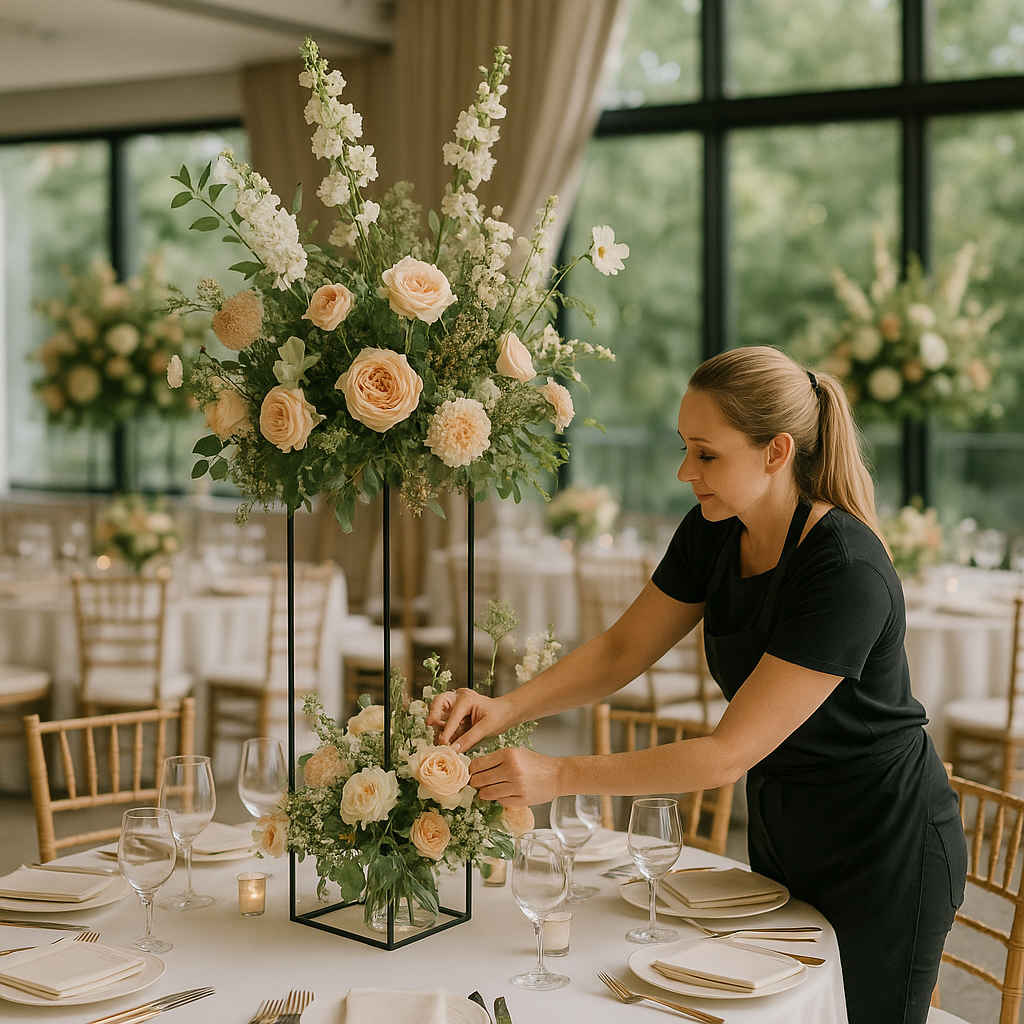
Foam-Free Florals: What Changes When Your Florist Drops the Green Brick
Five weeks before a Saturday reception in Fort Lauderdale, a couple gets a revised floral proposal. Same flower count. Same palette. Same ceremony arch. But three things moved: the centerpieces now sit in watertight ceramic compotes instead of shallow trays, install call time shifted two hours earlier, and there's a new line labeled on-site build. Nobody changed the design. The florist stopped using floral foam.
That is the part almost no article about "sustainable wedding flowers" tells you. Going foam-free is not a values checkbox you tick at the tasting. It is a mechanical decision that reshapes weight, water, labor hours, transport, and the last ninety minutes before doors open. Some of those changes are in your favor. A few will cost you something. You should know which is which before you sign.
What the green brick was actually doing for you
Floral foam is a phenol-formaldehyde plastic, first developed in the 1950s, and it solved three problems at once: it held stems at any angle, it acted as a water reservoir, and it let a designer build a finished arrangement in a workroom and ship it upright. The Sustainable Floristry Network notes it can hold up to fifty times its own weight in water, which is why a saturated brick the size of a paperback could feed forty stems for a weekend.
That combination is what made foam so hard to give up. It is a reservoir with no walls. Take it away and the water has to live somewhere else — in a vessel, in tubes, in the vase itself — and water is heavy. A US gallon weighs about 8.34 pounds. Twenty guest tables with a gallon apiece is roughly 167 pounds of water that someone carries, levels, and tops off after the room is set.
The science, stated accurately
Most foam-free marketing overstates the case, which makes it easy to dismiss. Here is the defensible version.
Floral foam is a single-use plastic that crumbles readily into microplastic particles. A peer-reviewed study published in Science of the Total Environment examined how aquatic animals interact with phenol-formaldehyde microplastics generated from floral foam, and found effects both from the particles themselves and from compounds leaching out of them. Notably, the plant-derived "biofoam" tested alongside conventional foam did not perform better on leaching. Rinse water from a foam workroom carries those particles straight into the drain.
Formaldehyde itself is listed by the National Toxicology Program as known to be a human carcinogen. What that does not mean is that a foam centerpiece is gassing your guests. Residual free phenol and formaldehyde in cured foam is very low; the meaningful exposure question is chronic and occupational — the designer who cuts and shapes dry bricks weekly for twenty years — not the four hours your arrangement sits on table nine. Any florist who sells you foam-free by implying your reception is a toxic environment is selling you the wrong reason.
The claim to be most skeptical of is "biodegradable foam." Under the FTC's Green Guides, an unqualified degradable claim requires evidence that the entire item completely breaks down and returns to nature within a reasonably short period after customary disposal — and for solid waste headed to a landfill, the FTC treats "reasonably short" as one year. Independent testing summarized by the Sustainable Floristry Network puts so-called biofoam far outside compostability standards, and the practical guidance is blunt: foam belongs in landfill, never in a compost bin, because composting disperses the particles into soil.
Industry bodies have already moved. The Royal Horticultural Society restricts floral foam across its shows and bans plastic and artificial flowers outright — a useful signal, because RHS exhibitors build some of the largest and most technically demanding floral installations in the world without it.
This article is general information for planning purposes. It is not legal, regulatory, health, or environmental-compliance advice. Venue rules, waste-handling requirements, and product claims change; verify anything you intend to rely on with the venue, the manufacturer, or a qualified professional.
The mechanics that replace it, and what each one costs you
| Mechanic | How it holds the stem | Water source | Strongest use | The trade-off |
|---|---|---|---|---|
| Crumpled chicken wire in a watertight vessel | Layered hexagonal netting creates a grid of stem locks | Full vessel of water and flower food | Compotes, urns, low guest-table work | Vessel must be opaque or the wire shows; adds weight |
| Pin frog / kenzan with floral putty | Stems impale on brass pins at a fixed angle | Shallow water in the dish | Sparse, sculptural, ikebana-influenced designs | Low stem density; putty needs a bone-dry surface |
| Reusable metal armature or cage | Welded or bent frame carries stems and greenery | Water tubes, picks, or a hidden reservoir | Arches, hanging installs, ceremony structures | Higher build labor; frames must be stored and returned |
| Individual water tubes and picks | Each stem sits in its own vial fixed to the structure | Per-stem, refilled by hand | Vertical and overhead work where a reservoir can't sit | Refill labor scales with stem count; tubes must be collected |
| Living plants integrated with cut stems | Root ball and pot do the structural work | Potting media | Aisle runs, bar backs, lounge vignettes | Heavier; pots need concealment |
| Coir-based compressed media | Coconut fiber block behaves somewhat like foam | Absorbed in the block | Retail-style and low-profile designs | Drains and dries faster; verify the compostability certification |
| Hand-tied into a vase | The stems brace each other | The vase | Bud vases, bars, cocktail tables, bulk volume | Requires design restraint and a designer with the technique |
The Sustainable Floristry Network is candid that no single product replaces foam one-for-one. The honest answer is that foam-free design substitutes technique and labor for a consumable — which is exactly why it shows up on your proposal as hours rather than materials.
What actually changes on your event day
- Install moves earlier and on-site. Foam let a designer finish an arrangement Thursday and truck it Saturday. Water-based mechanics travel dry or half-built and get finished in the room. Expect a longer load-in window and more people in the space before you are ready for photos.
- Weight and stability become real constraints. A tall, top-heavy arrangement in a water-filled vessel is a tipping risk on a padded linen or a soft lawn. Ballast, low centers of gravity, and vessel selection stop being aesthetic choices.
- Overhead work needs a rethink. Suspended installs are where foam was most convenient and where its absence is most felt. Tubed stems, moisture-retentive wraps, and hardy varietal selection carry the load instead.
- Teardown gets simpler and cheaper. No foam means less landfill-bound waste, cleaner vessel returns, and arrangements guests can actually take home in water.
- Flower selection tightens. Varieties that wilt fast out of a deep drink get cut from the palette. That is often an upgrade in longevity, but it narrows the shopping list.
The South Florida variable most couples underestimate
Heat and humidity are the real adversary here, not the mechanic. A normal June-through-August stretch at Miami International runs around 64 days at or above 90°F, with Palm Beach International near 55. Cut stems respond to that in hours. UF/IFAS guidance for cut flower care is direct about the fundamentals: use a commercial floral preservative, keep arrangements out of direct sun, and hold them cool, and extension guidance elsewhere puts short-term holding in the 40–60°F range and longer storage near 33–35°F.
This cuts in favor of foam-free more often than not. A stem sitting in an inch of foam has a finite reservoir; a stem in a full compote has a deep drink and can be topped off between ceremony and reception. What it demands is planning: shade during the build, a cool holding area, and a schedule that does not park finished arrangements in a sunny courtyard at 2 p.m.
Tented and outdoor builds add wind, uneven ground, and load paths for anything suspended. Those are installation and venue-condition questions that should be answered in the same conversation as the design, not after the design is approved.
The fair counterargument
Foam-free is not automatically the lower-impact choice for your event overall. Chicken wire is manufactured, galvanized, and frequently binned after one use. Sheet moss pulled from wild stands has its own ecological cost. And the single largest environmental variable in most wedding florals is not the mechanic at all — it is what you chose and where it flew in from. A foam-free arch built entirely from out-of-season imported stems is not a sustainability win; it is a better-marketed one.
If the goal is genuine impact reduction, the sequence is: seasonal and regionally grown first, mechanic second, waste plan third. The SFN's own pledge frames foam elimination as one action inside a broader "design out waste" commitment, not as the whole of it.
Six questions that separate a real foam-free florist from a marketing one
- Which mechanic will you use for each design category, and can you show me a build from a comparable event?
- How much of this gets finished on site, and what install window do you need?
- What is the loaded weight of a guest-table arrangement, and how does it behave on a soft surface?
- What happens to the arch and any suspended work if it is 92°F and breezy?
- Which vessels and armatures are rentals I return, and which are mine to keep?
- Where does the waste go at teardown — and what, if anything, goes to landfill?
A designer who answers all six without hedging has done this before. One who answers only the first two is likely to discover the rest on your event day. Working these answers into the production schedule alongside the rest of your design and sustainability decisions is what keeps the change from becoming a surprise at load-in.
Frequently asked questions
Will foam-free arrangements cost more?
The materials usually cost less; the labor usually costs more. Foam is inexpensive and fast. Water-based mechanics shift spend into build hours, on-site time, and sometimes rented armatures. Whether the total lands higher depends on the design, not on the principle. Ask for the proposal broken into product, mechanics, and labor so you can see where the money actually moved.
Do the flowers really last longer without foam?
Often, yes — a stem in a full vessel has more water available than one in a saturated brick, which is a meaningful advantage in South Florida heat. But hydration also depends on clean water, floral preservative, a fresh cut, and holding temperature. The mechanic helps; it does not do the work alone.
Is "biodegradable" floral foam a reasonable middle ground?
Treat the label skeptically. Under the FTC's Green Guides an unqualified biodegradable claim requires complete breakdown within about a year after customary disposal, and independent testing of plant-derived floral foam falls well short of compostability standards. Research also found the bio version leached more, not less. If you want to leave foam behind, leave it behind.
Can foam-free handle a large ceremony arch or a suspended installation?
Yes, but it changes the build. Suspended and overhead work relies on reusable armatures, tubed stems, moisture-retentive wraps, and varieties chosen for out-of-water tolerance. RHS exhibitors produce show-scale installations under foam restrictions, so scale is not the barrier — planning time and rigging are.
Should foam ever go in the compost or the recycling bin?
No. It is a plastic that fragments into microplastics; composting spreads those particles into soil and rinsing it disperses them into wastewater. Landfill is the correct destination for foam already in use, and the better answer is not generating it.
What if I already love a design that seems to need foam?
Bring the reference image to the mechanics conversation rather than abandoning it. Most foam-dependent looks — the floating arch spray, the tight low compote, the cascading bar piece — have a wire, armature, or tube equivalent. What usually changes is the build schedule, not the photograph.
The decision, not the sentiment
Dropping the green brick will not, by itself, make your wedding sustainable. What it does is force every hydration and structural question out of a disposable block and into the open, where you and your designer have to answer them on purpose. That is the actual value: fewer hidden assumptions, more decisions made in daylight.
So the question to bring to your next floral meeting is not "are you foam-free?" It is "show me the install schedule." A florist who can hand you that document has already made the change. Everyone else is still practicing on someone's Saturday.
Foam-free in the room

Mechanics in the vessel
Get the install schedule before you approve the design
Tell us the venue, the date and the look you want, and we'll walk you through the mechanics, the load-in window and the heat plan behind it. Start the floral conversation.