One Event, Six Vendors, Nobody in Charge: Where Multi-Vendor Events Usually Break Down
Event Vendor Coordination
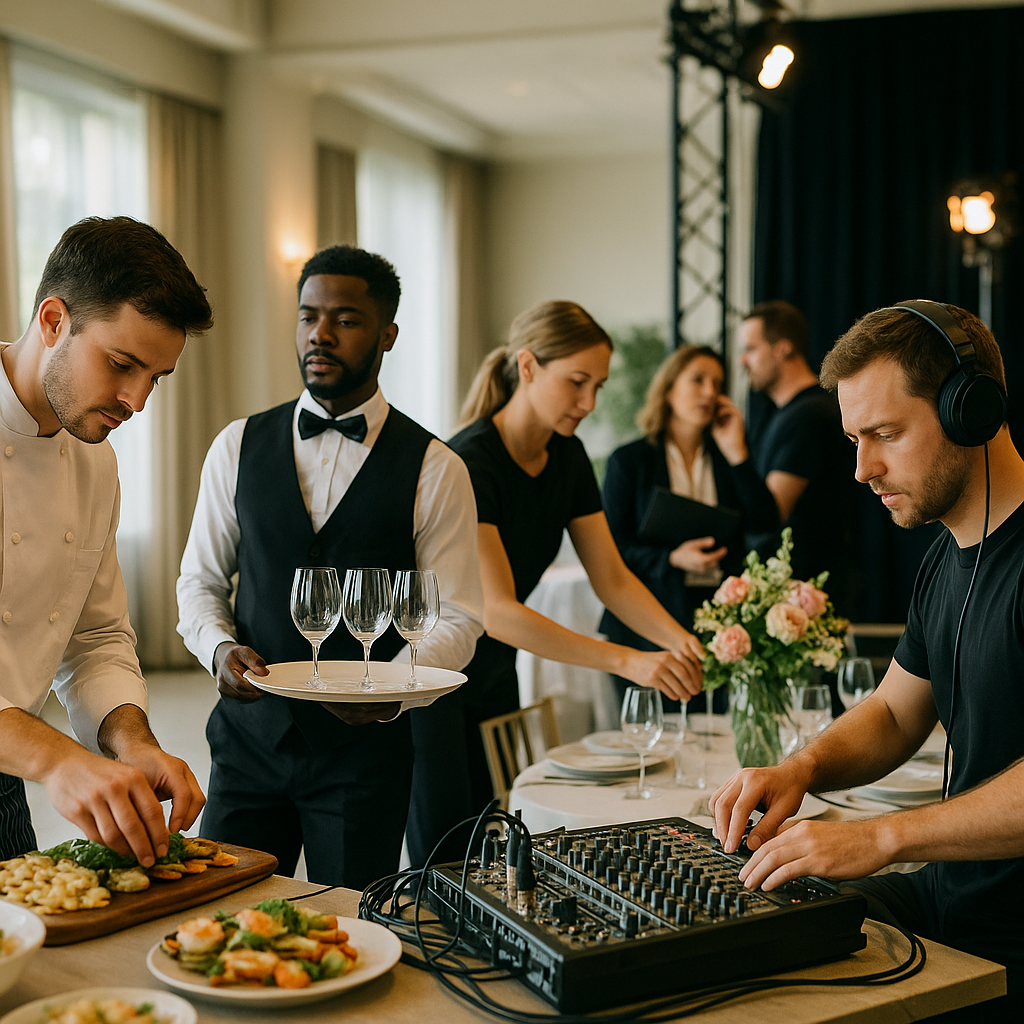
Nobody books a bad caterer on purpose. Nobody hires an AV crew hoping the projector fails. And yet events fall apart anyway — not because a vendor was bad, but because six good vendors showed up with six different versions of the plan and no one held the pen. This is a field guide to the seams where multi-vendor events actually break, and how to close them before load-in day.
The problem isn't the vendors. It's the space between them.
Every vendor on your event is competent inside their own box. The florist knows flowers. The AV company knows line arrays. The caterer knows fire hold times. Ask any one of them and they'll tell you they're ready.
They're all telling the truth. The failure doesn't live inside anyone's scope — it lives in the handoffs between scopes. And handoffs are exactly what nobody is paid to own.
This isn't an event-industry quirk. It's a project-management law. Research from the Project Management Institute found that of the money organizations put at risk on projects, more than half is on the line because of poor communication — roughly US$75 million of every US$135 million at risk per US$1 billion spent. Events just compress that failure mode into a single eight-hour window with 200 guests watching.
And the vendor count is higher than most clients think. Production planners note that a typical event production involves somewhere between 10 and 30 separate vendors once you count AV, catering, rentals, decor, security, cleaning, transport and photography (ProductionPlanner). Six is not a lot. Six is the number where people still believe it'll sort itself out.
The seven seams where multi-vendor events break
Below is the map. Each row is a handoff no single contract covers. Read the middle column carefully — that's the assumption that kills the timeline.
| The seam | What each side quietly assumes | What actually happens | Who should own it |
|---|---|---|---|
| Dock & load-in order | "We were told 2 p.m., so the dock is ours at 2 p.m." | Four trucks, one elevator, one freight door. Two crews wait on the clock. | Production lead |
| Power & distro | "The venue has outlets." | Coffee urns, LED wash and the DJ share one circuit. Something trips mid-toast. | Production lead |
| Floor plan authority | "The client approved my layout." | Three approved layouts exist. The band riser sits where table 12 goes. | Planner |
| Final guest count | "Someone will send the update." | Catering cooks for 180, staffing plans for 160, seating is set for 200. | Planner |
| Compliance paperwork | "The venue handles permits." | A COI is missing an endorsement and a crew is turned away at the gate. | Producer / client |
| Room turns | "We get 45 minutes to flip." | Ceremony runs long. The flip has 18 minutes and half the staff. | On-site coordinator |
| Strike & load-out | "We'll break down after the last song." | Rentals leave at midnight, gear leaves at 2 a.m., overtime lands on someone's invoice. | Production lead |
Seam 1: The dock is the real bottleneck
A load-in window is not a schedule. It's a wish, right up until somebody sequences it. The order isn't about who's most important — it's about who needs floor space, power, height or quiet to finish their work, and who physically cannot start until someone else finishes.
Build it backward, not forward. AV specialists advise constructing the load-in schedule working backward from guest arrival, since the schedule has to absorb both setup and technical testing before doors. If guests arrive at 6:00, "show-ready" is not 5:59. It's 4:30, with 90 minutes of margin you will absolutely use.
Seam 2: Power is a plan, not an outlet
Nobody argues about amperage until the room goes dark. Total draw, circuit separation, generator placement and cable paths belong on one document owned by one person — usually whoever runs event production. Kitchen equipment, stage lighting and audio should not discover each other on a shared breaker at 7:15 p.m.
Seam 3: Compliance is a schedule item, not a formality
Paperwork is where "we'll figure it out on the day" becomes expensive, because the authority having jurisdiction does not negotiate at load-in.
In South Florida, for example, Miami-Dade County requires a fire watch for tents with a capacity of 300 people or more (Miami-Dade County short-term event requirements), and for special events in county parks, Fire Rescue requires a minimum of two inspections before the event date, plus an inspection once the event is underway (Miami-Dade Parks special events permit). Those inspections have to sit on the production calendar weeks out — not in someone's inbox.
Insurance is the other trapdoor. Many venues require to be named as an additional insured on a vendor's general liability policy, and ask for a certificate of insurance as proof of coverage (Insureon). Collect every COI early, check the endorsement wording matches what the venue asked for, and confirm the policy dates cover setup and strike — not just the event day.
The fix: one owner, one document, one clock
You don't solve this with more group chats. Unstructured messaging is how information gets lost in the first place. You solve it with three things.
1. One owner with actual authority
Not "the main point of contact." An owner who can make a call at 3 p.m. on show day without phoning the client. Somewhere in the contracts, one name has to sit above the vendor layer — an event logistics coordinator, a producer, or a lead planner with delegated decision rights. If two people can both say yes, nobody is in charge.
2. One document everyone works from
A single run of show plus a load-in sequence, version-stamped, distributed to every vendor. Not the client's Pinterest board, not the venue's floor plan, not the caterer's BEO. One master file with the current version, and a rule that anything not in that file did not happen.
3. One clock
Every vendor's call time, deadline and dependency expressed in the same timeline, with buffers between arrivals. A load-in schedule that puts five suppliers in the same hour is not a schedule.
The countdown that prevents 90% of this
| When | What gets locked | What breaks if you skip it |
|---|---|---|
| 60–90 days out | Venue rules, permit path, engineered drawings for temporary structures, decision authority named in writing | Permit timelines outrun your build schedule |
| 30 days out | Master contact sheet, vendor briefs, scope boundaries in writing (who supplies tables, power, ladders, labor) | Two vendors both assume the other brought it |
| 14 days out | All COIs collected and verified against venue wording; site walk with the vendors who need it | A crew gets turned away at the dock |
| 7 days out | Load-in sequence with time windows, dock and parking instructions, power plan, floor plan v-final | Dock congestion, circuit conflicts, layout arguments on the day |
| 72 hours out | Guest count frozen; run of show distributed; escalation contact named for the day | Catering, seating and event staffing ratios drift apart |
| Show day | A vendor liaison on site who greets crews, directs them and answers logistics questions | Your producer spends the day explaining which elevator to use |
| Strike | Load-out order, rental pickup windows, who locks the room | Overtime charges and a damage dispute nobody can resolve |
Six questions to ask before you sign anyone
- Who has final authority on show day, by name? If the answer is "we'll coordinate," there's no answer.
- What's your load-in and strike window, and what does overtime cost? Get the number now, not at 1 a.m.
- What do you need from other vendors to do your job? Power, access, floor space, quiet, a finished surface — write it down.
- What's your power draw, and do you bring distro? Amps, not adjectives.
- Can you provide a COI naming the venue and organizer as additional insured, covering setup through strike? Ask before the deposit clears.
- Who's your on-site lead, and will they have a working phone all day? A crew without a decision-maker is a crew that waits.
What good looks like at 3 p.m. on show day
Nothing dramatic. That's the point. Trucks arrive in a sequence somebody designed. A liaison meets each crew at the dock with parking and elevator instructions already answered. Power is distributed off a plan, not off whichever outlet is closest. The floor plan on the wall matches the one in every vendor's hand. When the ceremony runs eleven minutes long — and it will — one person adjusts the flip and tells five crews at once.
The chaos didn't get solved on the day. It got engineered out three weeks earlier by an owner, a document and a clock. That's the entire trick, and it's why experienced event planners spend more time on handoffs than on any single vendor's scope.
FAQs: managing event vendors
Do I really need a coordinator if my venue has an event manager?
Usually yes. A venue manager protects the venue — access rules, house policies, condition of the room. That's a different job from sequencing your vendors, holding the run of show and making calls on your behalf. The two roles overlap on maybe 20% of the work.
What's the difference between an event planner, a producer and a logistics coordinator?
Roughly: the planner owns design, budget and vendor selection; the producer owns technical scope and build; the logistics coordinator owns the timeline, the sequencing and day-of execution. On smaller events one person wears all three hats. The problem starts when nobody does.
How many vendors is "too many" to self-manage?
It's less about count than about dependencies. Two vendors who never touch each other are easy. Four vendors who share a dock, a circuit and a floor plan are already a coordination job.
Who's liable when two vendors' mistakes collide?
Frequently, the client — which is exactly why COIs, additional insured endorsements and written scope boundaries matter more than they seem. If two vendors both assumed the other was supplying power distribution, no contract covers the gap.
Can't we just run everything through one group chat?
Group chats move messages; they don't establish a source of truth. Use them for real-time alerts on show day. Use a versioned run of show and load-in sequence for everything that matters.
How far ahead should permits and inspections be handled?
Earlier than feels necessary. Requirements vary by jurisdiction and venue, engineered drawings for temporary structures take time to produce and review, and inspection slots are finite. Confirm the exact requirements with the authority having jurisdiction as soon as the site is locked.
Sources
- Project Management Institute — Pulse of the Profession: The Essential Role of Communications
- Miami-Dade County — Short Term Events: Special Requirements for Assemblies, Circuses and Sporting Events
- Miami-Dade County — Parks Special Events Permit
- Insureon — A Guide to Vendor Insurance
- ProductionPlanner — Event Vendor Coordination
- Lumina — What Event Planners Should Know About AV Load-In and Load-Out
Permit, inspection and insurance requirements vary by jurisdiction, venue and event type. Always confirm current requirements with the authority having jurisdiction and your insurer.
Need Help Managing Your Next Event?
Let VNV Events take the lead. Our experienced team knows how to coordinate multiple vendors for seamless execution. Request a Quote today.
Visuals