One Room, Two Parties: When Zoned or Headphone Audio Beats a Single Sound System
Sound and Media · Event Planning
It is 10:40 p.m. The dance floor is finally full, the groom's college friends are requesting reggaetón, and the bride's grandmother has moved three tables away and still cannot hear her daughter. At 11:00 p.m., the venue's contract says amplified sound ends. You have twenty minutes to decide whether the night dies at 11, splits into two rooms, or moves into headphones — and that decision should have been made eleven weeks ago, on a floor plan, not at the DJ booth.
The real problem is not "different music tastes"
Most articles frame this as a taste problem. It is not. It is a physics-and-jurisdiction problem that shows up as a taste problem.
A single sound system has exactly one volume, and that volume is set by whoever is standing farthest from the speakers on the dance floor. Push it high enough for the back of a 150-person dance floor and you have simultaneously made conversation impossible at every table in the same acoustic space, because the room's reflections do not respect your seating chart. Pull it down to conversation level and the floor empties. There is no setting that serves both, which is why the DJ ends up riding the fader all night and nobody is happy.
Zoned audio and headphone audio are the two ways out. They solve different problems, cost different amounts of labor, and fail in different ways. Choosing between them is a planning decision that belongs on the same page as your guest-flow and program timeline, not a last-minute equipment upgrade.
Three ways to run audio in one building
| Single system | Zoned / multi-zone | Headphone (silent disco) | |
|---|---|---|---|
| What guests hear | One mix, one volume, everywhere | Different mixes per physical area, separated by walls, distance or directivity | Two or three channels chosen at the receiver; the room itself is near-silent |
| Best for | Under ~100 guests, one program, one focal point | Cocktail hour + dinner + dance running in parallel; ceremony and reception in one venue | Hard curfews, residential neighbors, late-night extensions, rooftops and open-air tents |
| Ordinance exposure | Highest — one loud source radiating to the property line | Moderate — you can lower or kill the outdoor zone and keep the indoor one | Lowest — the only sound leaving the room is guests singing along |
| Speech intelligibility (toasts, ceremony) | Good near the source, poor at the far edges | Good if each zone has its own speech feed | Excellent — the mic goes straight to every receiver, no room reverberation |
| Labor and load-in | Lightest | More cable runs, more amplification points, more time in the room | Receiver distribution, charging, sanitizing, collection at the end of the night |
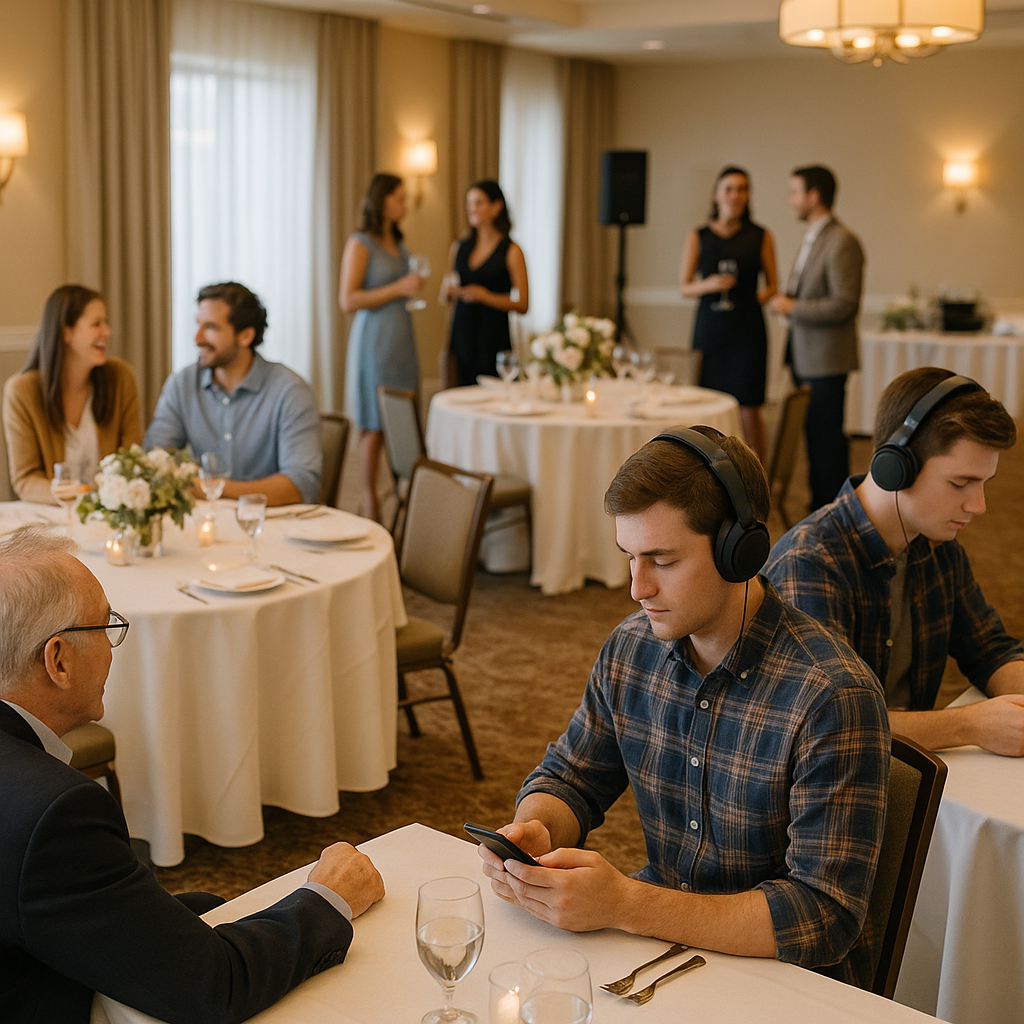
| Main failure mode | Volume war between the dance floor and the tables | Zone bleed — two mixes arriving at the same table out of phase | Guests who never put the headset on and stand outside the party |
When a single system is still the right answer
Do not over-engineer a room that does not need it. If the guest count is modest, the program is linear (ceremony, then dinner, then dancing, with no two happening at once), and the venue is not sharing a wall or a property line with people trying to sleep, one well-placed system with proper speaker aiming outperforms a badly zoned one. Zoning a room that has no acoustic separation just gives you two mixes fighting in the same air.
The honest test: walk the space and ask whether any two activities will overlap in time. If nothing overlaps, you have a scheduling solution, not an audio solution.
When zoning wins
Zoning wins when the building already gives you the separation for free — a covered terrace, a separate salon, a foyer, a tented area attached to a hard structure. The equipment is not what makes zoning work; the architecture is. Under-tent and temporary layouts are especially forgiving here, because you can place the quiet zone on the far side of a solid element and use directional speaker placement rather than raw distance to buy separation. That is a decision to make while the tent and room layout is still on paper.
Practical zoning rules that hold up on site:
- Separate the speech path from the music path. Toasts, ceremony audio and announcements should feed every zone independently of the music, so a toast in the main room can be heard on the terrace without also sending the dance mix out there.
- Aim before you amplify. Distance is weaker than it looks indoors. Outdoors, sound pressure from a point source drops roughly 6 dB per doubling of distance; indoors, reflections fill in the gap and your "quiet" zone forty feet away is nowhere near 6 dB quieter. Directivity and physical barriers do more than raw footage.
- Give every zone an owner. If nobody is responsible for the terrace mix, the terrace mix will be wrong by 9 p.m.
- Assign zones a curfew each. Outdoor zones often need to go dark hours before indoor zones do.
When headphones win
Headphone audio is not a novelty upgrade. It is a curfew tool. Its single defining advantage is that it decouples what your guests experience from what your neighbors experience — and in South Florida, the neighbors are usually the binding constraint.
The typical pattern that works: run the reception on a conventional system, then transition to headphones for the late-night set. Guests get an hour or two more of dancing; the property line goes quiet; the venue keeps its permit. It also works in reverse for daytime events with a nearby quiet use — a hotel pool deck, a residential block, a shared-wall office building.
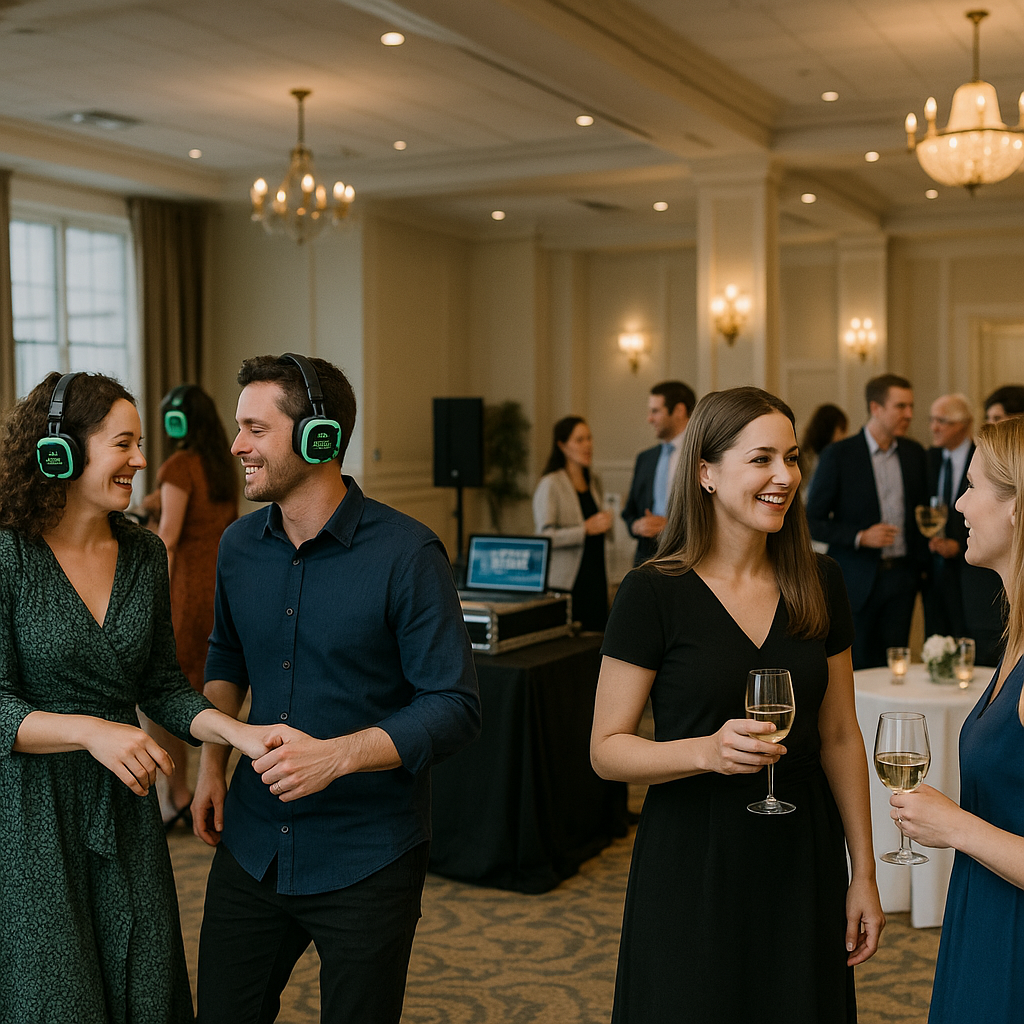
Headphones also solve a problem zoning cannot: they let two genuinely different parties happen on the same square of floor. Two or three channels means the salsa crowd and the house crowd dance shoulder to shoulder without either being asked to compromise. Building that into the flow of the night — when the switch happens, who announces it, how the room is primed for it — is a DJ and karaoke programming decision as much as a gear decision, and karaoke in particular changes shape on headphones: the singer is amplified to every receiver while the room stays quiet enough for the next table to talk.
What the rules actually say
Local noise ordinances set your real end time
In Miami-Dade County, operating a sound-producing device between 11:00 p.m. and 7:00 a.m. so that it is plainly audible at 100 feet from the building, structure or vehicle it is in is prima facie evidence of a violation under Section 21-28 of the county code. Note the standard: it is not a decibel reading. It is audibility at a distance, which a single complaint and one officer can establish.
Broward County maintains its own noise regulations, and individual municipalities layer stricter rules on top. Hollywood, for example, requires that any nonresidential establishment producing amplified musical entertainment, live or recorded, be equipped with a noise level detection device that alerts the occupants — and escalates fines for repeat violations within a six-month window. Variance processes exist in Broward's ordinance, but they run on published notice and public hearing timelines, not on the week of your event.
The operational takeaway: get the governing curfew in writing from the venue and confirm it against the municipality, not just the county, before you sign the entertainment plan. A venue's "we go till 1 a.m." often means "till 1 a.m. indoors, with the patio doors closed."
Your headphone transmitters live under FCC rules
Wireless audio is regulated spectrum, and some of it became illegal to operate. The FCC repurposed the 600 MHz service band, and wireless microphones and similar devices operating on the 617–652 MHz and 663–698 MHz frequencies were required to cease operation no later than July 13, 2020; manufacture, import and sale of that equipment for U.S. use is prohibited. The earlier 700 MHz ban still stands. If a vendor shows up with legacy gear from a closet, that is a compliance question, not a nostalgia question.
Licensed operation under Part 74 is available to certain entities, including venue operators and professional sound companies that routinely use 50 or more wireless microphones. Most headphone systems instead run unlicensed on shared bands — which is why the practical risk is not enforcement, it is congestion: transmitters in the 2.4 GHz range compete with the venue's Wi-Fi, the photo booth, the POS terminals and 200 phones. Coordinate frequencies with the venue's IT contact in advance, and ask for a channel scan during load-in. This is standard practice in serious multi-zone sound production and it is the difference between three clean channels and an hour of dropouts.
Accessibility does not disappear because the room is quiet
Under the 2010 ADA Standards, an assistive listening system is required in each assembly area where audible communication is integral to the use of the space and audio amplification is provided. At least 25 percent of the provided receivers, and never fewer than two, must be hearing-aid compatible, and receivers must include a standard 1/8-inch mono jack.
Headphone events have a genuine advantage here — a direct, room-independent signal path is exactly what many guests with hearing loss need — but only if you plan for it. Ask whether the receivers accept a neck loop or a personal earpiece, and whether a guest can use their own hearing device rather than the supplied over-ear headset. Scoping and compliance obligations sit with the venue and the facility owner, so confirm what the venue already provides before assuming your rental fleet covers it.
Silence breaks your emergency announcement path
This is the risk nobody puts on the quote. NFPA 72 sets audible notification performance relative to the room's own ambient sound — generally at least 15 dB above the average ambient level, or 5 dB above a maximum lasting at least 60 seconds, whichever is greater. A room full of people wearing headphones has defeated that logic entirely: the ambient level is low, but every guest has a personal sound source clamped over their ears.
Before you run a headphone segment, confirm three things with the venue and the fire code official with jurisdiction: whether the house fire alarm interfaces with or overrides the entertainment system, whether visual notification (strobes) covers the entire dance area, and who on staff is assigned to physically clear the floor. Also confirm the transmitter has a hard override so an announcement — an emergency, a weather call, a lost child — reaches all channels at once. Then rehearse it during sound check, not at 11:30 p.m.
The volume math, honestly
Both formats can be run too loud. The difference is who is exposed and for how long.
For your working crew — bartenders, catering staff, coordinators, the DJ — OSHA's permissible exposure limit is 90 dBA as an 8-hour time-weighted average, with a hearing conservation program required at an 85 dBA action level and a 5 dBA exchange rate. NIOSH recommends a more protective 85 dBA over 8 hours with a 3 dB exchange rate, under which 100 dBA exhausts the daily allowable dose in about 15 minutes. A hot dance floor clears 100 dBA without effort.
For guests on headphones, the relevant reference is the WHO–ITU safe listening standard, which frames a weekly allowance rather than a nightly one: roughly 80 dB for 40 hours a week, dropping to about four hours a week at 90 dB. The companion standard, ITU-T H.870, specifies dose tracking and volume-limiting behavior for personal audio systems. Ask whether the headsets you are renting have a maximum output limit, and set the transmitter gain so the receiver's own volume control has usable range rather than being pinned at maximum all night.
This article is general operational information, not legal, engineering or code advice. Noise ordinances, fire code interpretations and accessibility obligations vary by municipality and by venue, and the authority having jurisdiction has the final word. Confirm requirements with your venue, your municipality and the relevant officials before locking your program.
A decision path you can run in ten minutes
- Get the curfew in writing — from the venue, then verified against the municipality. Separate indoor and outdoor end times.
- Map overlap. List every hour where two activities happen at once. No overlap means no zoning needed.
- Walk for separation. Is there a wall, a level change, a covered structure? If yes, zone. If the "quiet area" is just the far end of the same room, zoning will disappoint you.
- Test the curfew against the guest list. If the crowd will want another 90 minutes past the outdoor cutoff, headphones are the only format that buys it.
- Resolve safety and access before booking gear. Alarm override, strobe coverage, floor-clearing assignments, hearing-aid-compatible receivers.
- Coordinate RF. Confirm transmitter bands, scan for congestion, and get the venue's IT contact on the load-in list.
Frequently Asked Questions
Will headphones kill the energy of the room?
Only if the transition is handled badly. The two things that break it are an unannounced switch and slow distribution. Announce the change on the house system while it is still live, hand out receivers at the tables rather than at a single line, and have the first headphone track be something the room already knows. The energy risk is logistical, not musical.
Can we run zoned audio and headphones at the same event?
Yes, and it is often the strongest configuration: conventional zoned audio through dinner and the main dance set, then headphones for the after-curfew segment. It also gives you a fallback — if RF conditions turn out to be poor, you still have a working room.
Do we need a permit for a headphone event?
Usually the opposite question applies: headphone audio is typically what lets you avoid needing a variance for amplified sound. But permitting depends on the venue, the property, and whether the event is public or private. Confirm with the venue and the municipality — and note that a variance from a county noise ordinance is a process with notice and hearing requirements, not a same-week request.
How many channels do we actually need?
Two is enough for most weddings and corporate events; three is worth it when the guest list has three genuinely distinct crowds. Beyond three, most guests stop cycling through channels and just pick one, and the extra channel mainly adds cost and confusion.
What about guests who refuse to wear headphones?
Plan for it. Keep a small conversational zone with light ambient audio on speakers so non-participants have somewhere to be that is not the parking lot. A headphone segment that isolates 20 percent of your guests has traded one problem for another.
Does zoned audio make toasts and the ceremony harder?
It makes them easier, if the speech path is designed separately from the music path. The mistake is treating speech as just another zone input. Ceremony audio, officiant mics and toasts should have a dedicated path that can be routed everywhere at once, independent of what the music zones are doing.
The decision, stated plainly
Pick a single system when nothing overlaps and nobody is trying to sleep nearby. Pick zoning when the building already gives you separation and two activities must run at once. Pick headphones when the clock, not the crowd, is what ends your night — and when you would rather add ninety minutes of dancing than argue with a code officer at midnight.
The one choice that is always wrong is deciding at 10:40 p.m.
Let Us Help You Plan Your Event
Bring us your venue, your curfew and your guest list, and we will tell you which of the three formats your room can actually support — before the floor plan is locked. Ask about our DJ and Karaoke Services and how we design the sound plan around your end time, not around ours.
Visuals