The Power Plan Is the Food Safety Plan
A planner approves a site plan in March. The catering tent goes on the far side of the lawn, tucked behind the bar, because that is where it disappears from the ceremony photos. Nobody writes the word "power" anywhere on the drawing.
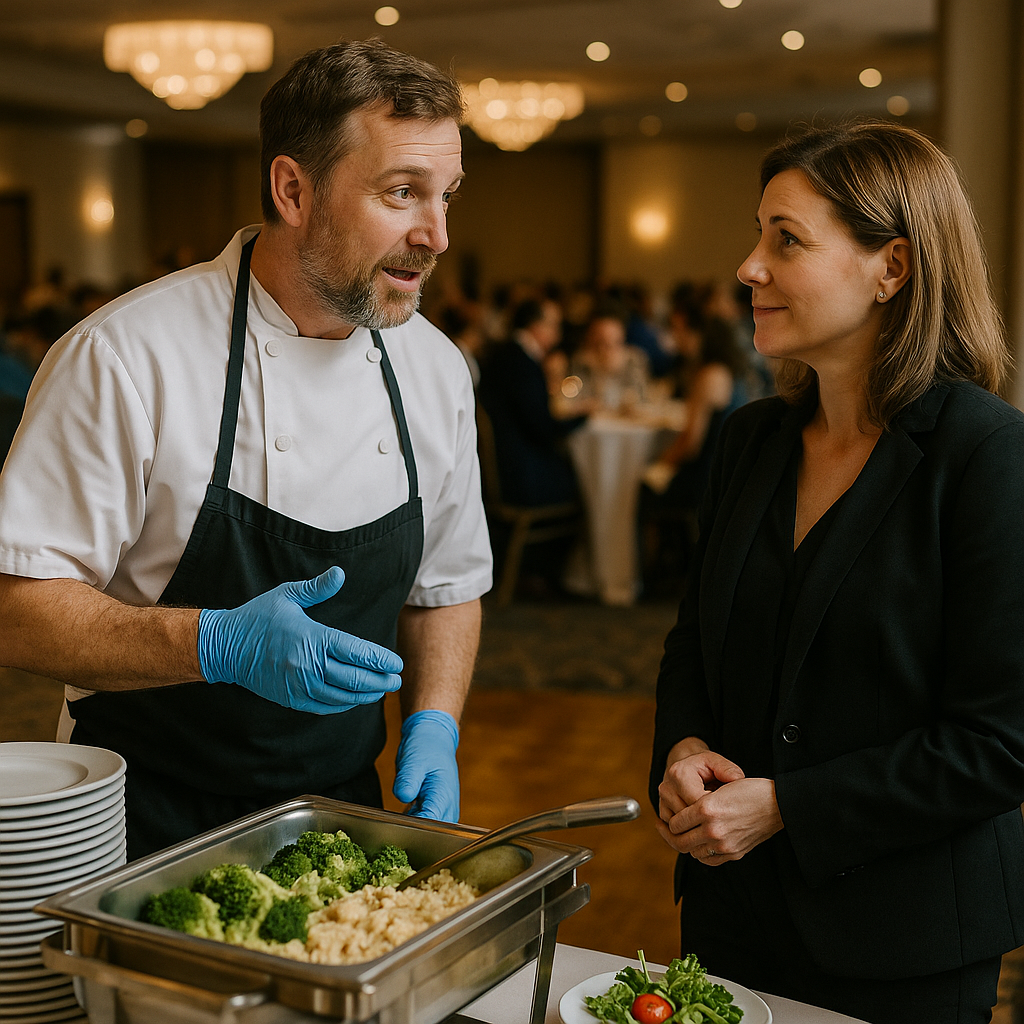
In October, at 5:40 p.m., a chef is standing over four chafers reading 118°F, doing arithmetic in his head about how long 180 portions of short rib have been out of temperature control — while a rental generator 200 feet away runs the band, the uplighting and a coffee station on the same leg.
The food safety plan for that event was not written at the tasting. It was written in March, on a site plan, by someone who thought they were making an aesthetic decision.
Off-site catering has no building behind it. There is no walk-in, no hood, no panel with spare capacity, no maintenance tech. Every degree of holding temperature at a tented or remote event is purchased with amperage that someone has to plan, deliver, distribute and protect. Get the electrical plan wrong and the temperature failure is not a possibility — it is a schedule.
Start with the number your checklist probably gets wrong
A large share of catering checklists still circulating in South Florida say "hold hot food above 140°F." That number is a legacy of an older code cycle. The current FDA Food Code (2022 edition) sets hot holding for time/temperature control for safety (TCS) food at 135°F or above and cold holding at 41°F or below. The FDA has published a Supplement to the 2022 Food Code and has said an updated edition is due in 2026 — worth tracking, because the Food Code is a model that each state adopts and amends on its own timeline.
The practical point is not the trivia. It is that 135°F is a floor, not a target. Holding equipment holds; it does not heat. A chafer loaded at 137°F in a 30-knot breeze under an open-sided tent is already failing, and the pan will read 128°F before anyone notices. Design your load-out to leave the commissary well above the floor so that the inevitable losses — transport, transfer, wind, lid-off service — do not eat through your only margin.
| Control point | Current standard | What changes off-site |
|---|---|---|
| Hot holding | 135°F or above | Wind and open-sided tents strip heat fast; chafers and warmers must be pre-heated before food is loaded, not after |
| Cold holding | 41°F or below | Ice baths melt in Florida heat; refrigerated units draw compressor inrush that trips undersized circuits |
| Temperature danger zone | 41°F to 135°F | Every minute in transit, in queue, and on a dead circuit counts against you |
| Reheating for hot holding | 165°F for 15 seconds, reached within 2 hours | Chafers, steam tables and warming boxes are not reheating equipment — they cannot get there fast enough |
| Time as a public health control | Up to 4 hours without temperature control, then discard | Requires written procedures prepared in advance and time-marking — it is a plan, not an excuse invented at 6 p.m. |
Those last two rows are where off-site events actually get hurt. The Food Code's reheating provision requires cooked-and-cooled TCS food to reach 165°F for 15 seconds within two hours before it returns to hot holding — and hot-holding equipment is not designed to do that. And time as a public health control under Food Code §3-501.19 only exists if you built the written procedure before the truck left, with initial temperatures verified and discard times marked. You can read the provisions in the full Food Code text.
"There's power on site" is not an answer
It is the most expensive sentence in off-site catering. Venues, estates and municipal parks say it sincerely, and they usually mean there is an exterior receptacle somewhere. Before you build a menu around electric holding, get numeric answers:
- How many circuits, at what amperage and voltage — not "outlets." Two duplex receptacles are frequently one 20-amp circuit.
- What else is on those circuits — band, DJ, uplighting, AV, photo booth, restroom trailer, and the venue's own pumps and irrigation controllers.
- Distance from the panel or distro to the food stations, in feet, along the actual cable path.
- Who holds the key to the panel at 4 p.m. on a Saturday when a breaker trips.
Then do the arithmetic. A 120-volt, 20-amp branch circuit is 2,400 volt-amperes at nameplate. Catering holding equipment runs for hours, which makes it a continuous load under the National Electrical Code — a load expected to draw maximum current for three hours or more — and continuous loads are sized at 125% of the load, which in practice means the circuit is worked at 80% of its rating. The International Association of Electrical Inspectors walks through that 125%/80% relationship in detail. Call it roughly 1,900 usable volt-amperes per 20-amp circuit, and plan against that, not against 2,400.
Ask your caterer for a nameplate schedule — the actual watts stamped on each holding cabinet, coffee urn, induction range, immersion circulator and refrigerated unit — rather than a station count. Nameplate watts is a number your production electrician can design around. "Three stations and a bar" is not.
This is exactly the handoff we build into event production planning: the culinary equipment list and the electrical distribution plan get reconciled on paper, before load-in, with the kitchen's holding equipment on dedicated circuits rather than sharing legs with entertainment.
A generator is a power source, not a backup plan
Adding a generator solves a capacity problem. It does not, by itself, solve a redundancy problem — a single generator is a single point of failure, and it fails all at once, silently, usually mid-service.
Three things planners routinely miss:
- Runtime, not just output. A unit sized correctly for your load may still need refueling inside your service window. Refueling a hot generator during dinner is not a plan; a fuel tank sized for uninterrupted operation across the full event is.
- Inrush. Refrigeration compressors and HVAC draw a multiple of running current at startup. Everything on one leg starting simultaneously after a brownout is how a "correctly sized" generator ends up tripping.
- Carbon monoxide and separation. The U.S. Consumer Product Safety Commission is unambiguous: portable generators are for outdoor use only, kept well away from occupied structures, with exhaust directed away from openings — its generator and CO guidance and its safety bulletin both put the working distance at 20 feet or more. A tent with sidewalls down is an enclosed space for this purpose.
If a temperature failure would be catastrophic — a plated dinner for hundreds, a menu built on shellfish or a high-risk protein — the honest question is not "do we have a generator," it is "what happens in the eleven minutes between the generator dying and someone reaching it." Sometimes the right answer is a second unit. Often the cheaper answer is menu design: shift a portion of the service to items that do not depend on continuous power, and reserve your electrical margin for what genuinely needs it. That is a conversation to have with the culinary team early, and it is one we have constantly on VNV Gourmet Catering builds.
Tents change the geometry, and the fire code has opinions
Under a temporary structure, the power plan stops being purely an electrical question and becomes a permitting question. Florida enforces the Florida Fire Prevention Code, based on NFPA 1, and local fire officials apply it to tented events. Municipal guidance in Florida — see, for example, DeLand's temporary cooking requirements citing NFPA 1 Chapter 25 — reflects the recurring provisions: generators and other internal combustion power sources separated from tents and membrane structures by a minimum of 20 feet and protected from public contact by fencing or enclosure; fuel tanks sized so refueling is not required during operation; LP-gas cylinders separated from cooking appliances with lines secured.
On the electrical side, temporary event wiring falls under NEC Article 525, which is deliberately stricter than ordinary temporary power precisely because the public is in physical contact with the environment. Section 525.23 requires GFCI protection for 125-volt, single-phase, 15- and 20-amp non-locking receptacles and equipment readily accessible to the public; Electrical Contractor and the IAEI both cover the practical inspection points, including bonding of metal equipment frames and overcurrent protection at distribution boxes.
Three layout consequences follow directly, and they should shape the floor plan rather than be retrofitted onto it:
- Put the kitchen tent near the power, not near the view. Cable runs cost voltage and create trip hazards; every hundred feet you save is margin returned to the holding equipment.
- Keep the generator's 20-foot exclusion zone off the guest circulation path. It has to be fenced or enclosed anyway — decide where that fence goes before guests arrive, not after.
- Protect every cable crossing. Ramps, mats or trenching. A cord damaged by a forklift at 2 p.m. is a temperature failure at 7 p.m.
All of this is easier when the structure and the power are specified together — one reason our tent and event rental planning treats distribution location, cable paths and sidewall configuration as part of the same drawing as the tent itself.
The site walk questions that actually matter
- How many dedicated circuits can the kitchen area get, at what amperage, and can we see the panel?
- What is the cable distance from distro to each food station?
- What is the total nameplate wattage of the catering equipment list?
- Which loads are continuous (3+ hours) and therefore sized at 80% of circuit rating?
- Is entertainment on separate legs from holding equipment?
- Who is the on-site electrician during service, and what is their phone number?
- If a generator is used: runtime at load, refueling plan, and physical location relative to the tent and guest paths.
- Is there a second source, or a documented failure plan?
- Where is the shade/shelter for the cold station, and what keeps ice from becoming water?
- Who takes and logs temperatures, on what interval, with which calibrated thermometers?
- Does the caterer have written time-as-a-public-health-control procedures for this event?
- What permits does the local fire official require for the tent and the generator, and who is pulling them?
On item ten: thermometers drift, and a thermometer nobody checks is decoration. USDA's Food Safety and Inspection Service documents the ice-water calibration method — the reading should land at 32°F — and it takes about ninety seconds per unit at load-in.
When the power fails anyway
It will, eventually. What separates a recoverable incident from a disaster is whether the decisions were made in advance.
| Situation | What the framework allows | The call to make in advance |
|---|---|---|
| Hot food drifts below 135°F, outage just started | Reheating to 165°F for 15 seconds within 2 hours, using equipment capable of getting there | Do you have a heat source independent of the failed circuit? If not, this option does not exist for you. |
| Extended outage, hot food out of control | Time as a public health control, if written procedures existed beforehand and initial temperature and time were captured | Written TPHC procedure travels with the load-out, or it is not available. |
| Cold station, refrigeration down | Ice, insulated transport, or the TPHC clock — with the food discarded at the limit | Ice quantity and a shaded, sheltered position decided on the site plan. |
| Unknown duration out of temperature, no marking | Discard | Someone is assigned to time-mark and log from the first minute of service. |
Note what the table does not contain: a row where food that has been sitting at ambient for an unrecorded period gets served because the client is upset. That row does not exist, and the moment to agree on that is at contract, not at 7:15 p.m.
Who owns which piece
In Florida, catering is a licensed activity. The Department of Business and Professional Regulation's Division of Hotels and Restaurants classifies a caterer as a public food service establishment preparing food for service elsewhere under contract, and holds caterers to public food service establishment standards; DBPR publishes a catering licensing guide and the licensing detail appears in its food service license application packet. Tent permits, generator placement and fire inspections sit with the local authority having jurisdiction — which in South Florida means the specific municipal or county fire official for that address, not a countywide assumption.
A workable division of labor: the caterer owns equipment nameplate data, holding temperatures, logs and TPHC procedures. The production or rental partner owns distribution, cable protection, GFCI compliance and generator placement. The planner owns the fact that those two conversations happen in the same room, on the same drawing, before the site plan is approved.
This article is general operational guidance, not legal, code, engineering or health-department advice. Fire and electrical codes are adopted and amended locally, and food code editions differ by jurisdiction — confirm requirements with your licensed electrician, the authority having jurisdiction and your regulator for the specific venue and date.
Frequently asked questions
Is 140°F still the hot holding temperature?
Not under the current FDA Food Code. Hot TCS food is held at 135°F or above and cold TCS food at 41°F or below. Older 140°F and 45°F figures come from earlier code cycles and still circulate on outdated checklists. Because the Food Code is a model adopted state by state, confirm the edition your jurisdiction enforces.
Can we reheat food in the chafers if the power comes back?
No. Chafing dishes, steam tables and warming cabinets are holding equipment, not reheating equipment — they cannot bring food to 165°F within the two-hour window the Food Code requires for reheating before hot holding. Reheating needs a heat source designed for it.
How much catering equipment can one standard outlet run?
Less than most people assume. A 120-volt, 20-amp branch circuit is 2,400 volt-amperes at nameplate, and holding equipment running three hours or more counts as a continuous load, which effectively caps it near 1,900 volt-amperes. Two duplex receptacles are often a single circuit, so "two outlets" frequently means one circuit's worth of capacity, not two.
Where does the generator go at a tented event?
Outside, at least 20 feet from the tent, isolated from public contact by fencing or enclosure, with exhaust directed away from occupied areas — and with fuel capacity for uninterrupted operation through the service window. Confirm the exact requirement and any permit with the fire official for that address.
What is the single most useful thing a planner can do?
Ask for nameplate wattage and cable distances at the site walk, and reconcile the catering equipment list against the electrical plan on one drawing — months before load-in.
The decision, restated
You do not decide whether food is safe at 6 p.m. on event day. You decide it the moment you mark where the kitchen goes, how many circuits it gets, and what happens when one of them dies. Everything after that is execution against a decision already made.
So make it on purpose. Put the equipment schedule and the power plan side by side, name the person who owns the failure scenario, and move the catering tent forty feet closer to the panel if that is what it takes. The photographs will survive it. The short rib might not.
Plan the Power and the Menu in the Same Conversation
Bring us the venue and the guest count, and we will reconcile the equipment schedule with the electrical plan before anyone approves a site drawing. Request a Quote today.
Visuals