
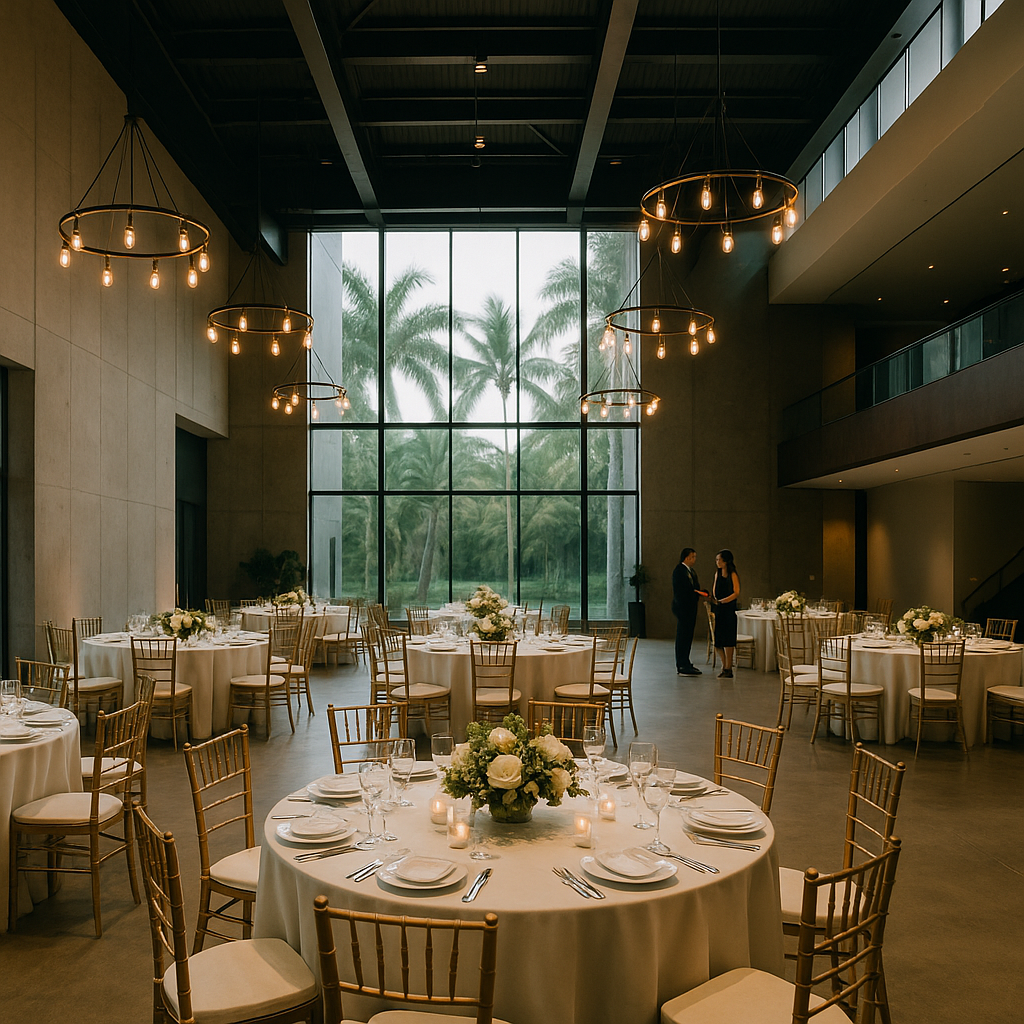
The South Florida Venue Isn't the Event: What the Space Doesn't Include
Raw Space, Real Scope
You are walking an empty warehouse in an industrial park off Oakland Park Boulevard on a Tuesday afternoon. Great bones, twenty-foot ceilings, roll-up door, and a rental fee that makes the hotel ballroom look absurd. Then you notice there is no kitchen, one restroom, and a single 120V outlet by the office door. The space is not cheaper than the ballroom. It is unbundled — and everything the ballroom quietly included now has to arrive on a truck, get permitted, and get paid for separately.
The number you are comparing is not a price, it's a starting line
Ballrooms, country clubs and hotels sell an assembled event: tables, chairs, linens, a licensed kitchen, restrooms sized to occupancy, parking, power, a loading dock, insurance, and staff who know where the breaker panel is. A warehouse, a rooftop, a private estate, a gallery or a stretch of lawn sells square footage and a date. Both quotes are real. Only one of them is complete.
The useful exercise before signing anything is not "is this venue beautiful?" It is: what does this space refuse to provide, and what does it cost to bring that in? In Broward and Miami-Dade, the answer usually lands in four buckets — structure, kitchen, utilities, and access — and each one has a regulator attached to it.
What the space fee usually covers vs. what still has to arrive on a truck
| Typically included in a raw-space rental | Typically your responsibility |
|---|---|
| Exclusive or semi-exclusive use of the footprint for stated hours | Tenting, flooring, staging, and any structure that creates weather cover |
| Existing restrooms, at whatever count the building already has | Supplemental restroom trailers, handwash stations, and the accessible route to them |
| Whatever electrical service is already installed | Distribution, generators, cabling, cable ramps and a load plan that doesn't trip the building |
| The floor, walls and roof | Tables, chairs, linens, bars, lounge furniture, climate control, lighting and power for it |
| A parking lot or street frontage | Traffic plan, valet, ADA parking, signage, security and vendor staging |
| Building access during agreed load-in hours | Permits, inspections, fire watch, certificates of insurance and the labor to hit those hours |
This is the honest version of the venue comparison most people never build. If you want it built for a specific short list of spaces before you commit, that's exactly the work behind our true-scope venue comparison — and it is a lot cheaper to do in a spreadsheet than on site.
In South Florida, "we'll just put up a tent" is a permit, not a decision
Weather cover is the first thing raw space forces you to buy, and it is the fastest way to discover you are now a permit applicant. In unincorporated Miami-Dade, building permits are required for temporary tents and membrane structures larger than 10' x 12', and plans must comply with the Florida Building Code and include structural calculations plus a Class A flame-spread certification — with product approval drawings and a Miami-Dade Notice of Acceptance where applicable. The county's own membrane structure permitting guidance also sets operational conditions inside the tent: no unauthorized open flame, no smoking, extinguisher travel distance limits, and fire watch for larger tents.
Broward works differently. The county only permits special events in unincorporated areas and specific county parks, and tells you to go to the city otherwise — which is why the same tent is a different application in Weston than in Hollywood. Weston, for example, requires a site plan showing tents, stages, port-o-lets, generators, inflatables and food trucks, plus liability insurance naming both the city and the Broward Sheriff's Office, with additional Fire Marshal requirements whenever there is on-site cooking. Fort Lauderdale runs its own outdoor special event permit process with its own calendar.
All of it sits under the Florida Fire Prevention Code, 8th Edition, which the State Fire Marshal adopted from the Florida-specific editions of NFPA 1 and NFPA 101 — so egress width, occupant load and extinguisher placement in your tent are code questions, not styling questions.
Triggers that turn a nice idea into a submittal
| If your plan includes… | Expect scrutiny from… | What it usually adds |
|---|---|---|
| A tent above the local size threshold | Building department + fire marshal | Sealed structural calcs, flame certification, anchoring detail, inspection |
| Cooking under or near a tent | Fire marshal | Separation distances, extinguisher class and tagging, sometimes fire watch |
| Generators or temporary distribution | Building department (electrical) | Licensed electrician, permit, load plan, inspection window |
| Occupancy above the space's normal use | Fire marshal | Egress plan, aisle widths, capped headcount |
| Alcohol service | State + city/county | Correct license type, liquor liability insurance, on-site licensee representative |
| Amplified sound after hours | Code enforcement / police | Curfew, possible waiver, an actual shutoff time in the run sheet |
Two things matter more than the specifics: lead time and anchoring. Municipal submittals run on weeks, not days, and in the High Velocity Hurricane Zone that covers Miami-Dade and Broward, how a structure is ballasted or staked is the whole review. That is the difference between a tent that is delivered and a tent that is engineered, permitted and installed for the site it's actually standing on.
The kitchen that isn't there
Raw space almost never comes with a compliant kitchen, and this is where "we'll bring in a caterer" quietly becomes a production problem. Under Florida's Division of Hotels and Restaurants catering guidance, catering operations must meet the standards of a public food service establishment, and all food storage and preparation must happen in an approved, licensed establishment. Your venue's back hallway is not that. The division also notes that temporary event license holders may not provide catering services.
What that means on the ground: a real caterer working a blank space builds a temporary kitchen — hot boxes, prep tables, handwash, refrigeration, waste capture, sometimes flooring under all of it — and prices the labor and equipment to do so. Ask any caterer where the food is being cooked and how it is being held. If the answer is vague, the answer is a risk. Our own catering prep and service requirements exist for exactly this reason: the menu is the easy part, the back of house is the constraint.
Alcohol adds a second layer. Florida's 13CT catering license lets a licensed food caterer sell and serve alcohol at an event where it is also providing the food, and it carries conditions — most notably that a majority of gross food and beverage revenue at the event comes from food and non-alcoholic beverages. Since May 2025, licensees must also prepare and keep a Catered Event Form (DBPR BLE-202) available for inspection at the event location, with a representative of the licensee present for the duration. If your "blank canvas" plan is BYO liquor plus a hired bartender, that is a different legal arrangement than a catered bar, and the venue contract should say which one it is.
Power, water, restrooms and the route between them
Four utilities decide whether a space is genuinely usable. Walk them physically, not on a floor plan.
- Power: count circuits and amperage, not outlets. Kitchen equipment, HVAC, DJ or band, and lighting rarely coexist on a building's existing service. Generators solve it, but they need placement, fuel, sound isolation and, usually, a permit and a licensed electrician.
- Water and waste: ask where potable water comes from and where grey water and grease go. "There's a hose bib out back" is not a plan for a 200-guest dinner.
- Restrooms: compare fixture count to guest count and event length honestly. Trailers are the standard fix; they need level ground, power and water.
- Climate: in South Florida, cooling is infrastructure, not décor. Tented cooling is a load calculation and a generator conversation.
Access is the piece most people skip. The ADA National Network's planning guide for temporary events is blunt about it: parking, drop-off and the site's amenities have to be connected by an accessible route that is wide, smooth and as level as possible, free of hazards and obstructions. On grass, gravel or sand — which is most of the pretty raw space in this market — that means real flooring or matting, not good intentions, plus accessible restroom units placed on firm ground with an unobstructed path to them. The technical dimensions live in the 2010 ADA Standards for Accessible Design, maintained alongside the U.S. Access Board's accessibility guidelines. Even the U.S. Department of Justice's older guidance for temporary events points organizers toward accessible parking placement, accessible portable toilets and accessible assembly seating as baseline planning items.
Sound, curfew, and the neighbors you didn't rent
A blank space in a mixed-use block borrows its noise limits from whoever lives nearby. Miami-Dade's ordinance prohibits unreasonably loud, excessive or unusual noise and enumerates specific offenses rather than setting one universal decibel number; several Broward cities do use measured limits at the property line. The practical translation is the same in both counties: get the hard shutoff time in writing, put it in the timeline, and tell the DJ and the band before contracts are signed, not at 11:40 p.m.
The related trap is the load-out clock. Raw spaces often grant access windows that don't fit a real build. A tent, floor, kitchen and lighting package is a multi-day install; a same-day in-and-out is a labor premium at best and impossible at worst. Sequencing all of it — deliveries, inspections, vendor arrival order, strike — is what production in a nontraditional space actually is.
The restaurant buyout: fewer gaps, different limits
A restaurant buyout is the middle path, and it is genuinely underrated. You inherit a licensed kitchen, staff, restrooms sized to occupancy, an existing liquor license and a certificate of occupancy. What you give up is control: fixed layout, fixed capacity, the venue's beverage program, the venue's minimum, and a room whose identity you cannot fully overwrite.
The questions that decide a buyout are narrow and answerable. What is the true seated versus standing capacity? Is the buyout total, or does the bar stay open to walk-ins? Is there a food-and-beverage minimum, and does tax and service charge count toward it? Can you bring in outside rentals, and where do they stage? Who owns the sound system, and does it have a working input for a DJ? What time does amplified music stop?
Get these in writing before you sign
- Exact access hours for load-in, event and load-out — with the cost of each additional hour.
- Whether your use of the space is exclusive, and what else is booked on the property that day.
- Electrical service actually available: circuits, amperage, panel location, and whether a generator is permitted on site.
- Restroom count and whether supplemental units are allowed, plus where they may be placed.
- Kitchen access, or written confirmation that there is none and that a temporary kitchen is permitted.
- Alcohol rules: whose license governs, and what insurance the venue requires.
- Who pulls the permits — you, the venue, or your production team — and who pays for inspections and fire watch.
- Insurance requirements verbatim, including additional-insured language and limits.
- Parking capacity, ADA spaces, and the accessible route from parking to the event area.
- Noise limits and the hard music curfew.
- Weather contingency: what happens to the deposit if a named storm or a rain-out forces a reschedule.
- Damage, cleaning and overtime penalties, stated as numbers rather than "reasonable costs."
Frequently asked questions
Is a warehouse or raw space really cheaper than a full-service venue?
Sometimes — but only after you add tenting or climate control, flooring, power, restrooms, rentals, kitchen build-out, permits and extra labor. Price both options fully scoped. The raw space usually wins on distinctiveness and loses on convenience; occasionally it wins on both, and occasionally it is the more expensive choice by a wide margin.
Do I need a permit for a tent in my own backyard?
It depends on size, jurisdiction and what happens under it. Miami-Dade exempts tents at single-family residences from building permits and sets a size threshold for other temporary tents, while Broward municipalities each set their own rules — and cooking, generators or public attendance can change the answer. Confirm with the local building department and fire marshal before you commit to a date.
Can my favorite restaurant cater my event at an outside venue?
Only if it is licensed to do so. Florida requires catering food preparation and storage to happen in an approved, licensed establishment, and a restaurant's own license does not automatically extend to every off-premise arrangement. Ask for the license classification, not a reassurance.
How far ahead should I start permitting a nontraditional venue?
Earlier than feels necessary. Municipal submittals, sealed drawings, insurance certificates and inspection scheduling run on weeks. Treat the permit calendar, not the venue calendar, as the real deadline — and confirm the current lead time with the specific city, because it varies across Broward and Miami-Dade.
What is the single most overlooked cost in a blank-canvas venue?
Labor and time. Equipment rental line items are visible; the crew hours to install a floor, hang lighting, run cable, build a kitchen, and strike all of it overnight are where budgets quietly double.
The decision
Choose the raw space when the room is the story and you have the runway to build the rest properly. Choose the buyout or the full-service venue when the date is close, the budget is fixed, or nobody on your side wants to own a permit application. Both are good answers. The bad answer is picking the cheapest rental fee, discovering the gaps in week three, and paying rush rates to close them.
Before you sign, do one thing: walk the space with the people who will actually build in it, and ask what has to arrive on a truck. If the list is short, you found a bargain. If it's long, you found a project — and now you can price it honestly.
This article is general operational information for event planning in South Florida, not legal, licensing, insurance or tax advice. Permit thresholds, fees and lead times differ by municipality and change over time. Confirm requirements with the authority having jurisdiction — your city or county building department, fire marshal and, where applicable, the relevant state agency — for your specific site and date.
Visuals