
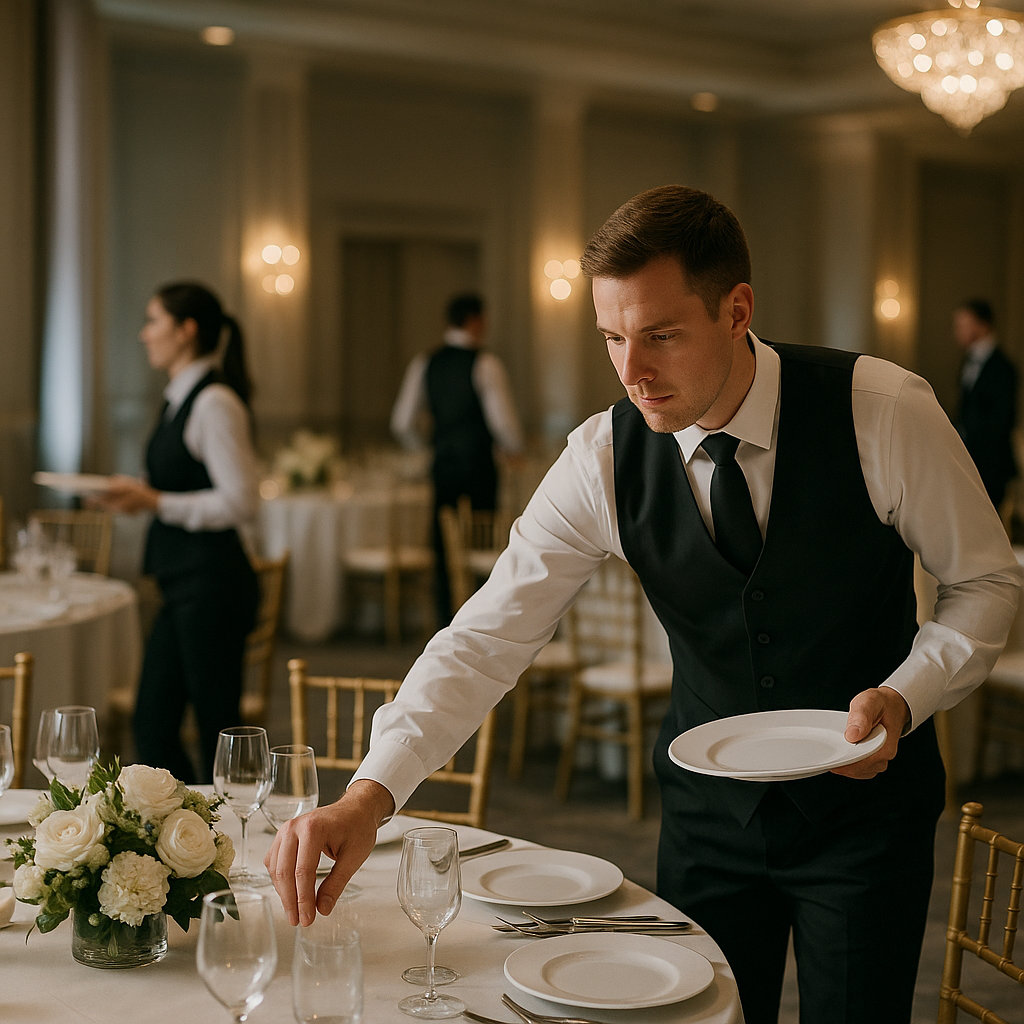
The 30 Minutes Before Dinner Can Make or Break Your Catering Service
Nobody remembers the buffet that opened smoothly. Everybody remembers the one where 180 guests stood in a line that wrapped past the bar, while two servers squeezed past them carrying replacement pans of short ribs.
That outcome is almost never decided at the buffet. It is decided in the 30 minutes before it, when catering, event staff, entertainment and the run of show all land on the same five minutes. Food moves from holding into service position. Cocktail debris comes off the tables. The emcee gets ready to speak. And someone — ideally one named person — has to decide whether the room is actually ready to release.
Treat that half hour as setup time and you get a scramble. Treat it as a controlled handoff with checkpoints, owners and a fallback, and a strong event catering timeline does most of the work for you. Here is what that handoff looks like in practice.
What Actually Breaks in the Last 30 Minutes
Guests experience dinner as a single moment: an announcement, a buffet opening, a first plate arriving. Operationally it is a chain of dependencies, and the chain fails in predictable places.
Food readiness is not room readiness. Room readiness is not guest readiness. A caterer can have every chafer at temperature while the event team is still pulling cocktail glassware off the dinner tables. An emcee can be lifting the microphone while a final tray is still crossing a service corridor. A buffet can be flawlessly stocked and still be positioned so the first fifteen people in line block the bar, the restrooms or the only staff route back to the kitchen.
So the useful question is not "Is the food ready?" Good catering logistics ask: is the whole service system ready, and who is confirming that?
A Workable T-Minus 30 Countdown
Exact timings shift with guest count, venue and menu. The sequence rarely does. Use this as a template and adjust the clock, not the order.
| Clock | Owner | What must be true before moving on |
|---|---|---|
| T-30 | Catering lead | Hot items at holding temperature, cold items iced or refrigerated, backup pans identified. Nothing decorative is on display yet. |
| T-25 | Event coordinator | Program confirmed with the emcee or DJ: what happens immediately before dinner, and what happens immediately after. |
| T-20 | Service captain | Traffic walk-through. Line start, line end, beverage access, staff replenishment route, accessible path in and out. |
| T-15 | Dining-room staff | Final clearing pass: cocktail glassware, appetizer plates, napkins, bottles. Tables in dinner mode. |
| T-10 | Station attendants | Utensils, plates, labels, allergen signage and serving pieces at every station. Attendants in position, not still walking. |
| T-5 | Catering lead | Food moves into final service position. Temperatures verified with a thermometer, not by eye. |
| T-0 | Release owner | Green light given, then the announcement. Never the reverse. |
The single most common sequencing error sits in the last row: the announcement goes out first, and the operation spends the next four minutes catching up in front of an audience.
The Five Systems That Must Converge Before Dinner
1. Food ready, but not exposed a minute early
The most consequential timing decision is when food leaves controlled holding and enters its final service position. Too early and you burn through your safety margin while the room is still socializing. Too late and guests watch the setup happen.
Two numbers matter, and they are different on purpose. The FDA Food Code 2022 — a model code that most state and local jurisdictions adopt or adapt — specifies hot holding of time/temperature control for safety foods at 135°F or above and cold holding at 41°F or below. That is the regulatory framework a licensed caterer works inside, and applicable state and local requirements always govern the actual operation.
USDA's consumer-facing guidance uses a more conservative rule of thumb for buffets: keep hot foods at 140°F or warmer and cold foods at 40°F or colder, with chafing dishes, warming trays or ice beds doing the work, and a thermometer confirming it. The wider margin is deliberate — it absorbs the temperature drop that happens every time a lid comes off or a pan gets swapped.
The practical takeaway for buffet service timing: if the timeline moves, the food plan moves with it. Prepared food should never be the thing that quietly absorbs a program delay.
2. A room built for a sudden movement of people
Before anyone picks up a plate, a hundred or more people have to physically get somewhere. Twenty minutes out, walk the room as a traffic system rather than a floor plan:
- Where does the line begin, and where does it end when it is at maximum length?
- Can guests reach the bar and water stations without crossing the queue?
- Can staff replenish pans without walking against guest flow?
- Is there a clear path in and out for guests using wheelchairs, walkers or canes?
On that last point, the 2010 ADA Standards set 36 inches as the minimum clear width for accessible walking surfaces, narrowing to 32 inches only for short stretches. Those standards govern built environments rather than temporary furniture placement, but 36 inches is a sound working benchmark for the aisles you create with tables, buffets and cocktail rounds — and it is a far more useful test than "does this look roomy."
When an event uses several presentations rather than one long line, the layout of catering stations for South Florida events becomes a circulation decision first and a menu decision second. Multiple stations shorten queues only if they are far enough apart that their lines do not merge.
3. Staff need positions, not assignments
"Everyone help with dinner" is not a plan. In the final minutes, every critical function needs a named owner who is not simultaneously responsible for something else.
- Station attendants: presentation, utensils, portion flow, and flagging items approaching replenishment before they run out.
- Runners: move replacement pans, plates and supplies — so attendants never have to abandon a guest-facing station.
- Dining-room staff: finish clearing, monitor tables, keep pathways open.
- Service captain: confirms every operational checkpoint before release.
- Coordinator or timeline owner: synchronizes catering with announcements, formalities and entertainment.
The role most often missing is the runner. Without one, an attendant walks away mid-service, the station goes unstaffed, and the line stalls at exactly the moment it is longest. Hosts weighing how many people a given event food service plan actually requires can use event staffing information as a starting point for that conversation.
4. Tables must switch from cocktail mode to dinner mode
Look past the buffet. The dining room is usually still carrying the previous hour: empty glasses, appetizer plates, crumpled napkins, half-finished bottles, guests parked in circulation space.
The final clearing pass belongs before the announcement. Miss that window and the team is clearing backward — resetting tables while guests return to them with full plates. It is slower, it looks worse, and it puts servers and guests in the same square footage at the same time.
For wedding dinner service this matters even more, because speeches, first dances and other formalities cluster around the same moment. Clearing, food release and program transitions should not compete for the same five minutes.
5. One person controls the release
This is the checkpoint most timelines leave implicit, and it is the one that fails. Dinner should open when a single identified person says it opens, after a verbal confirmation from the catering lead that the service area is ready. The DJ or emcee announces afterward.
Name that person in writing during planning, not in the moment. When nobody owns the release, it defaults to whoever is holding a microphone — which is how announcements get made over unfinished stations. Hosts working without a dedicated coordinator should decide early whether the venue, the caterer or an event planner is carrying that authority on the day.
How Service Style Changes the Last 30 Minutes
| Service style | What the final 30 minutes look like | Most common failure point |
|---|---|---|
| Single buffet line | Heavy focus on queue geometry and release sequencing | One release for everyone, creating a line longer than the room |
| Multiple stations | Parallel setup; each station needs its own attendant and supply route | Stations placed too close together, so lines merge into one |
| Plated | Kitchen-side timing dominates; room must be fully reset earlier | Clearing not finished, so the first plates land on cluttered tables |
| Family style | Simultaneous drop across all tables; needs the largest staff surge | Uneven delivery — table 3 eating while table 14 waits |
Progressive release — sending tables or sections in waves — is worth planning for any style where a simultaneous release would produce a queue the room cannot physically hold. Decide the wave order in advance, and tell the emcee how you want tables called.
When Dinner Runs Late: The Recovery Playbook
Programs slip. That is normal. What separates a controlled delay from a bad one is whether the catering lead learns about it in the first minute or the fifteenth.
- Tell the catering lead immediately, with an estimated new time, not a vague "running behind."
- Hold, don't hover. Food stays under appropriate hot or cold holding rather than sitting in service position while the room catches up.
- Stage in waves. Bring out cold and shelf-stable items first; keep hot items back until the release is genuinely imminent.
- Watch the cumulative clock. USDA's two-hour limit for perishable food at room temperature is cumulative, not reset by putting something back and bringing it out again.
- Re-confirm the release. A delayed timeline needs a fresh green light, not the one issued twenty minutes ago.
Outdoor Events: The Rule That Changes Everything
Under warm outdoor conditions, the usual margins compress sharply. USDA guidance cuts the two-hour room-temperature window to one hour when the ambient temperature is above 90°F — a threshold that South Florida clears routinely from late spring through early fall.
That single number should reshape an outdoor timeline. It argues for shorter service windows, smaller pans replaced more often instead of large ones sitting out, shaded or tented service areas, and a release that is genuinely tight rather than "sometime after the toasts." USDA's food-safety guidance for catered and DIY wedding food makes the same point across transport, holding and service — the risk accumulates across all three, not just at the buffet.
It also matters because of who is in the room. CDC estimates that 48 million people get sick from foodborne illness each year in the United States, and identifies adults 65 and older, children under five, pregnant guests and people with weakened immune systems as more likely to become seriously ill. A wedding or family celebration reliably contains all four groups.
The Pre-Release Checklist
Print it, put it on a clipboard, and make the captain physically confirm each line before the green light.
- Hot items verified at holding temperature with a thermometer
- Cold items iced or refrigerated and verified
- Backup pans identified and reachable without crossing guest flow
- Serving utensils at every dish — including the one everyone forgets
- Plates, napkins and cutlery stocked at the start of the line, not the end
- Allergen and dietary labelling in place and legible
- Line start and line end walked; nothing blocks bar, restrooms or exits
- Accessible path in and out, roughly 36 inches clear
- Cocktail glassware and appetizer plates cleared from dinner tables
- Every station has a named attendant standing in position
- At least one runner assigned and not doubling as an attendant
- Emcee or DJ briefed on wording and on wave order if releasing progressively
- Release owner named, present, and confirmed by the catering lead
Questions Worth Asking Before the Day
USDA suggests hosts ask caterers a specific set of operational questions during planning. The ones that bear directly on timing:
- Where is the food prepared, and how is it transported to the venue?
- How and where is it held on site until service?
- When will it be served, and how long will it be out?
- Will temperatures be monitored during service, and by whom?
- Who receives the guest allergy and dietary list, and when?
- What happens to leftovers — and are they permitted to leave?
Answers to these determine how much slack your timeline actually has. A caterer cooking on site has different constraints than one transporting finished food across the county in August.
The Bottom Line
Dinner service is not a moment. It is a handoff between two very different phases of an event, and handoffs fail when nobody owns them. Give the last 30 minutes a written sequence, a named release owner, a traffic plan and a recovery path for delay, and the transition becomes invisible — which is exactly what guests should experience.
Everything above is planning work. None of it costs anything on the day. All of it is far cheaper than fixing a stalled buffet in front of an audience.
FAQs
How early should a buffet be completely ready before guests are released?
There is no universal number, and chasing one misses the point. Distinguish between being operationally ready — staff positioned, utensils out, traffic path clear, temperatures verified — and having food sitting exposed in service position. The first should be finished several minutes before release; the second should happen as late as the plan safely allows.
What happens if dinner is delayed after the food is ready?
Tell the catering lead immediately with a revised time. Food should return to or stay under appropriate hot or cold holding rather than waiting at room temperature. USDA guidance advises keeping buffet hot foods at 140°F or warmer and cold foods at 40°F or colder, and treats the two-hour room-temperature limit as cumulative across the event. Professional operations also follow applicable state and local food codes.
Should all tables be released to a buffet at the same time?
Not necessarily. It depends on guest count, number of service points, buffet capacity and how much floor space a full queue would occupy. Progressive release by table or section is worth planning whenever a simultaneous release would create a line that interferes with circulation, the bar or the exits.
Who should decide when dinner officially opens?
One named person, confirmed by the catering lead that the service area is ready. The DJ or emcee announces only after that green light. Assign the role during planning — if it is left undefined, it defaults to whoever happens to be holding the microphone.
Why are food temperatures part of the event timeline?
Because a program delay is also a food-safety event. Every minute the timeline slips extends the time prepared food spends in holding or service conditions. FDA, USDA and CDC guidance all treat time and temperature control as central to reducing risk, which makes timeline communication an operational safety practice, not just a scheduling courtesy.
Does an outdoor event need a different timeline?
Yes. Above 90°F, USDA cuts the room-temperature limit for perishable food from two hours to one. That compresses the entire service window and argues for shaded service areas, smaller pans replaced more frequently, and a tightly controlled release rather than an open-ended one.
Elevate Your Event with VNV Catering
Ready to create a flawless dining experience? Request a Quote today.
Visuals